
Brahma vs Cochin
 By John Walker · Backyard chicken keeper in Dallas, Texas since 2017
Brahma vs Cochin: two of the largest, gentlest breeds a backyard keeper can choose, and they are often confused, because both are big, feather-footed, and calm. But they are distinct breeds with different histories, different laying ability, and different habits, and the right choice depends on what you want from your flock. Brahmas are the better layers and the hardier birds, while Cochins are the more broody and the more ornamental. This guide compares them side by side, so that you can choose the breed that fits your flock.
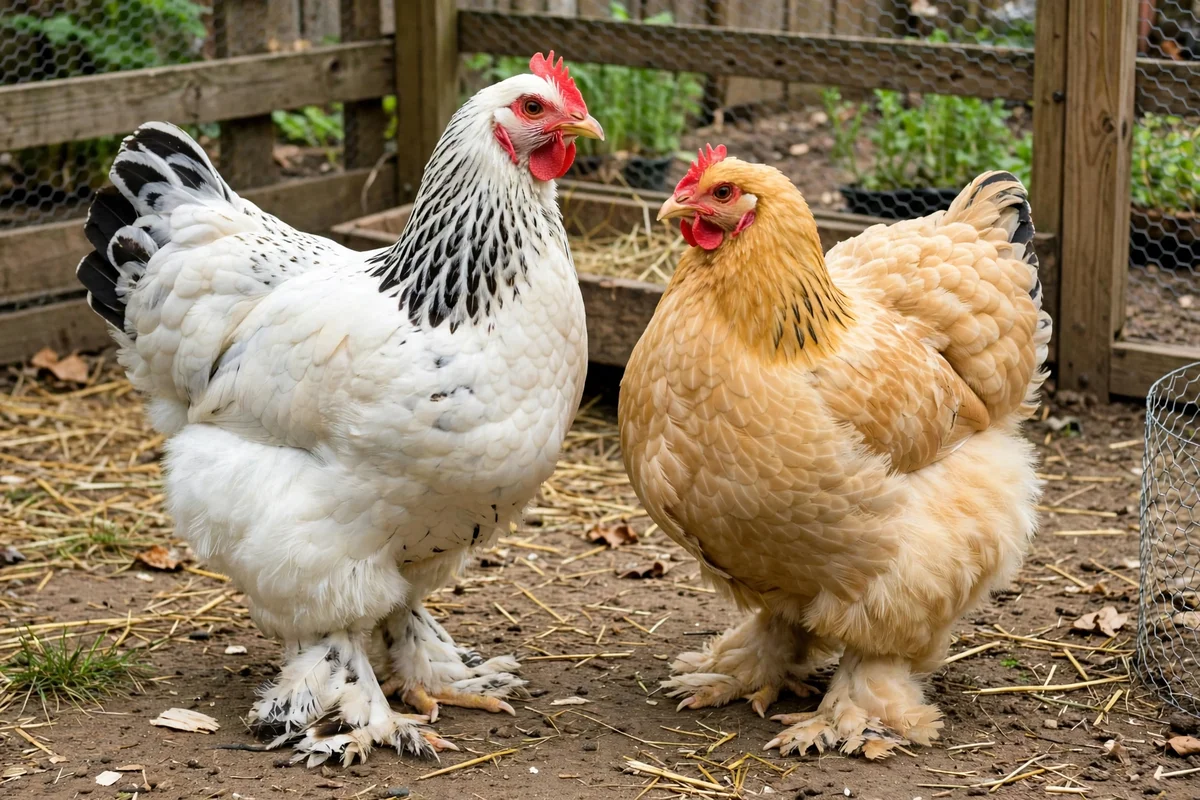
Brahma vs Cochin: which is right for you?
Brahma vs Cochin is a choice between two large, gentle, feather-footed breeds, and the short answer is that Brahmas are the better layers and the hardier birds, while Cochins are the more broody and the more ornamental. If you want eggs, choose a Brahma.
If you want a broody hen to hatch chicks, or a pet that looks like a feathered ball, choose a Cochin. If you want both, keep one of each, because they get along well in a mixed flock.
Both breeds are large, calm and friendly, and both are good for a beginner or a family flock. Both have feathered feet, which need care in wet weather, and both are slow to mature, taking longer to reach full size and to start laying than a commercial breed. Both are also poor flyers, which makes them easy to contain, and both are quiet, which makes them good for a suburban flock.
The differences are in the details: the Brahma is larger and more upright, with a pea comb and a more imposing presence, while the Cochin is rounder and fluffier, with a single comb and a profusion of soft feathers that make it look bigger than it is. The Brahma lays more eggs, and the Cochin goes broody more often. The Brahma is hardier in cold weather, and the Cochin is more prone to muddy feet in wet weather, because its foot feathering is denser.
The rest of this guide compares the two breeds in detail: size, appearance, eggs, temperament, broodiness, hardiness and care. By the end, you will know which breed fits your flock, and you will know what to expect from each one.
Size and appearance: Brahma vs Cochin
Brahmas are one of the largest chicken breeds, and a Brahma rooster can weigh 5 kilograms or more, with hens around 4 kilograms. They are tall, upright and imposing, with a broad back, a full breast, and a pea comb, which is a small, low comb with three ridges.
The Brahma's feathering is tight and close, and its feet are feathered, but the feathering is less profuse than a Cochin's, and the bird looks powerful rather than fluffy.
Cochins are also large, but they are rounder and fluffier, with a profusion of soft, loose feathers that make them look like a ball of fluff. A Cochin rooster weighs around 4 to 5 kilograms, and a hen around 3.5 to 4 kilograms, so they are slightly smaller than a Brahma, but they look bigger because of the feathering. The Cochin has a single comb, a round body, and heavily feathered feet and legs, with feathers that can drag on the ground in wet weather.
The most popular Brahma variety is Light, with white feathers and black hackles and tail, and there are also Dark and Buff varieties. The most popular Cochin variety is Buff, with a rich golden-buff colour, and there are also Black, White, Blue and Partridge varieties. Both breeds come in bantam sizes as well, and the bantam Cochin is one of the most popular bantams, while the bantam Brahma is less common.
The table below compares the two breeds at a glance, so that you can see the differences side by side. The size, comb and feathering are the easiest ways to tell them apart, and a keeper who sees the two breeds together will notice the difference immediately: the Brahma is tall and powerful, and the Cochin is round and fluffy.
| Trait | Brahma | Cochin |
|---|---|---|
| Size | Very large, roosters 5 kg+ | Large, roosters 4-5 kg |
| Comb | Pea comb, small and low | Single comb, medium |
| Feathering | Tight, close, less fluffy | Loose, profuse, very fluffy |
| Feet | Feathered | Heavily feathered |
| Body shape | Tall, upright, powerful | Round, low, ball-like |
| Popular varieties | Light, Dark, Buff | Buff, Black, White, Blue |
Egg laying: Brahma vs Cochin
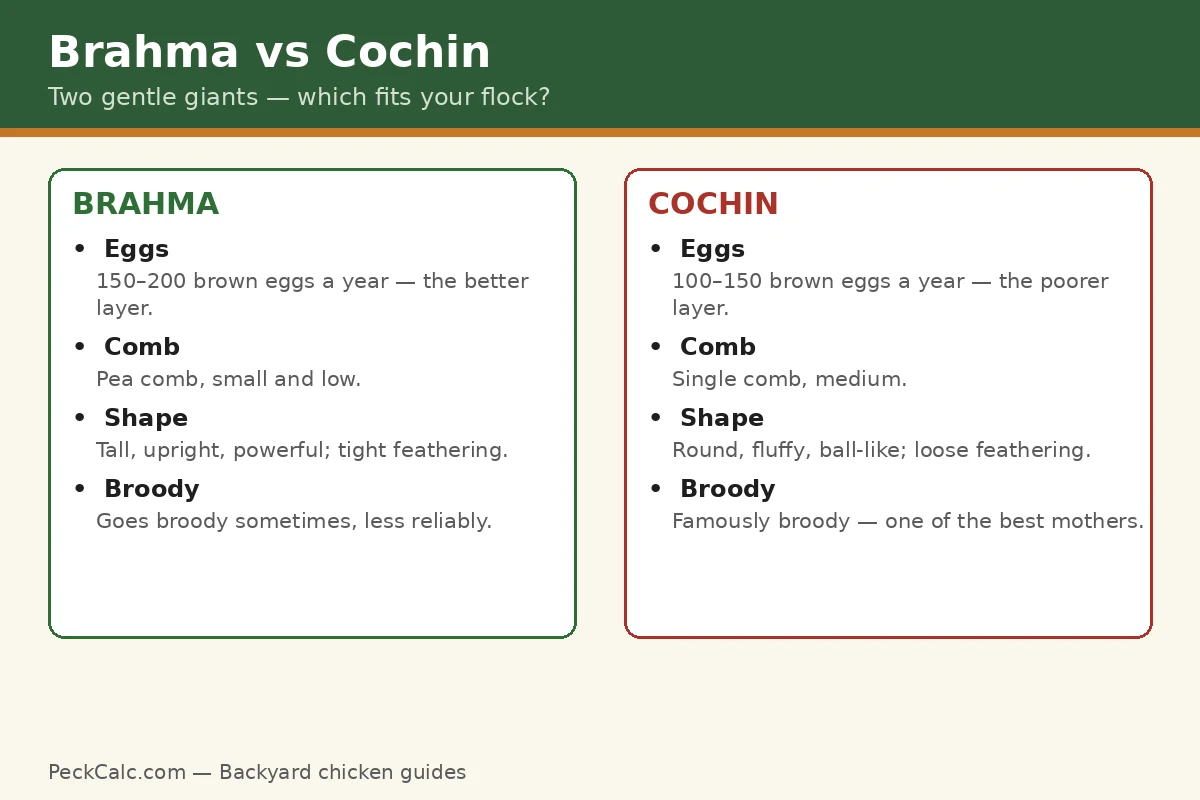
Brahmas are the better layers, and a Brahma hen will lay around 150 to 200 brown eggs a year, which is a respectable rate for a large heritage breed. The eggs are medium to large, brown-shelled, and well-shaped, and the hens lay steadily through the spring and summer, with a natural break in winter.
A Brahma hen starts laying at around twenty to twenty-four weeks, which is later than a commercial breed, but she will lay reliably for several years.
Cochins are poor layers, and a Cochin hen will lay only around 100 to 150 brown eggs a year, which is one of the lowest rates among the large breeds. The eggs are medium-sized and brown, and the hens lay in bursts, with long breaks when they go broody. A Cochin hen that goes broody will stop laying for weeks, and she may go broody several times a year, which cuts her total sharply. A keeper who wants eggs should not choose a Cochin as the main layer.
The difference in laying is the main reason to choose a Brahma over a Cochin, if eggs are the priority. A Brahma will give you a useful supply of eggs, while a Cochin will give you a small supply and a lot of broodiness. But the Cochin's broodiness is a virtue if you want to hatch chicks, because a broody Cochin is one of the best mothers in the chicken world, and she will sit on eggs, hatch them, and raise the chicks with care.
If you want both eggs and broodiness, keep a Brahma for eggs and a Cochin for hatching, because the two breeds complement each other. A Cochin hen can hatch Brahma eggs, and a Brahma hen can lay the eggs that the Cochin hatches, and the mixed flock will give you the best of both breeds. It is a practical combination, and it is one that many keepers use.
Temperament and behaviour
Both breeds are calm, gentle and friendly, and both are good for a beginner or a family flock. Brahmas are calm and dignified, and they are not flighty or nervous. They tolerate handling well, and they are good with children, provided the children are gentle.
A Brahma rooster is generally calm and not aggressive, although any rooster can become protective during the breeding season, and a large rooster should be respected.
Cochins are even calmer, and they are one of the gentlest breeds. They are slow-moving, docile and affectionate, and they are often kept as pets rather than as layers. A Cochin hen will sit on your lap, follow you around the garden, and tolerate being picked up by children. They are not good foragers, because they are slow and heavy, and they prefer to stay near the coop and the feeder rather than ranging far.
Both breeds are poor flyers, which makes them easy to contain. A low fence will keep a Brahma or a Cochin in, and they will not fly over a fence the way a Leghorn or a Hamburg will. This is a practical advantage for a suburban keeper, because a low fence is cheaper and less obtrusive than a high one, and the birds are less likely to escape into a neighbour's garden.
Both breeds are quiet, and they do not make as much noise as a more active breed. A Brahma or a Cochin flock is a quiet flock, and the hens are not loud layers, which is a benefit in a suburban area. The roosters will crow, as all roosters do, but the crow is not louder than average, and the birds are generally peaceful. A keeper who wants a quiet, gentle flock will be happy with either breed.
Broodiness: Cochins are the champions
Cochins are famous for their broodiness, and a Cochin hen is one of the most reliable broodies in the chicken world. She will go broody readily, sit tightly on a clutch of eggs, and raise the chicks with care and patience.
A broody Cochin is a hen that has stopped laying and wants to hatch, and she will sit for three weeks, turning the eggs, keeping them warm, and defending the nest from intruders.
Brahmas also go broody, but less often and less reliably than Cochins. A Brahma hen may go broody once a year, or not at all, and she is less persistent than a Cochin. A Brahma that does go broody is a good mother, but she is not the breed to choose if you want a reliable hatcher. The Cochin is the breed for hatching, and the Brahma is the breed for laying.
Broodiness is a virtue if you want to hatch chicks, and a nuisance if you want eggs. A broody hen stops laying, and she needs to be broken, which means discouraging her from sitting, or given eggs to hatch. A keeper who does not want chicks should break a broody hen promptly, by removing her from the nest, putting her in a wire-bottomed cage for a few days, or simply by collecting the eggs daily so that she has nothing to sit on.
If you want to hatch chicks naturally, a Cochin is the best choice, and she will hatch eggs from any breed, not just her own. A Cochin hen can hatch duck eggs, turkey eggs and even goose eggs, because she is large, patient and persistent. A Brahma hen can also hatch, but she is less reliable, and a keeper who wants a natural hatcher should choose the Cochin.
Hardiness and care: feathered feet need attention
Both breeds have feathered feet, and both need care in wet and muddy weather. The feathers on the feet get wet, muddy and matted, and they can harbour mites, lice and bacteria. In a wet winter, the foot feathers can become a problem, and the birds may develop sore feet or scaly leg mites.
Keep the run dry, provide a dry area under cover, and check the feet regularly, especially in wet weather.
Brahmas are hardier in cold weather than Cochins, because their feathering is tighter and less prone to getting wet and matted. A Brahma will tolerate a cold winter well, provided the coop is dry and draught-free, and it will keep laying through a cold snap better than a Cochin. Cochins are also hardy, but their loose feathering can get wet and stay wet, which chills the bird, so a Cochin needs a dry coop and a dry run more than a Brahma does.
Both breeds are slow to mature, and they take longer to reach full size and to start laying than a commercial breed. A Brahma or a Cochin may not reach full size until it is a year old, and it may not start laying until twenty-four weeks or later. Patience is needed, and a keeper who expects a quick layer will be disappointed. But the slow growth is part of the breed's character, and the birds live longer and lay for more years than a fast-maturing breed.
Feed a balanced layer ration once the hens are laying, keep oyster shell available, and offer grit at all times. Both breeds are large birds, and they eat more than a smaller breed, so the feed bill will be higher. But the birds are also a dual-purpose breed, and a surplus rooster can be a good table bird, which offsets the feed cost. Our guide on Brahma chickens covers the Brahma in detail, and our guide on Cochin chickens covers the Cochin.
Brahma vs Cochin: the bottom line
Brahma vs Cochin is a choice between a better layer and a better broody, and the right answer depends on what you want. If you want eggs, choose a Brahma, which lays 150 to 200 brown eggs a year and is hardy in cold weather.
If you want a broody hen to hatch chicks, or a pet that looks like a feathered ball, choose a Cochin, which is one of the gentlest and most broody breeds. If you want both, keep one of each, because they get along well.
Both breeds are large, calm, friendly and feather-footed, and both are good for a beginner or a family flock. Both need care for their feathered feet in wet weather, both are slow to mature, and both are quiet and easy to contain. The differences are in the laying, the broodiness, and the shape: the Brahma is tall and powerful, and the Cochin is round and fluffy.
A keeper who wants a practical, dual-purpose flock will choose the Brahma, and a keeper who wants a pet and a natural hatcher will choose the Cochin. A keeper who wants the best of both will keep both, and will enjoy the contrast between the two breeds in the same flock. Either way, the birds are a pleasure to keep, and they are a good introduction to the large, gentle breeds.
If you are choosing a breed for your flock, start with our guide on best chicken breeds for beginners, and consider the Brahma and the Cochin as two of the gentlest large breeds available. They are not the best layers, but they are among the best companions, and that is a trade worth making.
Sources: poultry.extension.org.
Related tools and guides
For more on the same topic, see Holland Chickens. Browse the full list in our guides hub.
Frequently asked questions
What is the difference between Brahma and Cochin chickens?
Brahmas are larger, taller and better layers, with a pea comb and tighter feathering. Cochins are rounder and fluffier, with a single comb, and they are much more broody but lay fewer eggs.
Do Brahmas or Cochins lay more eggs?
Brahmas lay more eggs, around 150 to 200 brown eggs a year. Cochins lay only around 100 to 150 a year, and they stop laying for weeks when they go broody, which they do often.
Are Brahma or Cochin chickens friendlier?
Both are calm, gentle and friendly, and both are good for families. Cochins are slightly gentler and more pet-like, while Brahmas are calm and dignified. Either breed is a good choice for a beginner.
Which is more broody, Brahma or Cochin?
Cochins are far more broody, and a Cochin hen is one of the most reliable broodies. Brahmas go broody less often and less reliably. Choose a Cochin if you want a natural hatcher.
Do Brahma and Cochin chickens get along?
Yes, both breeds are calm and gentle, and they get along well in a mixed flock. Keeping one of each gives you the Brahma's eggs and the Cochin's broodiness in the same flock.
About the author
John Walker is the founder of PeckCalc and has kept backyard chickens in Dallas, Texas since 2017. He started PeckCalc to give backyard keepers free calculators and guides with every figure traced to a university extension source.