
How Much Feed Per Chicken Per Day by Age
 By John Walker · Backyard chicken keeper in Dallas, Texas since 2017
How much feed per chicken per day by age rises from about 0.03 lb in week one to about 0.12 lb by week eight, about 0.15 lb as a grower, and about 0.25 lb a day for a laying hen.
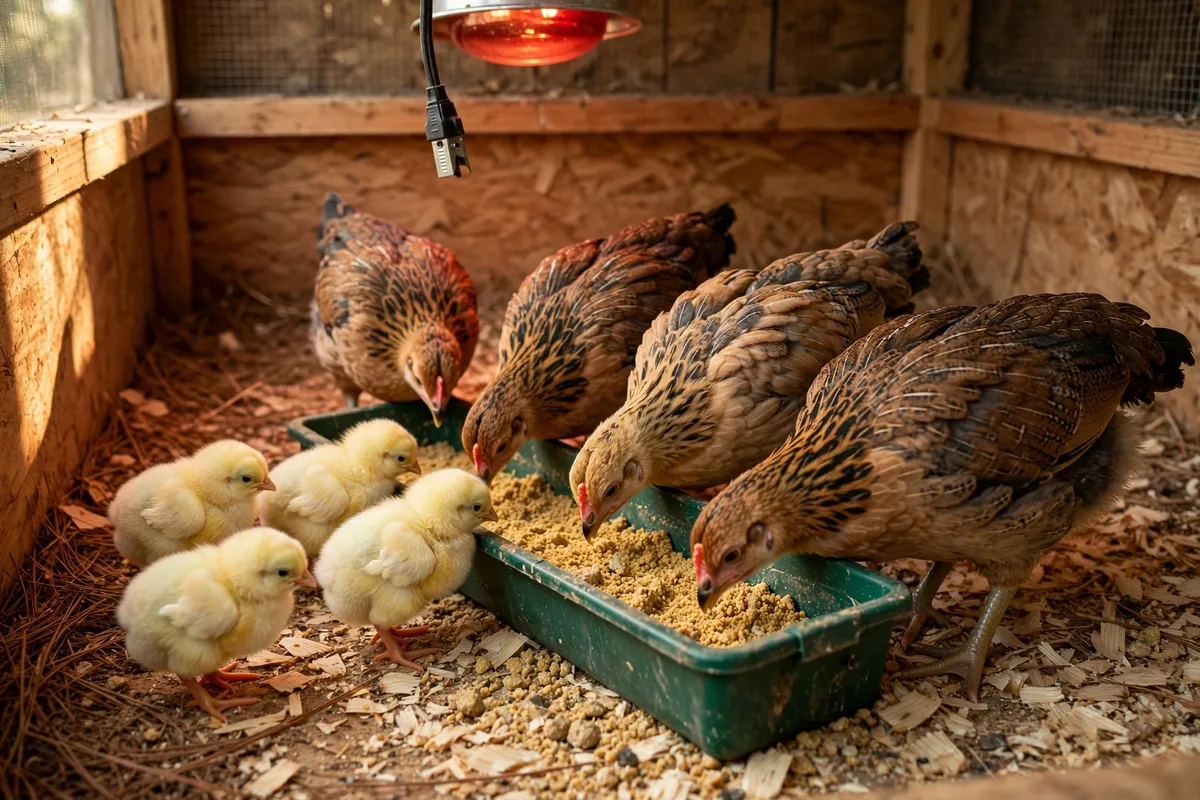
How much feed per chicken per day by age: the chart
Feed intake grows with the bird, and the chart below gives the planning figures for each age. A day-old chick eats almost nothing — about 0.03 lb (14 g) a day — and by eight weeks she is eating about 0.12 lb (54 g) a day.
A grower eats about 0.15 lb (68 g) a day, and a laying hen eats about 0.25 lb (113 g) a day, with a range of 0.22 to 0.28 lb depending on breed, weather and how much she forages. Broilers eat more, up to 0.35 lb a day at finishing weight.
| Age | Feed type | Feed per bird per day | Notes |
|---|---|---|---|
| Week 1 | Starter (20% protein) | 0.03 lb (14 g) | Scatter feed on paper for the first days |
| Week 2 | Starter | 0.05 lb (23 g) | Chicks find the feeder by now |
| Week 3 | Starter | 0.07 lb (32 g) | Intake rises fast as they grow |
| Week 4 | Starter | 0.08 lb (36 g) | About 0.5 lb a day for 6 chicks |
| Weeks 5–6 | Starter | 0.10 lb (45 g) | Feathers replace down, intake climbs |
| Weeks 7–8 | Starter to grower | 0.12 lb (54 g) | Switch to grower around week 8 |
| Weeks 9–18 (grower) | Grower (16% protein) | 0.15 lb (68 g) | Steady growth, no layer feed yet |
| 18 weeks to point of lay | Grower to layer | 0.18 lb (82 g) | Switch to layer at first egg |
| Laying hen | Layer (16–18% protein) | 0.25 lb (113 g) | Range 0.22–0.28 lb a day |
| Broiler, finishing | Broiler finisher | Up to 0.35 lb (159 g) | Meat birds eat far more |
Use the chicken feed calculator for flock totals, and the chick feed calculator by age for week-by-week chick feed with bag planning. The figures here are planning values from extension sources; real intake varies by breed, temperature and how much the birds forage.
Chicks: starter feed by week
Chicks need starter feed from day one. Starter is the highest-protein feed a chicken will ever eat, at about 20 percent protein, because chicks grow fast and build bone, muscle and feathers. In week one a chick eats only about 0.03 lb a day.
A 50 lb bag of starter lasts a small flock of chicks for weeks at that rate. By week four the same chick eats about 0.08 lb a day, and by week eight about 0.12 lb a day. For ten chicks at week two, that is about 0.5 lb a day in total.
Scatter feed on paper or a flat tray for the first two or three days, so the chicks find it easily, then move them to a proper chick feeder. A chick feeder with a small opening stops them standing in the feed and fouling it, and it stops them wasting feed by scratching it out. Keep the feeder full and the water clean — chicks that cannot find feed or water in the first 24 hours fall behind quickly, and a chick that is cold will not eat even if feed is in front of her.
Do not switch chicks to grower feed too early. Starter feed supports the fastest growth phase, and switching before eight weeks can slow growth and weaken the birds. Around eight weeks, change over gradually — mix the two feeds for a few days — and watch that every chick is eating. The brooder size and heat planner covers brooder space, temperature and feed together for the chick stage.
Growers: the forgotten stage
The grower stage — roughly 8 to 18 weeks — is the stage most keepers think about least, and it matters. Growers eat about 0.15 lb of grower feed a day, at about 16 percent protein, which is less protein than starter and less calcium than layer feed.
The lower protein suits steady growth without the fat that a high-protein diet can cause, and the low calcium is important: too much calcium before point of lay can damage a young bird's kidneys.
Do not feed layer feed to growers. Layer feed contains extra calcium for eggshells, and a bird that is not yet laying cannot use it — the excess calcium is stored and can cause kidney damage over time. Wait until the first egg appears, or until the flock is about 18 weeks old, before switching to layer feed. If your flock is mixed-age and you cannot feed them separately, offer grower feed to all of them and provide oyster shell in a separate container, so only the laying birds take the extra calcium.
Growers also eat more than you expect, because they are still growing fast and they are active. A flock of ten growers at 0.15 lb a day eats 1.5 lb a day, or about 10.5 lb a week — roughly a fifth of a 50 lb bag a week. Keep the feeder topped up, give them grit if they eat anything other than commercial feed, and make sure they have clean water at all times: a grower without water stops eating within hours.
Laying hens: the daily 0.25 lb
A laying hen eats about 0.25 lb of layer feed a day, with a range of 0.22 to 0.28 lb. That is the figure to plan around: ten layers eat 2.5 lb a day, 75 lb a month, or one and a half 50 lb bags a month.
A standard layer ration is 16 to 18 percent protein with added calcium — usually ground limestone or oyster shell — for eggshells. The calcium is the key difference from grower feed, and it is why you should not feed layer ration to birds that are not laying.
Feed use varies with the season and the bird. Free-ranging hens eat about 15 percent less bought feed, because they pick up insects, seeds and greens, while hens in cold weather eat about 10 percent more to stay warm. Heavy breeds eat more than light breeds, and a hen that is moulting or broody eats less because she is not laying. A sudden drop in feed intake is a warning sign: check water, health and whether something is frightening the flock before you assume the feed is the problem.
Feed the hens once a day or keep the feeder topped up — either works, provided the feed stays dry and clean. A hanging feeder at back height stops the birds scratching feed out onto the floor, and a feeder with a lip or a grill cuts waste further. Store feed in a sealed, rodent-proof container in a dry place, and use it within a few weeks of opening: stale or damp feed loses nutrition and can grow mould, which is toxic to chickens.
How much feed for your whole flock?
Multiply the per-bird figure by the number of birds, and you have the flock total. Six layers at 0.25 lb a day eat 1.5 lb a day, 10.5 lb a week and about 45 lb a month — just under one 50 lb bag a month.
Ten layers eat 2.5 lb a day, 17.5 lb a week and 75 lb a month, or one and a half bags a month. Twelve layers eat 3 lb a day, 21 lb a week and 90 lb a month, or just under two bags a month. The feed calculator does this for any flock size, breed and age mix.
Bag planning is the practical side of the same maths. A 50 lb bag lasts a flock of six layers about 33 days, a flock of ten layers about 20 days, and a flock of twelve layers about 17 days. For chicks the bag lasts far longer: a 50 lb bag of starter lasts ten chicks from day one to about eight weeks, because their intake is so low at the start. Buy feed in the size you will use within three to four weeks, and keep it dry — a bag that lasts two months in a damp shed will be mouldy before it is finished.
Waste is the hidden cost. Chickens scratch feed out of an open feeder, wild birds steal it, and rats take it at night. A feeder with a grill or a treadle design, a feeder hung at back height, and a habit of bringing the feeder in at night can cut waste by a fifth or more. The feed calculator has a waste percentage input, so you can see what waste costs you and whether a better feeder is worth buying.
What else chickens eat: treats, grit and water
Commercial feed should be at least 90 percent of what a chicken eats. Treats — kitchen scraps, greens, mealworms, cracked corn — are fine in small amounts, but too many treats dilute the balanced ration and cut laying. A good rule is that treats should be no more than 10 percent of the daily intake.
They should never replace the layer feed. Scratch grains are a treat, not a feed, and they are low in protein, so a hen fed mainly on scratch will stop laying.
Grit is essential if your birds eat anything other than commercial feed. Chickens have no teeth, so they grind their food in the gizzard with small stones, and a bird without grit cannot digest whole grains, greens or insects properly. Provide insoluble grit — small granite chips — in a separate container, and the birds will take what they need. Oyster shell is separate from grit: it is soluble calcium for eggshells, and it should be offered in its own container so only the layers take it.
Water is more important than feed. A laying hen drinks about 0.5 litres a day in mild weather and nearly double that in hot weather, and a hen without water stops laying within a day or two. Keep water clean, cool and always available, with one drinking point per ten birds and one gallon waterer per four birds. The water calculator works out daily water needs for your flock and temperature.
For more on the same topic, see How Much Water Do Chickens Drink in Summer? and How to Get Chickens to Lay in Nest Boxes.
Frequently asked questions
How much feed does a chicken eat per day?
A laying hen eats about 0.25 lb of layer feed a day, with a range of 0.22 to 0.28 lb. A chick eats about 0.03 lb a day in week one, rising to about 0.12 lb by week eight, and a grower eats about 0.15 lb a day.
How much feed for 10 chickens per day?
Ten laying hens eat about 2.5 lb of feed a day, or 75 lb a month, which is one and a half 50 lb bags a month. Ten chicks at week two eat about 0.5 lb a day in total.
When should chicks switch from starter to grower feed?
Switch from starter to grower feed at about 8 weeks of age. Starter is about 20 percent protein for fast early growth, and grower is about 16 percent protein for steady growth to point of lay.
Can I feed layer feed to young chickens?
No. Layer feed contains extra calcium for eggshells, and birds that are not yet laying cannot use it — the excess calcium can damage their kidneys. Wait until the first egg or about 18 weeks, and offer oyster shell separately for mixed-age flocks.
How much feed does a chicken eat per month?
A laying hen eats about 7.5 lb of feed a month. Six layers eat about 45 lb a month, or just under one 50 lb bag, and ten layers eat about 75 lb a month, or one and a half bags.
How much feed does a bantam eat per day?
About 50 to 80 grams a day, roughly half what a standard laying hen eats. Bantams are easy to overfeed by accident if you plan on standard-hen figures, so work them out separately in the Chicken Feed Calculator.
Do chickens eat less in summer?
Yes. Above about 30°C (86°F) a hen may eat 10 to 15 percent less than in winter, while her water intake can double. Feed early in the morning and in the evening when it is cooler, keep extra drinkers in the shade, and do not cut the protein level — every gram she eats needs to deliver more.
Can chickens overeat?
Laying hens regulate their own intake from complete feed and rarely overeat it. The risk is treats and scratch grains: too many dilute the balanced ration and add weight without adding nutrition. Broilers are the exception — they eat almost continuously and need their access managed in the later weeks.
Why has my hen suddenly stopped eating?
Check the water first — a blocked, frozen or dirty drinker cuts feed intake fast. Then check the feed for damp or mould, look for illness or a fright such as a predator visit, and check whether a bully is keeping her from the feeder. A hen that eats nothing for more than a day needs a closer look.
About the author
John Walker is the founder of PeckCalc and has kept backyard chickens in Dallas, Texas since 2017. He started PeckCalc to give backyard keepers free calculators and guides with every figure traced to a university extension source.