
Can You Eat the First Egg a Pullet Lays?
 By John Walker · Backyard chicken keeper in Dallas, Texas since 2017
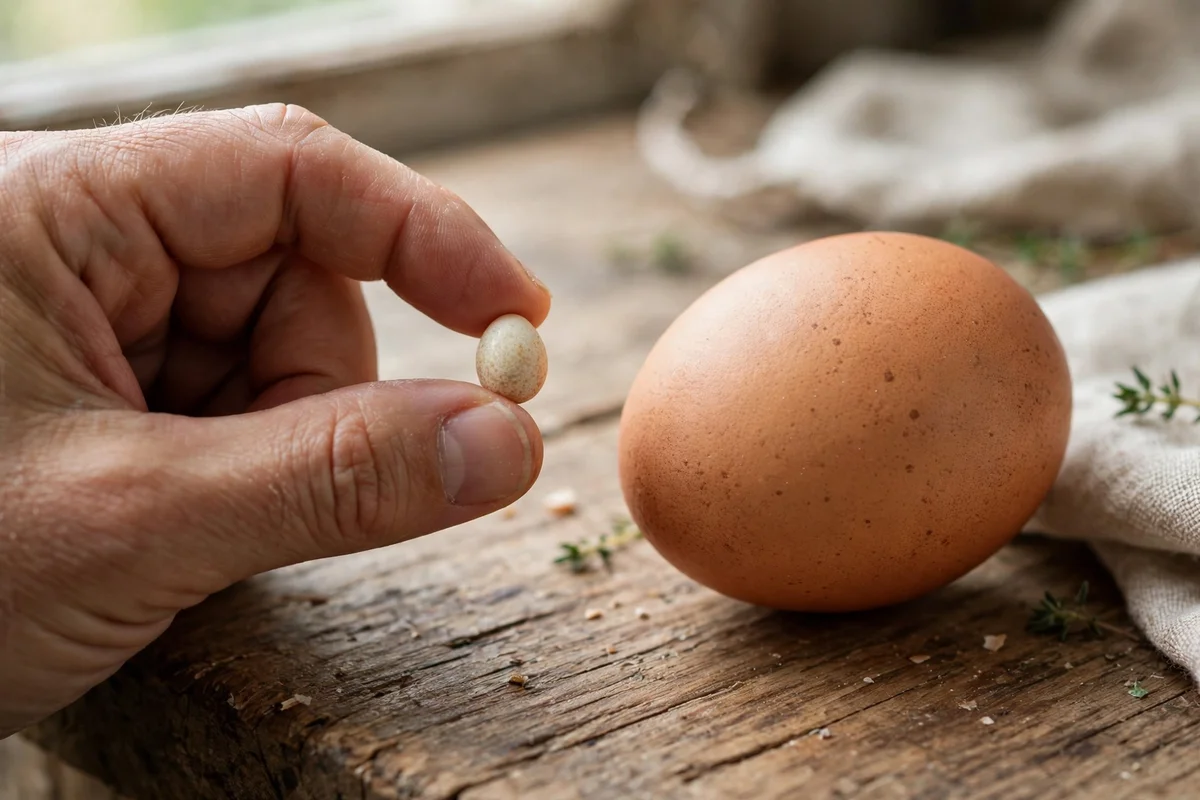
Can you eat the first egg a pullet lays? Yes, the first egg a pullet lays is safe to eat, and it is a normal egg in every way except size. A pullet is a young hen that has just started laying, usually at around eighteen to twenty-two weeks old, and her first eggs are small, because her reproductive system is still maturing. The first egg may be the size of a marble or a golf ball, and it may have a soft shell, a double yolk, or no yolk at all, but it is still a real egg, and it is still good food. Some keepers confuse first eggs with fairy eggs, which are tiny yolkless eggs, but the two are different, and this guide explains why first eggs are safe, why they are small, and how to use them.
Can you eat the first egg a pullet lays?
Can you eat the first egg a pullet lays? Yes, it is safe to eat, and there is no reason to throw it away. The first egg is a real egg, laid by a healthy young hen, and it is made of the same white and yolk as any other egg.
The only difference is size: a first egg is usually much smaller than a normal egg, because the pullet's oviduct, the tube where the egg is built, is still narrow and still learning its job.
The first egg may also look unusual. It may be very small, it may have a soft or thin shell, it may have a rough texture, or it may contain two yolks. All of these are normal for a pullet that has just started laying, and none of them make the egg unsafe. Crack it into a bowl, check that it smells fresh and looks normal, and cook it as you would any other egg.
Some keepers keep the first egg as a souvenir, and that is a lovely tradition. But if you want to eat it, there is nothing stopping you. The first egg is a milestone, and it is also breakfast. A pullet that lays her first egg is a healthy bird, and her egg is good food, even if it is small.
Why pullet first eggs are so small
Pullet first eggs are small because the pullet's reproductive system is still maturing. A hen's oviduct grows and stretches as she lays, and in the first weeks of laying it is still narrow, so the eggs it produces are small.
Over the next few weeks, the oviduct stretches, the eggs get larger, and by the time the pullet is thirty weeks old, her eggs are usually close to full size.
The yolk is also smaller at first. The ovary releases a yolk, and the yolk is then wrapped in white and a shell as it travels through the oviduct. In a young pullet, the yolks are smaller, and the white is less abundant, so the whole egg is smaller. The egg is still complete, with a yolk, a white, membranes, and a shell, but it is a small version of the adult egg.
Size varies by breed too. A pullet of a large breed, such as a Rhode Island Red, will lay a larger first egg than a pullet of a small breed, such as a bantam. And a pullet that starts laying early, at sixteen weeks, will lay smaller first eggs than a pullet that starts at twenty-four weeks. The pattern is the same in every case: small at first, larger over time, and full size within a month or two.
First eggs vs fairy eggs: what is the difference?
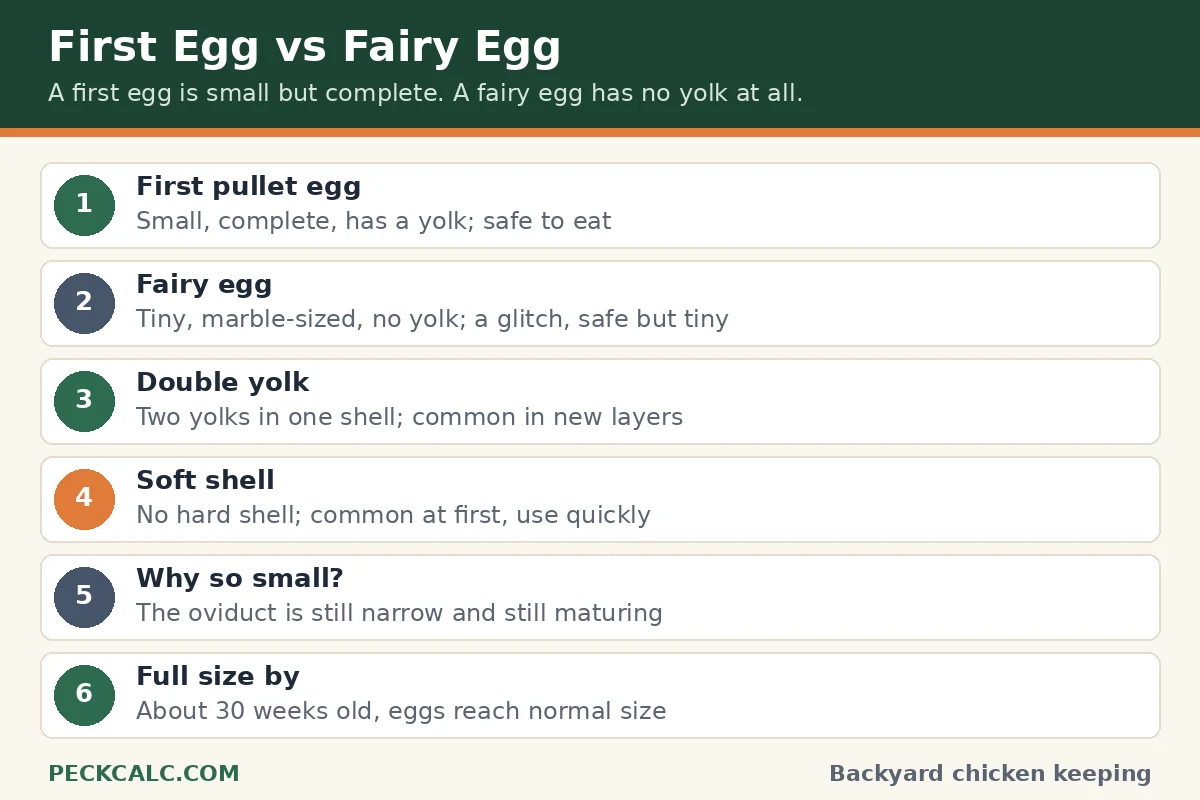
First eggs and fairy eggs are often confused, but they are different things. A first egg is the first egg a pullet lays, and it is small but complete, with a yolk and a white. A fairy egg, also called a fart egg or a wind egg,
is a tiny egg with no yolk at all, and it can be laid by a hen of any age, although it is most common in pullets that are just starting to lay.
A fairy egg forms when a small piece of tissue, rather than a yolk, travels through the oviduct, and the oviduct wraps it in white and a shell as if it were a yolk. The result is an egg the size of a marble, with white but no yolk. Fairy eggs are harmless and safe to eat, although there is very little to eat, and they are a sign that the reproductive system is still settling down.
Some sources confuse the two, and claim that a first egg is the same as a fairy egg, but that is not correct. A first egg is small but normal, and it has a yolk. A fairy egg is tiny and yolkless, and it is a glitch rather than a first. A pullet may lay a fairy egg as her first egg, but most pullets lay a small, complete egg first, and the fairy eggs, if they appear at all, come later. Our guide on what are fairy eggs explains the yolkless egg in full.
What to expect in the first weeks of laying
The first weeks of laying are unpredictable. A pullet may lay an egg every day for a week, then stop for a few days, then lay again. She may lay a soft-shelled egg, a double-yolked egg, or an egg with a rough shell.
She may lay in the nest box, or she may lay on the floor, because she has not yet learned where to lay. All of this is normal, and it settles within a few weeks.
Soft shells are common at first, because the shell gland, which makes the shell, is still learning to deposit calcium evenly. A soft-shelled egg, also called a shell-less egg, has only a membrane and no hard shell, and it is safe to eat if it is fresh, although it should be used quickly. If soft shells continue for more than a few weeks, check that the pullet has access to oyster shell and a balanced layer feed.
Double yolks are also common in new layers, because the ovary sometimes releases two yolks at once. A double-yolked egg is safe to eat, and it is a treat, because it has two yolks in one shell. It is also a sign that the pullet's system is still settling. Over time, the laying becomes regular, the eggs become larger, and the odd shapes disappear. Patience is the only treatment needed.
Are first eggs nutritious?
First eggs are just as nutritious as normal eggs, gram for gram. They contain the same protein, the same vitamins, and the same minerals, in a smaller package. A small first egg has less of everything, because it is smaller, but the nutrition per gram is the same.
There is no reason to think a first egg is less healthy than a large egg, and no reason to avoid eating it.
The yolk of a first egg is often a deeper colour than the yolk of a later egg, because the pullet has been eating well and the yolk is concentrated. That deep colour is a sign of a healthy diet, and it is the same rich yolk that makes backyard eggs so popular. The white may be firmer and less runny than the white of an older egg, because the egg is very fresh, and a firm white is a sign of freshness.
Cooking a first egg is the same as cooking any egg, although the small size means it cooks faster. A tiny first egg will fry in a minute, and it will boil in a few minutes. Use first eggs in baking, where size matters less, or fry two or three together for a small meal. A first egg is a small egg, but it is a real egg, and it deserves a place in the kitchen.
When should a pullet start laying?
Most pullets start laying between eighteen and twenty-two weeks old, although the exact age depends on the breed and the season. Light breeds that lay many eggs, such as Leghorns, often start earlier, at sixteen to eighteen weeks. Heavy breeds that lay fewer eggs, such as Brahmas, often start later, at twenty-four to twenty-eight weeks.
A pullet that hatches in spring will usually start laying in late summer, when the days are long.
Daylight matters. A pullet needs about fourteen hours of daylight to start laying, and a pullet that reaches laying age in autumn, when the days are shortening, may wait until spring. That is normal, and it is not a sign of a problem. A pullet that is well fed, healthy, and has enough light will start when her body is ready, and forcing her with extra light is not necessary for a backyard flock.
Signs that a pullet is close to laying include a reddening comb and wattles, squatting when you approach, and spending time in the nest box. The comb changes from pale pink to bright red as the hormones rise, and the bird becomes more interested in the nest. Our first egg calculator can help estimate when a pullet of a given breed and hatch date is likely to start laying.
What if a pullet never lays, or lays odd eggs for months?
A pullet that has not laid by thirty weeks old is worth watching, but not necessarily a problem. Heavy breeds start late, and a pullet hatched in autumn may wait until spring. Check that the bird is healthy, that it has access to layer feed and oyster shell, and that it has enough daylight.
If the bird looks well and is eating normally, give it time.
A pullet that lays odd eggs for more than two months, with soft shells, no yolks, or very small eggs, may need a closer look. Check the feed first: a pullet that is still on grower feed, rather than layer feed, may be short on calcium, and that can cause soft shells. Check the light: a pullet that does not get enough daylight may lay irregularly. And check for stress, such as overcrowding or bullying, which can disrupt laying.
If the problem continues, or if the bird shows other signs such as a pale comb, weight loss, or lethargy, call a vet. A vet can check for reproductive problems, which are uncommon in young birds but do happen. Most pullets settle within a few weeks, and the odd eggs stop. The few that do not usually have a fixable cause, such as feed, light, or stress, and finding it early saves a season of poor laying.
Celebrating the first egg
The first egg is a milestone for a keeper, and it deserves a small celebration. Many keepers photograph the first egg, keep it on the shelf for a day, or cook it as a special breakfast. It is the reward for weeks of feeding, watering, and waiting, and it is the first sign that the flock is becoming productive.
A keeper who has raised chicks from day one will feel a particular pride in that first small egg.
Some keepers blow out the first egg and keep the shell, which is a lovely keepsake. To blow out an egg, make a small hole in each end with a pin, and blow gently through one hole until the white and yolk come out of the other. Rinse the shell, let it dry, and keep it in a safe place. The shell is fragile, but it will last for years if it is handled gently.
Whether you eat the first egg, keep it, or photograph it, the first egg is a moment to enjoy. It is the start of a laying life that may last for years, and it is a sign that the flock is healthy and well cared for. A pullet that lays her first egg is a bird that has been raised well, and the keeper deserves to feel proud of that. The eggs will get larger, the laying will become regular, and the first small egg will soon be a memory, but it is a memory worth keeping.
| Egg type | Has a yolk? | Size | Safe to eat? |
|---|---|---|---|
| First pullet egg | Yes | Small, grows over weeks | Yes |
| Fairy egg | No | Tiny, marble-sized | Yes, but very little to eat |
| Double-yolk egg | Yes, two yolks | Large | Yes |
| Soft-shelled egg | Yes | Normal size, no hard shell | Yes, if fresh, use quickly |
| Normal adult egg | Yes | Full size | Yes |
Sources: poultry.extension.org.
Related tools and guides
For more on the same topic, see What Are Fairy Eggs?.
Frequently asked questions
Can you eat the first egg a pullet lays?
Yes, the first egg a pullet lays is safe to eat. It is a normal egg, just smaller than an adult egg, because the pullet's reproductive system is still maturing.
Why is a pullet's first egg so small?
The pullet's oviduct is still narrow and her yolks are smaller, so the egg is small. Eggs get larger over the first few weeks of laying and reach full size by about thirty weeks old.
Is a first egg the same as a fairy egg?
No. A first egg is small but complete, with a yolk and a white. A fairy egg is tiny and yolkless, formed when tissue rather than a yolk travels through the oviduct.
When do pullets start laying eggs?
Most pullets start laying between eighteen and twenty-two weeks old, depending on breed and season. Light breeds start earlier, heavy breeds start later, and short winter days can delay the start.
What should I do with my pullet's first egg?
Eat it, cook with it, or keep it as a souvenir. It is safe to eat, and many keepers photograph it or blow out the shell to keep. The eggs will get larger over the next few weeks.
About the author
John Walker is the founder of PeckCalc and has kept backyard chickens in Dallas, Texas since 2017. He started PeckCalc to give backyard keepers free calculators and guides with every figure traced to a university extension source.