
Chicken Names: How to Choose Names That Last
 By John Walker · Backyard chicken keeper in Dallas, Texas since 2017
Chicken names work best when they are chosen for the bird you will have in six months, not the chick you have today, and when they fit the breed, the colour and the personality that is already showing. A name that suits a fluffy yellow chick may not suit the tall, alert hen she becomes, and a name chosen in a hurry on arrival day is often the first thing a keeper regrets, so it is worth taking a few days and naming with intent.
Why chicken names deserve more thought than they get
Naming a chicken feels like a small, light-hearted decision, and for many keepers it is the first thing they do when the chicks arrive, often before the brooder is even warm. But a chicken lives five to ten years, and the name you choose will be used every day for that whole life, called across the garden, written on the vet's records, and used when you talk about the bird to other keepers. A name that felt funny for a week and then grated for five years is a real, if small, regret, and it is easily avoided by waiting a few days before deciding.
Waiting also gives the bird a chance to show you who she is. Chicks change fast, and the shy chick that hides in the corner on day one may be the boldest forager in the flock by week six, while the chick that seemed to be a hen may turn out to be a cockerel. A name chosen after a week of watching is far more likely to fit than one chosen in the first hour, and the birds will not mind waiting, because they do not know their names yet anyway.
Names also have a practical job. When you have six hens and one of them is limping, being able to say which one it is, to yourself, to a vet, or to another keeper, makes the conversation far easier than pointing and saying the brown one, when three of them are brown. A distinct name for each bird, tied to something you can actually see, is a small piece of flock management, not just a bit of fun.
That is the approach this guide takes. It is not a list of five hundred names to scroll through, because a list that long is no help at all, and most of the names on it would suit a dog or a cat as well as a chicken. Instead, it is a keeper's method for choosing names that fit the bird, survive the chick-to-hen change, and still make sense in five years' time.
Name by breed: let the bird's type do the work
Breed is the most reliable starting point for a name, because it does not change as the bird grows. A Silkie will always be a Silkie, with her soft, fur-like feathers and calm temperament, and a name that nods to that, such as Cloud, Muffin or Powder, will still fit when she is a grown hen sitting on a nest. A Rhode Island Red will always be a deep red bird with a practical, businesslike manner, and a name such as Rusty, Scarlett or Ginger suits her from chick to old age.
Heavy breeds and light breeds suggest different kinds of names. A big, slow Orpington hen, all soft feathers and gentle bulk, suits a soft, round name such as Biscuit, Dumpling or Mabel, while a quick, alert Leghorn, all white feathers and nervous energy, suits a sharper name such as Pepper, Zippy or Snow. The name does not have to describe the breed literally, but it should feel like it belongs to the kind of bird you have, and a mismatch, such as naming a tiny bantam Brutus, will feel wrong within a week.
Breed tables are a useful source of inspiration, and our breed guides can help you match the name to the bird. The Silkie profile describes a docile, broody bird that cannot fly and needs dry housing, which suggests gentle names, while the Polish profile describes a crested bird that is calm but easily startled, which suggests a name with a little more character. The best breeds for beginners guide covers the common backyard breeds and their temperaments, and reading it before you name the birds will give you a better sense of what each one is likely to become.
If you keep a mixed flock, breed-based names also help you tell the birds apart in conversation. Saying that Mabel the Orpington is broody again is clearer than saying that the big buff one is broody, and it helps other keepers picture the bird. It also helps children learn the breeds, because the name becomes a hook for remembering what kind of chicken it is.
Name by colour: the simplest system that works
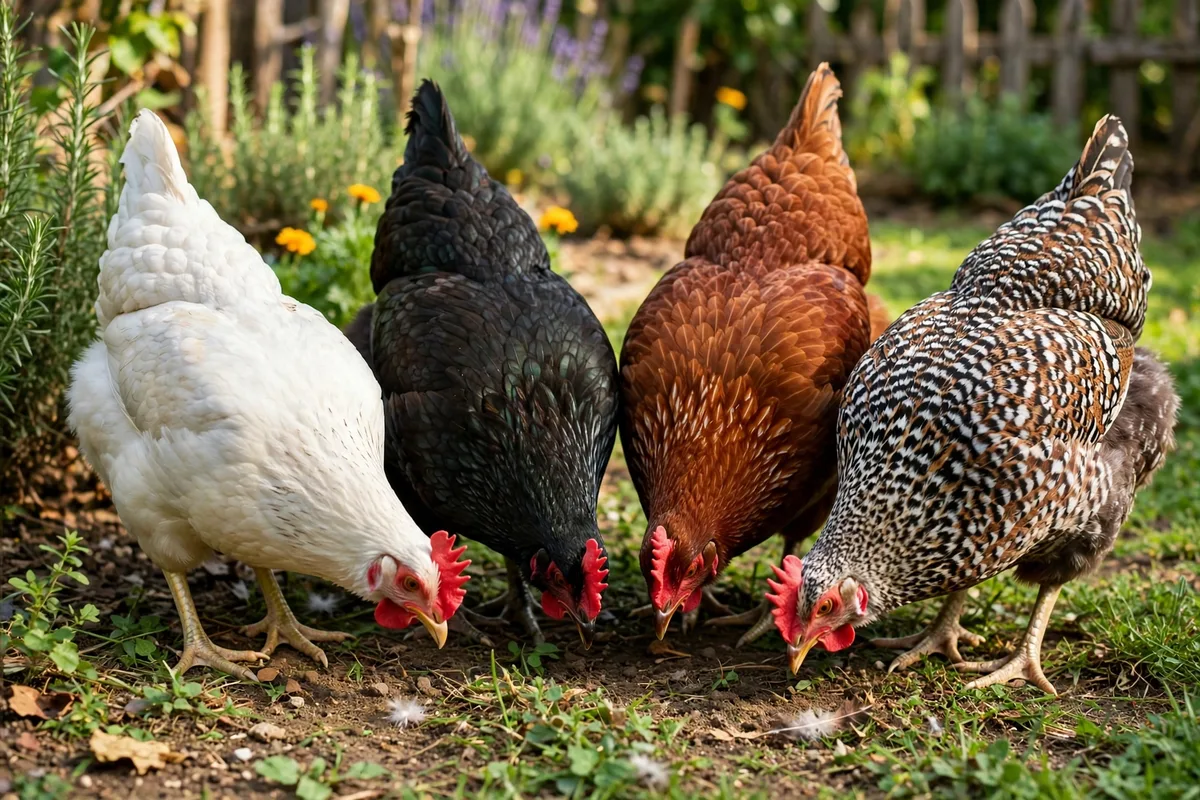
Colour is the simplest naming system, and it works because it is the first thing you see when you look at the bird. A black hen can be Midnight, Shadow or Sooty, a white hen can be Snow, Pearl or Daisy, a red hen can be Ruby, Scarlett or Autumn, and a speckled hen can be Freckles, Speckles or Domino. The name tells you which bird it is at a glance, and it never stops fitting, because the bird's colour does not change, even through the moult.
Colour names work best when they are specific rather than generic. Every flock has a brown hen, so calling one Brown is no help at all, but calling her Chestnut, Cocoa or Hazel tells you which brown she is, and it gives the name a little more character. The same applies to black hens: one can be Ebony and another Onyx, and the two names are distinct enough to use in the same sentence without confusion.
Be careful with colour names for chicks, because chick colour is not always adult colour. Many chicks are yellow or striped whatever colour they will be as adults, and a chick that looks like a pale yellow puffball may grow into a dark barred hen. If you name by colour, wait until the adult feathers start coming in at three or four weeks, or choose a name based on the breed's known adult colour rather than the chick's current fluff.
Colour and breed together make the strongest names of all. A barred Plymouth Rock hen called Domino, a buff Orpington called Honey, a black Australorp called Midnight, and a white Leghorn called Snow are all names that fit the bird, tell you which one it is, and will still make sense in five years. That combination, breed plus colour, is the backbone of most good chicken naming, and it is where most keepers should start.
Name by personality: wait, watch, then choose
Personality is the most satisfying way to name a chicken, and the one that takes the most patience, because a chick's personality is not fully formed on arrival day. Watch the birds for a week or two in the brooder and then in the run, and you will start to see differences: one chick is always first to the feeder, one is always last, one investigates everything new, one hides from everything new, and one seems to be the peacemaker when the others squabble.
The bold forager can be Scout, Explorer or Dash, the calm bird that sits on your lap can be Clover, Mabel or Biscuit, the bossy hen that runs the flock can be Queenie, Boss or Duchess, and the shy bird that keeps to the edges can be Willow, Wren or Fern. The name should describe what the bird does, not what you wish she did, and it should be based on a pattern you have seen more than once, not a single moment.
Personality names have one risk, which is that personality changes. The timid chick often becomes a confident hen once she grows up and finds her place in the pecking order, and the bold chick can become a cautious adult after a scare from a predator. A personality name that is too specific, such as Scaredy, can become a bad fit, while a looser name, such as Willow for a gentle bird or Scout for a curious one, has room to grow with her.
The safest approach is to combine personality with breed or colour, so the name has more than one reason to fit. A bold red hen called Scarlett has a colour name that will always be true and a personality that may or may not stay bold, while a shy white hen called Snow has a colour name that is always true and a gentle sound that suits her. If the personality changes, the colour still holds the name up, and the name survives.
Names that survive the chick-to-hen change
The chick-to-hen change is where most naming mistakes happen, because a chick and a hen are very different animals. A day-old chick is small, round, fluffy and helpless, and it invites cute names such as Peep, Fluffy, Nugget and Bubbles, but a grown hen is a tall, alert, businesslike bird that spends her day foraging, laying and keeping an eye out for hawks, and a name that suited the fluffball can feel ridiculous on the adult.
That does not mean cute names are forbidden, but it means they should be tested against the adult bird before they are fixed. Say the name out loud as if you were calling a grown hen across the garden, and ask whether it still sounds right. Nugget sounds charming for a chick and slightly odd for a three-year-old hen, while Hazel, Mabel, Ruby and Olive sound right at every age, because they are names that suit an adult as well as a chick.
One practical test is to imagine the name on a vet's record or in a message to another keeper. A name such as Duchess or Matilda reads well in both places, while a name such as Chickie or Baby is confusing once the bird is grown, and a name such as Dinner or Nuggets is a joke that wears thin fast, especially if children are involved. The name should be one you are happy to say in front of other people, for years, without explaining the joke.
Another test is length. A name of one or two syllables is easier to call across the garden and easier for children to remember, and it is less likely to be shortened into something you did not choose. A long name such as Henrietta will become Hetty within a week, so if you like Hetty, name her Hetty and be done with it, and if you like Henrietta, be prepared for the shortening and accept it.
Rooster names: a separate job
Roosters need names of their own, and they need a different kind of name from the hens, because a rooster's job in the flock is different. He is the lookout, the protector and the one who crows at dawn, and his name should reflect that role rather than sounding like a hen's name. Names such as Rusty, Rocky, Duke, Rex, Hugo and Barnaby suit roosters, while names such as Daisy and Pearl do not, and the distinction helps everyone, including children, understand which birds are which.
There is a practical reason to name roosters distinctly as well. If you have more than one rooster, or if you are deciding whether to keep a cockerel that may turn out to be aggressive, being able to talk about him by name makes the decision clearer, and our guide on how to handle an aggressive rooster is worth reading before you decide. A rooster with a name is a bird you have committed to, and that commitment should be made deliberately.
Sexing is the complication. Many keepers name their chicks before they know which are cockerels, and a chick named Daisy that turns out to be a rooster needs a new name or a name that works for either sex. Gender-neutral names such as Sage, Rowan, Robin, Ash and Charlie avoid the problem entirely, and they are a good choice if you are buying straight-run chicks, where roughly half will be male. Our guide on how to sex baby chicks at home explains the early signs, but even experienced keepers get it wrong sometimes, so a name that survives a change of sex is worth considering.
If a chick does change sex on you, do not be embarrassed about renaming. Keepers do it all the time, and the bird will not mind, because chickens do not learn their names the way dogs do. Rename early, before the name has stuck in your own head, and move on. The name is for you, not for the bird, and getting it right matters more than getting it right the first time.
Naming a whole flock: systems that scale
Naming one chicken is easy; naming twelve is a system, and a system keeps the names distinct and memorable. The simplest system is a theme, and themes work because they give you a ready-made set of names that go together without sounding alike. A herb theme gives you Sage, Basil, Thyme, Rosemary and Mint; a gemstone theme gives you Ruby, Pearl, Opal, Jade and Amber; a breakfast theme gives you Biscuit, Muffin, Honey and Maple; and a classic-names theme gives you Mabel, Hazel, Olive, Clara and Edith.
The theme should be broad enough to cover the number of birds you have, and the names should be distinct enough that you do not confuse them when you say them quickly. Sage and Basil are distinct; Sage and Paige are not, and neither are Ruby and Rosie when called across a garden. Say the names out loud together before you commit, and drop any that sound too alike, because a name you cannot distinguish at a distance is a name that does not do its job.
Another system is to name each bird after the place she came from, the day she arrived, or the person who chose her, which gives the names a story and makes them easier to remember. A hen that arrived in spring can be April or May, a hen from a particular breeder can carry the breeder's flock name, and a hen chosen by a child can carry the name the child picked, even if it is an odd one, because the story behind it matters more than the name itself.
Whatever system you choose, write the names down with the birds they belong to, and keep the list with your flock records. A list that says which hen is which, with a note of her breed, colour and hatch date, is the difference between a flock you know and a flock you guess at, and it becomes more valuable every year as the birds age and the flock changes.
Names to avoid, and why
Avoid names that are jokes about eating the bird, such as Dinner, Nuggets, Roast and KFC, unless you are certain everyone in the household finds them funny and will still find them funny in five years. Children in particular can become attached to a bird called Nuggets and then distressed when they realise what the name means, and the joke is rarely worth the awkwardness it creates.
Avoid names that are hard to say or spell, because you will be saying and writing the name for years, and a name that trips you up every time is a name you will stop using. Avoid names that are the same as a family member's name, because calling for the hen and having a person answer is confusing for everyone, and avoid names that are rude or that you would not want a neighbour to hear you shouting across the garden at seven in the morning.
Avoid naming a bird after a bird that has died, at least straight away. It is natural to want to honour a favourite hen by giving her name to a new chick, but the new bird is not the old one, and the name carries expectations that the new bird cannot meet. Give the new bird her own name, and remember the old one in another way, such as a note in the flock records or a plant in the garden.
Finally, avoid choosing a name in the first hour. The chicks will not know the difference, and the extra days of watching will give you a better name than any list can. The best chicken names are the ones that fit the bird you have, not the chick you imagined, and they are worth waiting for.
Sources: the naming approach on this page is drawn from keeper practice and breed temperament descriptions published by university extension services and breed associations. For breed temperaments, see the best breeds for beginners guide and the poultry pages at the University of Minnesota Extension. For sexing cues, see poultry.extension.org.
Related tools and guides
For more on the same topic, see our Silkie breed profile and the guide on how to sex baby chicks at home.
Frequently asked questions
When should I name my chickens?
Wait a few days after the chicks arrive before naming them. Watching the birds for a week or two shows you their breed type, their colour as adult feathers come in, and their personality, so the name you choose is far more likely to fit the adult bird.
What are good names for hens?
Names that fit the breed, colour or personality and still suit an adult bird work best, such as Hazel, Mabel, Ruby, Olive, Scarlett, Honey and Domino. One- or two-syllable names are easiest to call across the garden and easiest for children to remember.
Should roosters have different names from hens?
Yes. A rooster's role in the flock is different, and a distinct name such as Rusty, Rocky, Duke or Hugo makes it clear which birds are male. Gender-neutral names such as Sage, Rowan or Charlie are a good choice if you are buying straight-run chicks and do not yet know which are cockerels.
What if I name a chick and it turns out to be a rooster?
Rename it. Keepers do this all the time, and the bird will not mind, because chickens do not learn their names the way dogs do. Rename early, before the name has stuck in your own head, and choose a name that fits the bird you actually have.
How do I name a whole flock without confusing the names?
Use a theme with distinct names, such as herbs (Sage, Basil, Thyme, Rosemary) or gemstones (Ruby, Pearl, Opal, Jade), and say the names out loud together before committing. Drop any that sound too alike when called across a garden, and write each name down with the bird's breed, colour and hatch date.
About the author
John Walker is the founder of PeckCalc and has kept backyard chickens in Dallas, Texas since 2017. He started PeckCalc to give backyard keepers free calculators and guides with every figure traced to a university extension source.