
Crested Chicken Breeds
 By John Walker · Backyard chicken keeper in Dallas, Texas since 2017
Crested chicken breeds are chickens with a tuft of feathers on top of the head, called a crest, which can be small and neat or large and full, covering the eyes and changing the way the bird sees the world. The best-known crested breeds are the Polish, the Silkie, the Houdan, and the Appenzeller Spitzhauben, and they are kept for their looks, their history, and their character, but the crest brings practical problems that a keeper needs to understand. A large crest blocks vision, makes the bird easy prey for predators and bullies, and needs care to keep it clean and dry. This guide lists the main crested breeds, explains the vision problem, and shows how to care for a crest.
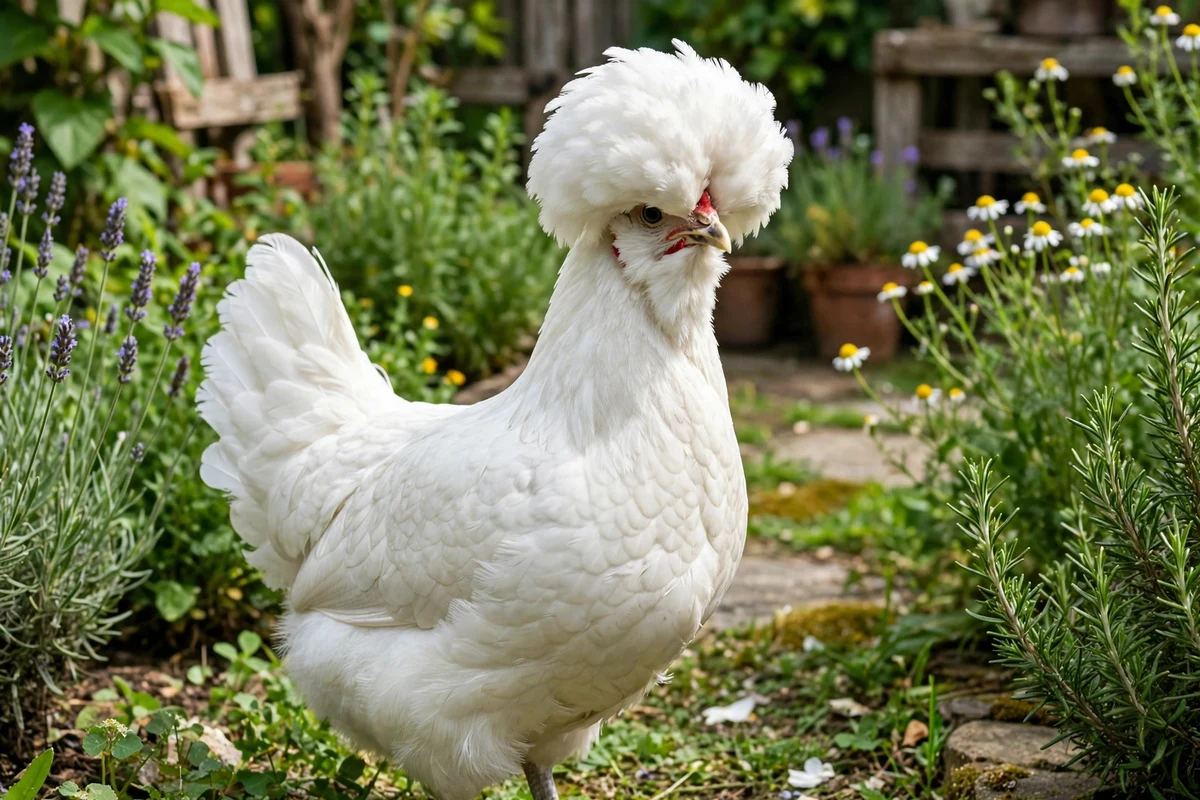
What are crested chicken breeds?
Crested chicken breeds are breeds with a tuft of feathers on the top of the head, called a crest, which grows from a bony knob on the skull, and the crest can be small and neat, as in the Appenzeller Spitzhauben, or large and full, as in the Polish, where it can cover the eyes completely.
The crest is a genetic trait, and it is the defining feature of the breed, which means a crested breed without a crest is not a good example of the breed.
The crest is not just decoration: it changes the way the bird sees, moves, and interacts with the flock, because a bird that cannot see well is more nervous, more likely to be bullied, and more likely to be caught by a predator. A crested bird needs a keeper who understands this, and who is willing to trim the crest, to keep the bird with gentle flockmates, and to give it extra protection.
The main crested breeds are the Polish, the Silkie, the Houdan, the Sultan, the Appenzeller Spitzhauben, and the Crevecoeur, and they come from different countries and have different histories, but they share the crest and the care it needs. The sections below introduce each one, and then explain the vision problem and the care in detail.
Polish: the classic crested breed
The Polish is the best-known crested breed, and it is famous for its huge, round crest, which looks like a powder puff and can cover the eyes completely. The breed comes from Europe, although its exact origin is disputed, and it has been kept for centuries as an ornamental bird.
Varieties include White Crested Black, Golden Laced, Silver Laced, and Buff Laced.
Polish hens lay around one hundred and fifty white eggs a year, which is modest for a laying breed, and they are not broody, which means they do not sit on eggs to hatch them. The birds are light, active, and nervous, and they startle easily, because they cannot see well, and they are not a good choice for a flock with aggressive breeds, because they are often bullied.
The Polish needs its crest trimmed, or tied up, so that it can see, and it needs a dry coop, because a wet crest gets heavy, cold, and dirty, and it can cause skin problems. Our guide on Polish chickens explains the breed in full detail, including the varieties and the care.
Silkie, Houdan, and Sultan: crests with beards
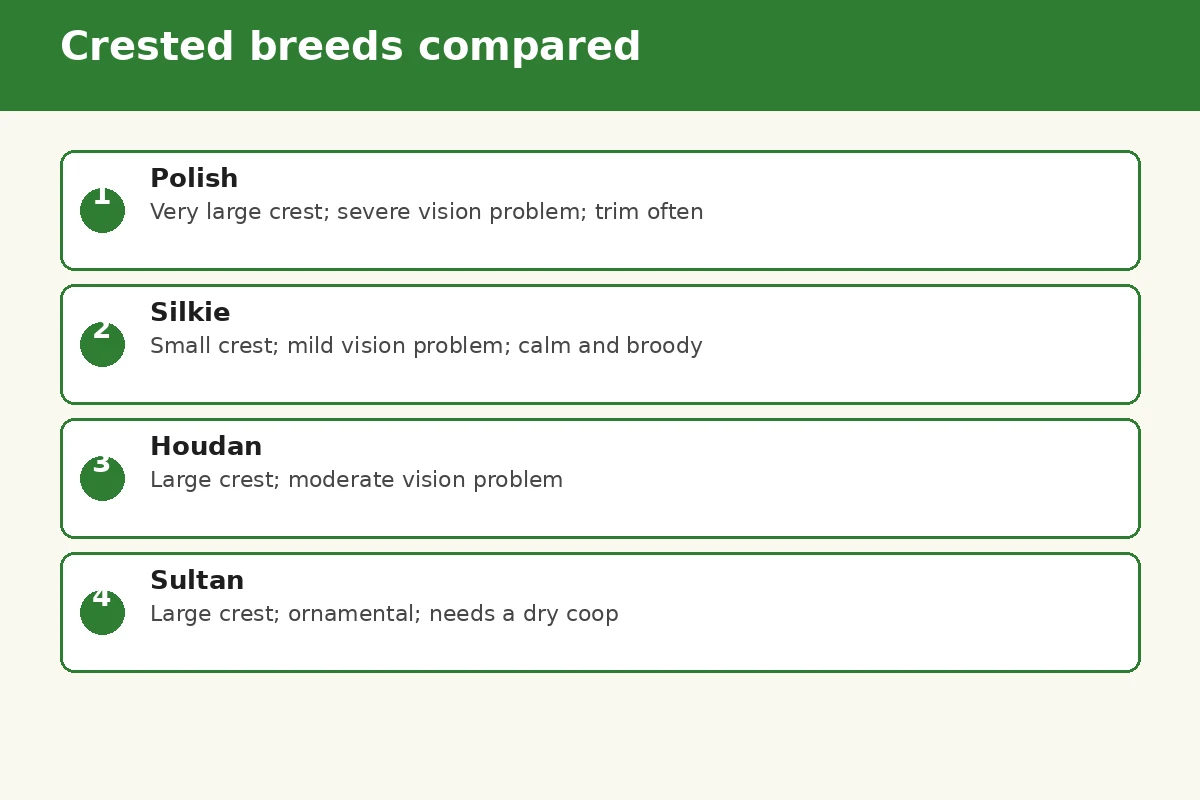
The Silkie is a crested breed with a small crest, a beard, and soft, fluffy feathers that feel like silk, and it is one of the most popular ornamental breeds in the world. Silkies are calm, friendly, and broody, which means they are excellent mothers.
And they are often kept as pets and as broody hens to hatch other breeds' eggs, although they lay only around one hundred small eggs a year themselves.
The Houdan is a French crested breed with a large crest, a beard, five toes, and a V-shaped comb, and it is a dual-purpose breed that lays around one hundred and fifty white eggs a year. Houdans are calm and friendly, and they are a good choice for a keeper who wants a crested bird that is also a reasonable layer, although the crest still needs care.
The Sultan is a Turkish crested breed with a large crest, a beard, feathered legs, and five toes, and it is a purely ornamental bird that lays few eggs and is kept for its looks. Sultans are calm and gentle, but they are not hardy, and they need a dry, warm coop, because their feathered legs and large crest get wet and cold easily. Our guide on Silkie chickens explains the Silkie in detail.
Appenzeller Spitzhauben and Crevecoeur
The Appenzeller Spitzhauben is a Swiss crested breed with a small, forward-pointing crest, like a Mohawk, and it is a light, active, and hardy bird that lays around one hundred and eighty white eggs a year, which is good for a crested breed.
The crest is small enough that it does not block vision much, which makes the Spitzhauben the easiest crested breed to keep, and a good choice for a keeper who wants a crested bird without the vision problems.
The Crevecoeur is a French crested breed with a large crest, a beard, and a V-shaped comb, and it is a dual-purpose breed that lays around one hundred and fifty white eggs a year. Crevecoeurs are calm and friendly, but they are rare, and they need the same crest care as other large-crested breeds, including trimming and a dry coop.
Both breeds are less common than the Polish and the Silkie, and they are usually bought from specialist breeders, but they are worth considering if you want a crested bird that is a little different, and the Spitzhauben in particular is a good choice for a first crested breed, because its small crest causes fewer problems.
The vision problem: when a crest blocks the eyes
The vision problem is the most important practical issue with crested breeds, because a large crest can cover the eyes and block the bird's view, which makes it nervous, slow to find food and water, and easy prey for predators and bullies.
A bird that cannot see well will startle at sudden movements, will miss food that is thrown to it, and will be the last to the feeder, which means it can lose weight and become weak.
The signs of a vision problem are a bird that stands still with its head tilted, that bumps into things, that does not react to food until it is very close, and that is often alone, away from the flock. A bird that is being bullied will have missing feathers on the crest, because other birds peck at the crest, and a bird that is frightened will hide in a corner and not come out to eat.
The fix is to trim the crest, which is the subject of the next section, and to keep the bird with gentle flockmates, in a run with no low obstacles, and with the feeder and drinker in a fixed place that the bird can learn. A crested bird that can see, even a little, is a much happier bird than one that cannot see at all.
How to trim and care for a crest
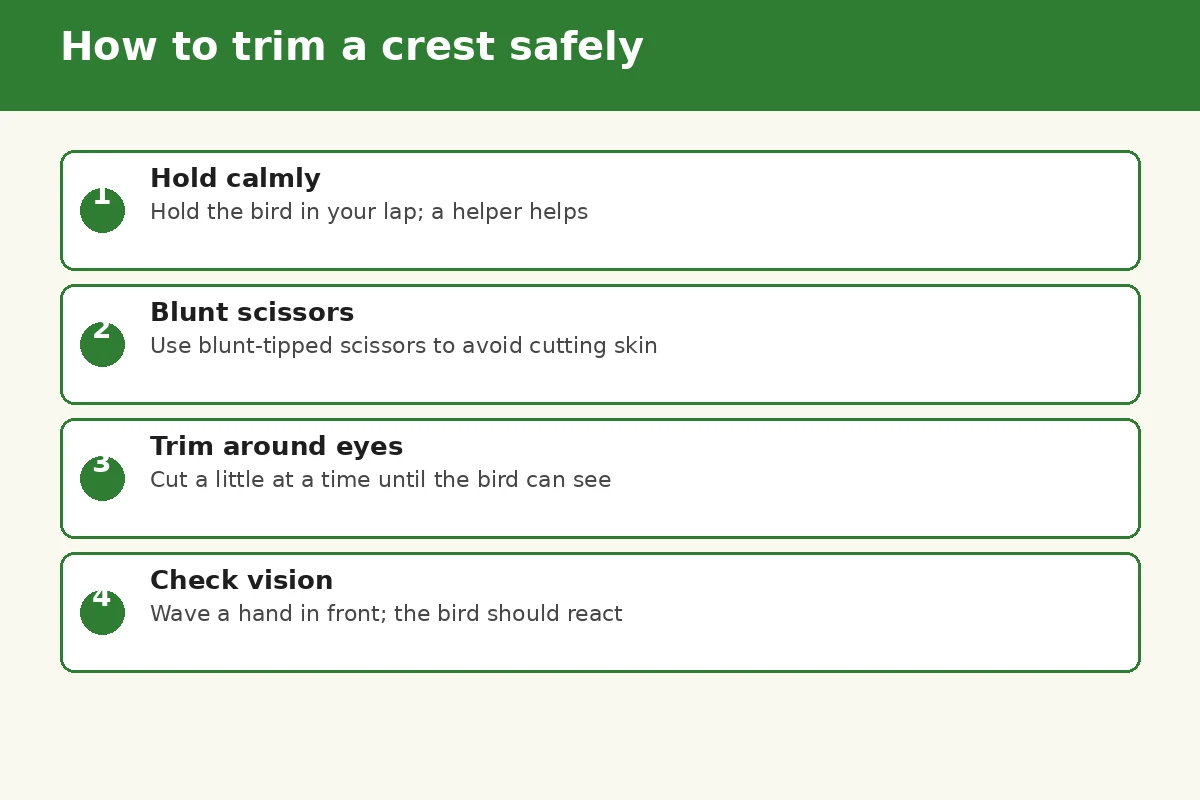
To trim a crest, hold the bird calmly in your lap, with a helper holding it if needed, and use blunt-tipped scissors to trim the feathers around the eyes, cutting them short enough that the bird can see clearly, but not so short that you cut the skin.
Trim a little at a time, and check the bird's vision by waving a hand in front of it, because the goal is to clear the eyes, not to remove the whole crest.
Trim the crest every few weeks, or whenever it grows back over the eyes, and check it after rain, because a wet crest flops over the eyes and blocks vision even more than a dry one. Keep the coop dry, because a wet crest gets heavy and cold, and it can cause skin infections, and do not let the crest get matted with mud or droppings, because a matted crest pulls on the skin and hurts the bird.
Some keepers tie the crest up with a small hair tie, which is a temporary fix that keeps the feathers out of the eyes without cutting them, but a tie can pull and hurt the bird if it is too tight, and it needs to be checked daily. Trimming is the better long-term solution, and it is a simple job that takes only a few minutes once you have done it a few times.
Keeping crested breeds safe: predators and bullying
Crested breeds are more vulnerable to predators than other breeds, because they cannot see well, and they are slower to run and to take flight, which means a hawk or a fox is more likely to catch them. Keep crested birds in a covered run, with a roof or netting over the top.
And do not let them free-range unsupervised, because a bird that cannot see a hawk coming is an easy target.
Crested birds are also more likely to be bullied, because other birds peck at the crest, which is a tempting target, and a bird that cannot see the peck coming cannot dodge it. Keep crested birds with gentle breeds, such as Silkies, Cochins, or Orpingtons, and do not mix them with aggressive breeds, such as Rhode Island Reds or Leghorns, which are more likely to bully them.
Give the flock enough space, more than one feeder and drinker, and places to hide, so that a crested bird can eat and drink without being chased, and check the crest daily for missing feathers, blood, or swelling, which are signs of bullying. If a bird is being bullied badly, separate it with a gentle companion, rather than leaving it alone, because chickens are social birds and a lone bird will be stressed.
Which crested breed should you choose?
Choose the Polish if you want the crested look, with a huge, round crest, and you are willing to trim it regularly and keep the bird in a covered run. The Polish is the most striking crested breed, and it is a good choice for a keeper who wants an ornamental bird and is prepared for the care it needs.
Choose the Silkie if you want a calm, friendly, and broody bird that is good with children and makes an excellent mother, and if you do not mind a small crest and a low egg count. The Silkie is the best crested breed for a family, and it is the most popular for a reason, although it needs a dry coop because its fluffy feathers get wet easily.
Choose the Appenzeller Spitzhauben if you want a crested bird with fewer vision problems, because its small, forward-pointing crest does not block the eyes much, and it is a good layer and a hardy bird. The Spitzhauben is the easiest crested breed to keep, and it is a good first choice for a keeper who is new to crested breeds and wants to learn the care without the worst of the vision problems.
| Breed | Crest size | Eggs per year | Vision problem | Best for |
|---|---|---|---|---|
| Polish | Very large | Around 150, white | Severe; trim often | Ornamental; striking looks |
| Silkie | Small | Around 100, small | Mild; beard as well | Families; broody hens |
| Houdan | Large | Around 150, white | Moderate | Dual-purpose; calm birds |
| Sultan | Large | Few | Moderate | Ornamental; gentle birds |
| Appenzeller Spitzhauben | Small, forward | Around 180, white | Mild | First crested breed |
| Crevecoeur | Large | Around 150, white | Moderate | Rare; dual-purpose |
Sources: The Livestock Conservancy, Polish chickens and Poultry Extension, crested breeds.
Related tools and guides
For more on the same topic, see Polish Chickens.
Frequently asked questions
What are crested chicken breeds?
Breeds with a tuft of feathers on top of the head, called a crest. The main ones are Polish, Silkie, Houdan, Sultan, Appenzeller Spitzhauben, and Crevecoeur.
Do crested chickens have vision problems?
Yes, a large crest can cover the eyes and block vision, making the bird nervous, slow to find food, and vulnerable to predators and bullying. Trimming the crest around the eyes fixes it.
How do I trim a crested chicken's crest?
Hold the bird calmly and use blunt-tipped scissors to trim the feathers around the eyes, a little at a time, until the bird can see clearly. Repeat every few weeks as it grows back.
Can crested chickens live with other breeds?
Yes, but only with gentle breeds such as Silkies, Cochins, or Orpingtons. Aggressive breeds will peck at the crest, so keep crested birds separate from them.
Which crested breed is easiest to keep?
The Appenzeller Spitzhauben, because its small, forward-pointing crest does not block vision much, and it is a good layer and a hardy bird. The Silkie is the best for families.
About the author
John Walker is the founder of PeckCalc and has kept backyard chickens in Dallas, Texas since 2017. He started PeckCalc to give backyard keepers free calculators and guides with every figure traced to a university extension source.