
Do Chickens Dream?
 By John Walker · Backyard chicken keeper in Dallas, Texas since 2017
Do chickens dream? The honest answer is that we cannot know for certain what a chicken experiences, but the science points strongly to yes: chickens have REM sleep, which is the sleep stage where dreaming happens in people, dogs, and other birds, and a sleeping hen will twitch its legs, move its beak, and flutter its wings, just as a dreaming dog does. Chicks show REM sleep from a few days old, and adult hens show the same brain patterns every night. This guide explains what the research says, what REM sleep is, how to tell if a hen is dreaming, and why a dark, quiet coop matters for good sleep.
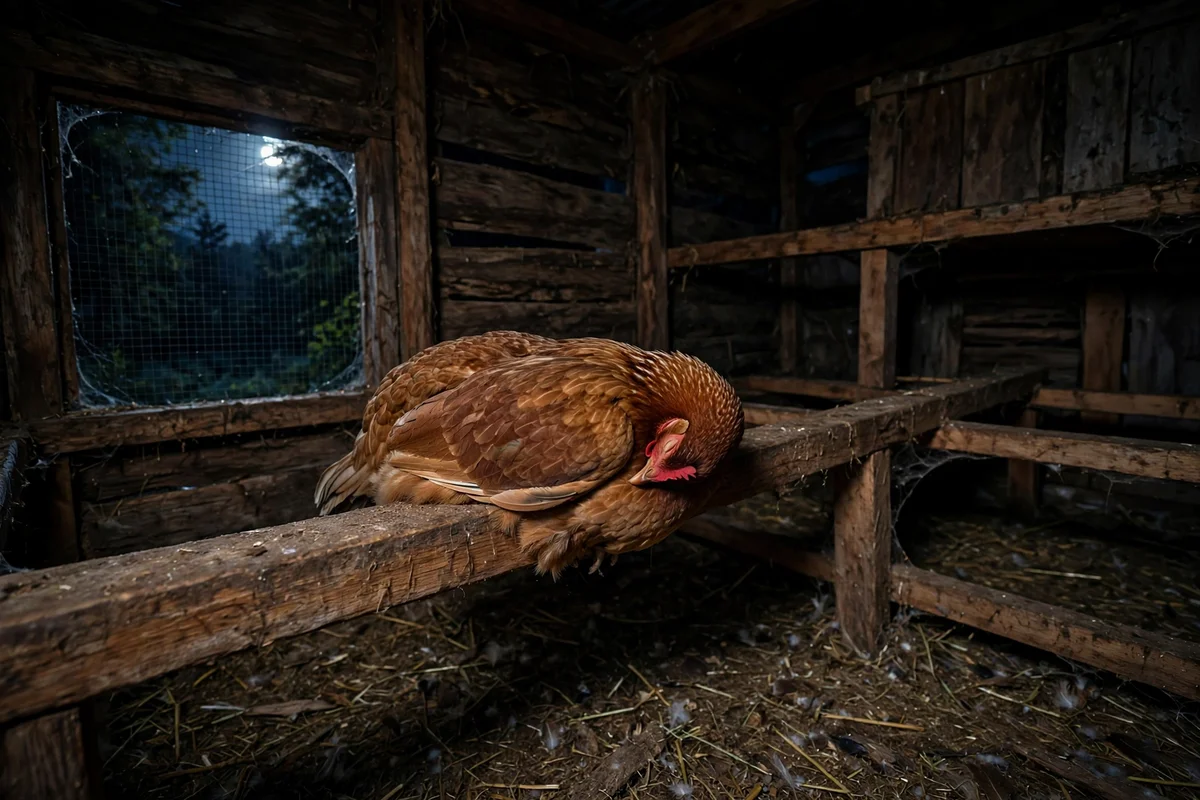
Do chickens dream?
Chickens almost certainly dream, because they have REM sleep, which is the sleep stage where dreaming happens in people, dogs, and other birds. REM stands for rapid eye movement, and it is the stage where the brain is active, the eyes move quickly under the lids, and the muscles twitch, even though the body is asleep.
Scientists cannot ask a chicken what it dreamed, because a chicken cannot tell us, but they can measure the brain. A chicken brain in REM sleep shows the same patterns as a human brain in REM sleep, and the same patterns are found in other birds that are known to dream, such as zebra finches, which replay their songs in their sleep.
Chicks show REM sleep from a few days old, and the amount of REM sleep is highest in young chicks, which is the same pattern seen in human babies, who dream more than adults. Adult hens have less REM sleep than chicks, but they still have it every night, and they still show the twitches and movements that go with it.
The evidence is strong, but it is not proof, because dreaming is a private experience and no one can measure it directly. The best answer we can give is that chickens have the brain activity of dreaming, they show the movements of dreaming, and it is very likely that they dream, just as other birds and mammals do.
What is REM sleep in chickens?
REM sleep is a sleep stage where the brain is active, the eyes move quickly under the closed lids, and the muscles twitch, while the body is deeply asleep. It is one of two main sleep stages, the other being slow-wave sleep, where the brain is quiet and the body is still.
Chickens, like other birds, have both stages, but their sleep is different from ours in one way: birds can sleep with one half of the brain awake and the other half asleep, which is called unihemispheric sleep. This lets a bird rest while still watching for predators, and it is why a sleeping hen may open one eye when you walk past.
In REM sleep, a chicken brain shows fast, waking-like activity, and the eyes move under the lids, just as they do in a dreaming person. The legs may twitch, the beak may move, and the wings may flutter, and these movements are the same as the twitches a dog makes when it dreams of running.
REM sleep is important for learning and memory, and a chicken that does not get enough REM sleep may have trouble learning where food is, or remembering the layout of its pen. A dark, quiet coop at night helps a hen get the sleep she needs, and that includes REM sleep.
How can I tell if my chicken is dreaming?
A dreaming chicken may twitch its legs, move its beak, flutter its wings, or make soft sounds in its sleep. These movements are small and quick, and they happen while the bird is perched on the roost with its head tucked under its wing, which is the normal sleeping position for a hen.
The twitches are the clearest sign, because a chicken in deep, slow-wave sleep is still, while a chicken in REM sleep twitches and moves. A hen that twitches its legs as if it is running, or moves its beak as if it is pecking, is likely dreaming, and the movements are the same as the twitches a dog makes when it dreams.
Do not wake a sleeping hen to check, because a hen that is woken suddenly can fall off the roost and injure itself, and a hen that is woken often will not sleep well. Watch from a distance, with a dim light, and let the bird sleep.
A chick that is dreaming may twitch more than an adult hen, because chicks have more REM sleep, and a brooder full of chicks will often show twitches and peeps in their sleep. This is normal, and it is a sign that the chicks are healthy and sleeping well.
What do chickens dream about?
We cannot know what a chicken dreams about, because a chicken cannot tell us, but scientists who study bird dreams have a good guess. In zebra finches, a small songbird, the brain replays the bird song during REM sleep, and the bird seems to practise its song in its sleep.
A chicken may do the same with the sounds and movements it knows.
A chicken may dream about pecking, scratching, dust bathing, or running from a predator, because those are the things a chicken does every day, and dreams are often a replay of the day. A hen that has spent the day foraging may dream about pecking, and a hen that has been scared by a hawk may dream about running.
Some scientists think that dreams help birds learn, by replaying the day and strengthening the memories, and that a chicken that dreams is a chicken that is learning. A chick that has just learned where the feeder is may dream about it, and the dream may help it remember.
These are guesses, not facts, and no one can prove what a chicken dreams about. But the guesses are based on real research into bird brains, and they are the best answer we have. A chicken that twitches in its sleep is almost certainly dreaming, and its dreams are probably about the things that matter to a chicken: food, safety, and the flock.
Chicken sleep: how much and when
Chickens sleep at night, on the roost, with their heads tucked under their wings, and they wake at dawn. A hen sleeps for about eight to ten hours a night, in short cycles of light sleep, deep sleep, and REM sleep, and she will wake briefly many times during the night.
Chicks sleep more than adult hens, and they sleep in short naps during the day as well as at night. A day-old chick may sleep for most of the day, waking only to eat and drink, and the amount of sleep falls as the chick grows. Our guide on baby chick sleeping a lot explains how much sleep is normal for a chick.
Chickens need darkness to sleep well, and a coop that is lit all night can stop them sleeping properly. A heat lamp that stays on all night can keep the brooder lit, and a coop light left on can stop the hens sleeping, which can affect their health and their laying.
A dark, quiet coop at night is important for good sleep, and it is one of the simplest things a keeper can do for the flock. Close the coop at dusk, turn off the lights, and let the hens sleep in the dark, and they will wake at dawn, rested and ready to lay.
Why good sleep matters for chickens
Good sleep matters for chickens because it helps them learn, grow, and stay healthy, and a hen that does not sleep well will lay fewer eggs and be more likely to get ill. Sleep is when the body repairs itself, when the brain stores memories, and when the immune system works hardest.
A hen that is kept in a lit coop at night, or that is disturbed by noise, light, or predators, will not sleep well, and she will show it in the morning: she will be dull, she will eat less, and she will lay fewer eggs. A flock that is disturbed at night is a flock that is stressed, and stress is bad for laying and for health.
A dark, quiet coop, with a secure door and no light at night, is the best way to give hens good sleep. Use a heat plate rather than a heat lamp in the brooder, because a heat plate gives off no light, and the chicks will sleep better in the dark.
Our guide on chicken pecking order explains how the flock settles at night, and our chicken coop size calculator helps you plan a coop that is big enough for the whole flock to roost comfortably. A hen that sleeps well is a hen that lays well, and a dark coop is the simplest way to help her.
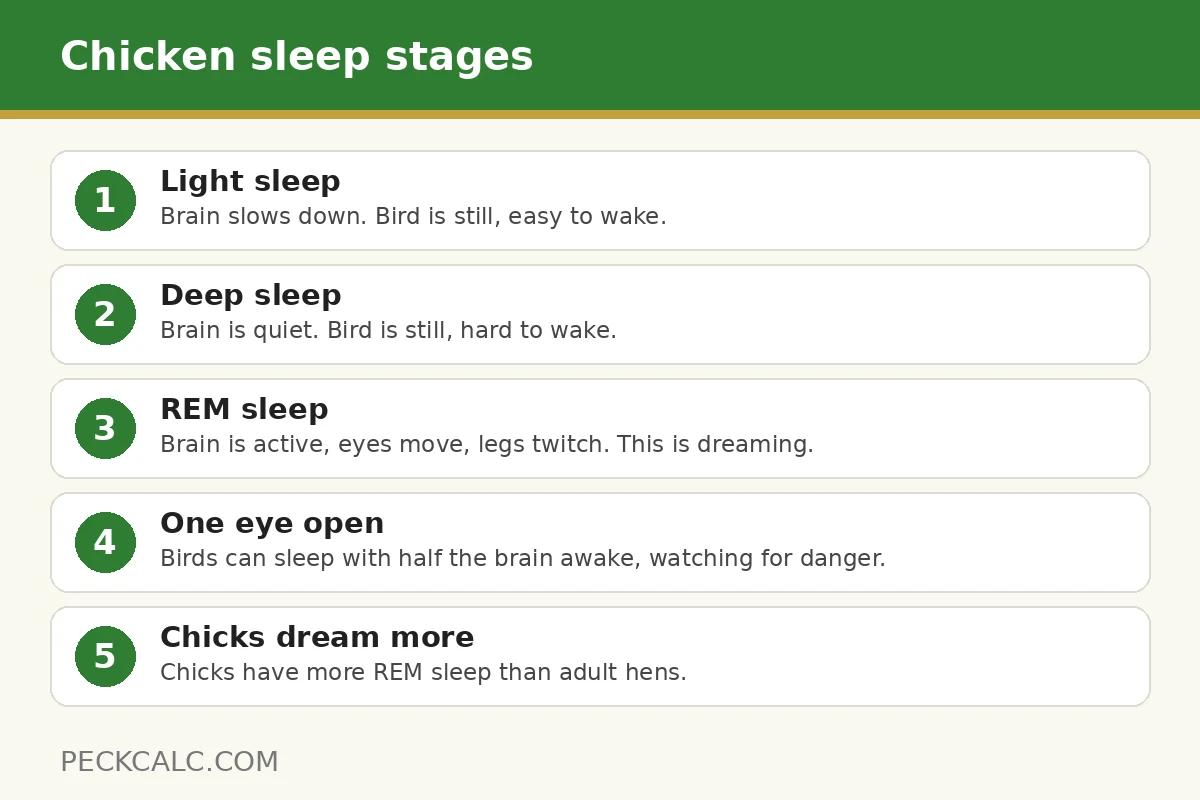
| Sleep stage | What the brain does | What the body does |
|---|---|---|
| Light sleep | Brain slows down | Bird is still, easy to wake |
| Deep sleep (slow-wave) | Brain is quiet | Bird is still, hard to wake |
| REM sleep | Brain is active, like waking | Eyes move, legs twitch, dreaming |
| Unihemispheric sleep | One half of brain asleep, one awake | One eye open, watching for danger |
Do chickens dream? The short answer
Do chickens dream? The best answer is yes, almost certainly, because chickens have REM sleep, the sleep stage where dreaming happens, and they show the twitches and movements of dreaming every night. Chicks dream more than adults, because they have more REM sleep, and a brooder full of chicks will often show twitches and peeps in their sleep.
We cannot know what a chicken dreams about, but the research on other birds suggests that a chicken dreams about the things it does every day: pecking, scratching, dust bathing, and running from danger. A dreaming chicken is a healthy chicken, and a hen that twitches in its sleep is a hen that is sleeping well.
Give your hens a dark, quiet coop at night, let them sleep without disturbance, and they will dream, learn, and lay well. A hen that sleeps well is a hen that is healthy, and a dark coop is the simplest gift a keeper can give a flock.
Sources: poultry.extension.org and University of Minnesota Extension, poultry resources.
Related tools and guides
For more on the same topic, see Can Chickens Fly?.
Frequently asked questions
Do chickens dream?
Yes, chickens almost certainly dream, because they have REM sleep, the sleep stage where dreaming happens in people and other birds. Chicks show REM sleep from a few days old, and adult hens show the same brain patterns.
How can I tell if my chicken is dreaming?
A dreaming chicken may twitch its legs, move its beak, flutter its wings, or make soft sounds in its sleep. These movements are the same as the twitches a dog makes when it dreams, and they are a sign of REM sleep.
What is REM sleep in chickens?
REM sleep is a sleep stage where the brain is active, the eyes move quickly under the lids, and the muscles twitch. It is the stage where dreaming happens, and it is found in birds and mammals, including chickens.
Do chicks dream more than adult chickens?
Chicks show REM sleep from a few days old, and the amount of REM sleep falls as the chick grows. Adult hens have less REM sleep than chicks, but they still have it every night.
Can poor sleep harm a chicken?
Yes, chickens that do not get enough sleep, or that are kept in a lit coop at night, can suffer from poor sleep, which affects their health and laying. A dark, quiet coop at night is important for good sleep.
About the author
John Walker is the founder of PeckCalc and has kept backyard chickens in Dallas, Texas since 2017. He started PeckCalc to give backyard keepers free calculators and guides with every figure traced to a university extension source.