
Do Chickens Get Jealous?
 By John Walker · Backyard chicken keeper in Dallas, Texas since 2017
Chickens do not feel jealousy the way people do, because jealousy needs a sense of what someone else has and a wish to take it, and there is no evidence that chickens think that way. What looks like jealousy is usually competition for food, attention or rank. The behaviour is real, even if the emotion behind it is simpler.
Do chickens get jealous?
Chickens do not get jealous in the human sense, because jealousy is a complex emotion that involves comparing yourself with someone else and resenting what they have. There is no evidence that chickens think in that way, and scientists who study chicken behaviour describe their social lives in terms of competition, hierarchy and resource guarding, not jealousy.
The word is a human label for a simpler behaviour.
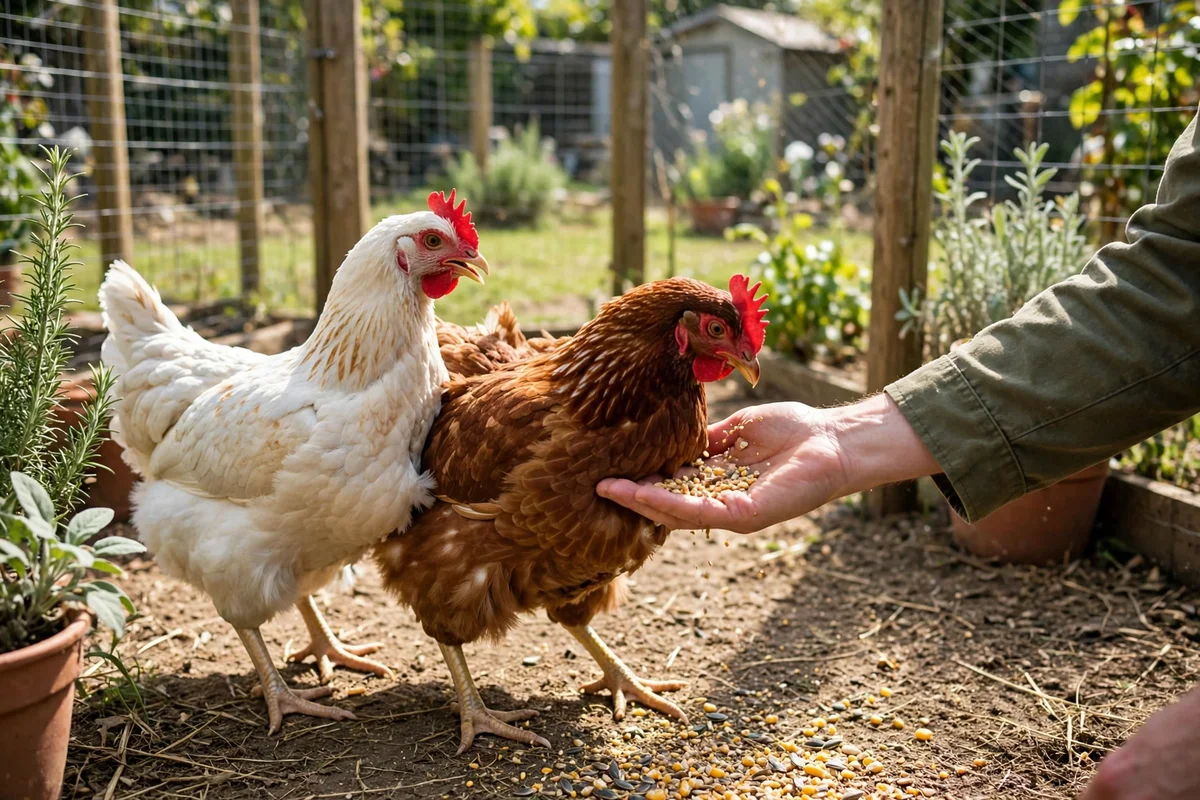
What looks like jealousy is usually a hen competing for something she wants: food, your attention, a favourite perch, or her place in the pecking order. A hen that pushes another bird away from your hand is not thinking that you love the other bird more; she is thinking that the treat in your hand is hers, and she wants it. The result looks like jealousy, but the cause is competition.
That distinction matters, because it changes how you respond. If a hen were truly jealous, you would need to reassure her, but if she is competing for food, you need to give her enough food and enough space so that competition is not necessary. The fix for rivalry is management, not reassurance, and our guide on chicken pecking order explains how the hierarchy drives this behaviour.
Why hens push each other away from you
Hens push each other away from you because you are a source of food, and food is the most valuable resource in a chicken's life. A hen that has learned that you bring treats will guard you the way she guards a feeder.
And she will peck at any bird that tries to get close. This is resource guarding, and it is normal flock behaviour.
The top hen is usually the one that guards you most jealously, because she is used to getting first access to everything, and she expects the same with your attention. Lower-ranking hens learn to wait their turn, or to approach you when the top hen is elsewhere, and they will often come to you more readily when the boss hen is not around. This is why some hens seem friendly only when they are alone with you.
You can reduce the guarding by scattering treats over a wide area instead of offering them from your hand, so every bird can eat without competing for one spot. Offer treats in several places at once, and make sure there are multiple feeders and drinkers in the run, so no single hen can guard them all. Our guide on chicken treats calculator can help you work out how much to offer.
Jealousy, the pecking order and new birds
New birds are the most common trigger for behaviour that looks like jealousy, because a new hen threatens the existing hierarchy and the established birds defend their rank. The top hen will often chase, peck and block the new bird from food and water.
And Keepers describe this as jealousy, but it is really the pecking order being renegotiated, which is a normal and necessary process.
The renegotiation takes time, usually a week or two, and it is worse if the new bird is introduced suddenly, without a period of seeing but not touching. Our guide on how to introduce new chickens to a flock explains the gradual method, which lets the birds sort out their hierarchy through a fence before they share a run, and that reduces the aggression a lot.
A hen that has lost a flockmate may also behave differently, and keepers sometimes describe this as jealousy or grief, but it is more likely to be the disruption of the hierarchy. Chickens do form social bonds, and they notice when a flockmate is gone, but the behaviour that follows is usually about rank and routine rather than emotion. A bird left alone may behave differently as the hierarchy shifts, and the change is usually about rank and routine rather than emotion.
Do chickens recognise their keepers?
Chickens do recognise their keepers, and they can tell people apart by face, voice and clothing. Research has shown that chickens can recognise dozens of individual faces, both chicken and human, and they remember people who have fed them and people who have frightened them.
A hen that runs to you and ignores a stranger is not being jealous; she recognises you as the source of food.
Chickens also recognise each other, and they remember the pecking order, which is why a hen that has been away for a few days may need to re-establish her rank when she comes back. The flock's memory is good, and the hierarchy is stable, but it is not fixed forever, and it shifts when birds are added, removed or fall ill.
Recognition is one reason chickens seem to have favourites among people, and why they may follow one person and ignore another. Hens follow their keepers mostly in hope of food, though some hens do seem to enjoy human company for its own sake.
When rivalry becomes bullying
Rivalry becomes bullying when one hen constantly chases, pecks or blocks another bird from food and water, and the victim starts to lose weight, lose feathers or hide in a corner. A little pecking is normal, but a hen that is being bullied every day is stressed.
And Stress makes her stop laying, lose condition and become ill. That is the point to step in.
The first step is to add more feeders, drinkers and hiding places, so the victim can eat and escape without being blocked. The second step is to give the flock more space, because bullying is worse in a crowded run, and our guide on chicken run size calculator will tell you how much run space your flock needs. If the bullying continues, separate the bully for a few days, because a hen that is removed from the flock loses her rank and comes back lower in the order.
Feather pecking is a related problem, and it is often caused by boredom rather than rivalry, though the two can look similar. Our guide on feather pecking in chickens explains the causes and the fixes, which include enrichment, more space and a check on the protein level in the feed. A flock that is busy, well fed and has room to move is a flock that bullies less.
How to keep the peace in your flock
Keep the peace by giving every bird enough of everything: enough feeders, enough drinkers, enough perches, enough nest boxes and enough space. Competition is worst when resources are scarce, and it fades when every bird can eat, drink and roost without fighting for a place.
The rule is to provide one more feeder and drinker than you think you need, and to spread them out so no single hen can guard them all.
Scatter treats widely instead of offering them in one place, and avoid hand-feeding in front of the whole flock, because that creates a single point of competition. If you want to tame a particular hen, do it when she is alone, or offer her treats in a separate area where the top hen cannot interfere. That way every bird gets attention without a fight.
Watch the flock for a few minutes every day, and learn which birds are rivals and which are friends, because the pattern tells you where the tension is. A hen that always chases the same bird, or a bird that always hides, is a sign that the hierarchy needs help, and the help is usually more space, more feeders or a brief separation, not punishment. Chickens do not understand punishment, and it only makes them more stressed.
Sources: behaviour guidance on this page follows the poultry behaviour guidance published by university extension poultry services. For poultry guidance, see the poultry pages at the University of Minnesota Extension and poultry.extension.org.
Related tools and guides
For more on flock behaviour, see the guides below.
Frequently asked questions
Do chickens get jealous?
Not in the human sense. There is no evidence that chickens feel jealousy, but they do compete for food, attention and rank, and that rivalry can look a lot like jealousy. A hen that pushes another bird away from you is guarding a resource, not resenting the other bird.
Why does my hen push other chickens away from me?
Because you are a source of food, and she is guarding that resource. The top hen usually guards you most, because she expects first access to everything. Scatter treats widely so every bird can eat without competing for one spot.
Do chickens get jealous of new chickens?
New birds trigger rivalry because they threaten the existing pecking order, and the established hens defend their rank by chasing and pecking the newcomer. This is the hierarchy being renegotiated, not jealousy, and it usually settles within a week or two.
Can chickens recognise their owners?
Yes. Chickens can recognise individual people by face, voice and clothing, and they remember who feeds them. A hen that runs to you and ignores a stranger recognises you as the source of food, not as a favourite in the human sense.
How do I stop chickens fighting over my attention?
Scatter treats over a wide area instead of hand-feeding in one place, provide multiple feeders and drinkers, and give the flock enough space. If you want to tame one hen, do it when she is alone so the top hen cannot interfere.
About the author
John Walker is the founder of PeckCalc and has kept backyard chickens in Dallas, Texas since 2017. He started PeckCalc to give backyard keepers free calculators and guides with every figure traced to a university extension source.