
Do Mothballs Keep Snakes Away From Chickens?
 By John Walker · Backyard chicken keeper in Dallas, Texas since 2017
Do mothballs keep snakes away from chickens? No — and they should never be used in or near a coop. Mothballs are toxic to chickens, to eggs and to people, and there is no good evidence that they repel snakes at all. This guide explains what mothballs are, why the myth persists, why they are dangerous, and what actually works to keep snakes out of a chicken coop.
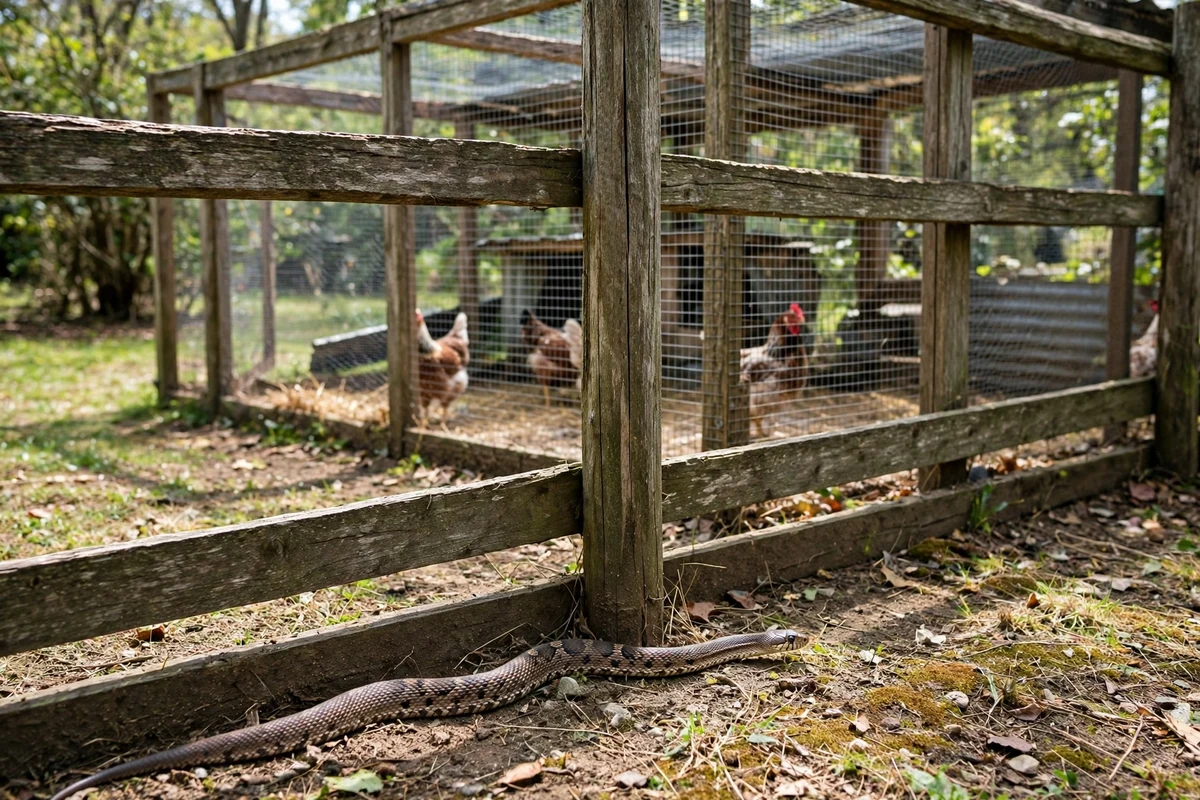
Do mothballs keep snakes away from chickens?
No, mothballs do not keep snakes away from chickens. There is no good evidence that mothballs repel snakes, and the agencies that test pest repellents have found that mothballs do not work as a snake repellent, whatever the label or the folk wisdom says.
A mothball is a small, white ball made from naphthalene or paradichlorobenzene, chemicals that slowly turn from a solid into a gas. They are sold to protect clothes from moths in a closed cupboard, and that is the only use they are registered for. Using them outdoors, in a coop, or as a snake repellent is an off-label use, and it is not legal in many places.
The idea that mothballs repel snakes comes from their strong smell, and from the hope that a strong smell will drive a snake away. Snakes do have a good sense of smell, and they use their tongues to taste the air, but a strong smell does not stop them from hunting, and a hungry snake will cross a line of mothballs to reach eggs or chicks.
The myth persists because it is cheap, it is easy, and it feels like doing something. A keeper who puts mothballs around the coop and then sees no snakes may credit the mothballs, when the real reason is that there were no snakes in the area, or that the coop was already secure. That is a common trap, and it is why this guide is blunt: mothballs do not work, and they are dangerous.
Why mothballs are toxic to chickens
Mothballs are toxic to chickens, because the chemicals in them damage the blood, the liver and the nervous system, and a chicken that eats or breathes them can become seriously ill. Chickens are curious birds, and they will peck at anything small and white on the ground, including a mothball.
Naphthalene, the chemical in older mothballs, damages red blood cells, which are the cells that carry oxygen around the body. A bird that has eaten naphthalene may become weak, stop eating, and pass dark or bloody droppings, and it can die if it eats enough. Paradichlorobenzene, the chemical in most modern mothballs, damages the liver and the nervous system, and it can cause tremors, weakness and breathing problems.
The gas that mothballs give off is also a problem. In a closed coop, the gas builds up, and the birds breathe it all night, which irritates their lungs and eyes and can cause long-term damage. A chicken's lungs are far more sensitive than a person's, and a level of gas that a person barely notices can harm a bird.
The poison does not stop with the birds. Mothball chemicals can pass into eggs, and they can contaminate the soil around the coop, where they persist for a long time. A keeper who uses mothballs is putting their flock, their eggs and their own family at risk, for a repellent that does not work.
Mothballs, eggs and people
Mothballs are a risk to eggs and to people, not just to chickens, because their chemicals can pass into eggs, into soil and into the air, and they are toxic to children and pets. A mothball in a coop is a hazard to everyone who eats the eggs or handles the birds.
Eggs from a flock kept near mothballs can carry traces of the chemicals, because a hen that breathes or eats the chemicals can pass them into her eggs. There is no safe level for a chemical that should not be in food at all, and there is no home test that can tell you whether an egg is clear.
Children are the highest-risk group, because they are more likely to pick up a mothball and put it in their mouth, and their small bodies are more sensitive to the poison. Dogs and cats can also be poisoned by mothballs, and a dog that eats one needs a vet at once. The chemicals are also a fire risk, because naphthalene is flammable.
For all of these reasons, mothballs should never be used in or near a chicken coop, a run, a garden where chickens range, or anywhere that children, pets or food animals can reach them. If you have mothballs in or near your coop now, remove them, wearing gloves, put them in a sealed bag, and dispose of them according to your local hazardous waste rules. Our guide on can you eat eggs from a sick chicken explains when eggs from an unwell flock should not be eaten.
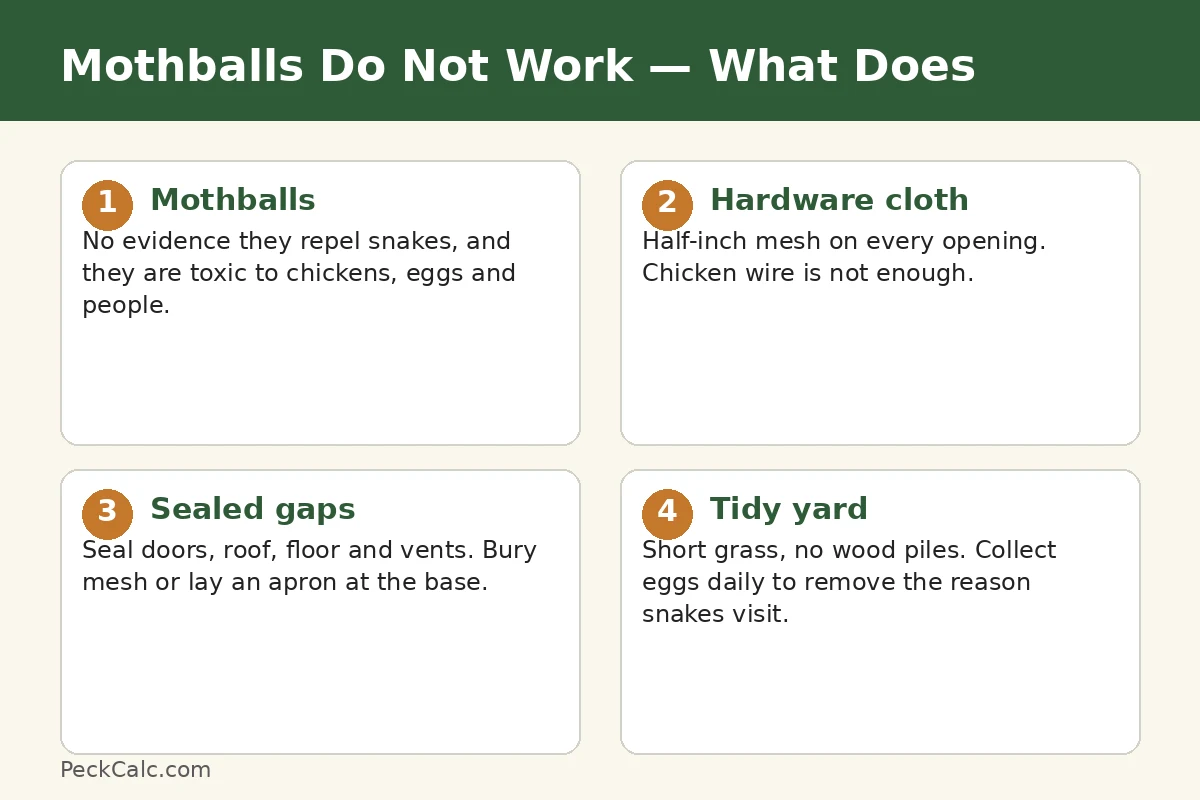
What actually keeps snakes away
What actually keeps snakes away from chickens is a secure coop, fine wire mesh, sealed gaps, and a tidy yard with no cover for snakes to hide in. Snakes come for eggs and chicks, and they get in through gaps, so the answer is to close the gaps, not to scatter chemicals.
Start with the coop. Use hardware cloth, which is a fine welded wire mesh, with openings no larger than half an inch, on every opening, including vents and windows. Chicken wire is not enough, because a snake can pass through its larger holes, and a rat can chew through it. Seal every gap around doors, roofs and floors, and bury the mesh a foot deep around the run, or lay an apron of mesh flat on the ground, so a snake cannot slip under the fence.
Collect eggs often, at least once a day, because eggs are the main reason a snake visits a coop. A nest box full of eggs is an invitation, and a coop with no eggs is much less interesting. Keep the feed in sealed containers, because spilled feed attracts rats, and rats attract snakes.
Clear the yard around the coop. Cut the grass short, remove piles of wood, rock and rubbish, and keep the area around the coop open and tidy, because snakes like cover and they avoid open ground where they can be seen. A snake that has nowhere to hide is a snake that will move on. Our guide on how to protect chickens from snakes explains the full method, and our guide on how to predator proof a chicken run covers the mesh and the gaps in detail.
If a snake is already in the coop
If a snake is already in the coop, stay calm, keep children and pets away, and call a local wildlife rescuer or animal control for help. Do not try to handle the snake yourself, and do not kill it unless it is an immediate danger and you have no other choice.
Most snakes that visit a coop are non-venomous rat snakes, which are after eggs and chicks, not people, but a scared snake can bite, and a venomous snake can kill. Do not reach into a nest box without looking, do not corner a snake, and do not try to catch it with your hands or a stick.
Check the birds after a snake visit. A snake that has eaten eggs will leave the birds alone, but a snake that has attacked a chick or a small bantam may have injured a bird, and a bird that has been squeezed by a constrictor needs a vet even if it looks unhurt. Count the eggs and the chicks, and look for any bird that is missing, injured or in shock.
After the snake is gone, find out how it got in, and fix the gap. A snake that has found food will come back, and the only way to stop it is to close the hole it used. Check the mesh, the doors, the roof and the floor, and look for a gap you missed, because a snake can pass through a hole much smaller than you would expect.
Safe snake deterrents that do work
Safe snake deterrents that work are physical barriers, tidy yards, and removing the food that attracts snakes, not chemicals, smells or gadgets. There is no spray, powder or device that reliably repels snakes, and the money spent on them is better spent on mesh and repairs.
The best deterrent is a secure coop, and the second best is a tidy yard. Keep the grass short, remove cover, store feed sealed, and collect eggs often. A coop with no eggs, no rats and no hiding places is a coop a snake will pass by, because there is nothing in it worth the effort.
Some keepers use a snake-proof fence, which is a fence of fine mesh buried a foot deep and angled outward at the top, and it works well where snakes are a serious problem. Others keep a few guinea fowl, which are noisy birds that alarm at snakes and can drive a small snake away, though they are not a guarantee.
| Method | Works? | Notes |
|---|---|---|
| Mothballs | No, and toxic | Never use in or near a coop |
| Hardware cloth, half-inch mesh | Yes | On every opening, buried or aproned at the base |
| Sealed gaps | Yes | Check doors, roof, floor and vents |
| Collecting eggs daily | Yes | Removes the main reason snakes visit |
| Tidy yard, short grass | Yes | Removes cover snakes hide in |
| Snake repellent sprays and powders | No good evidence | Money better spent on mesh |
If snakes are a serious problem in your area, talk to a local wildlife rescuer or extension office, because they will know which snakes are in your area and what works locally. Our guide on predator proofing chicken coop covers the full range of predators, and snakes are one of the most persistent.
Sources: pest and predator guidance from the poultry pages at the University of Minnesota Extension and poultry.extension.org. Mothballs are registered only for protecting clothes in closed containers; they are not a snake repellent and should never be used in or near a coop.
Related tools and guides
For more on the same topic, see How to Protect Chickens From Snakes and How to Predator Proof a Chicken Run.
Frequently asked questions
Do mothballs keep snakes away from chickens?
No. There is no good evidence that mothballs repel snakes, and they are toxic to chickens, eggs and people. Do not use them in or near a coop. A secure coop with fine mesh, sealed gaps and a tidy yard is what keeps snakes out.
Are mothballs toxic to chickens?
Yes. The chemicals in mothballs damage the blood, the liver and the nervous system, and a chicken that eats one or breathes the gas in a closed coop can become seriously ill. Chickens will peck at small white objects on the ground, including mothballs.
Can mothballs contaminate chicken eggs?
Yes. Mothball chemicals can pass into eggs from a hen that breathes or eats them, and they can contaminate the soil around the coop. There is no safe level for a chemical that should not be in food at all.
What actually keeps snakes out of a chicken coop?
Hardware cloth with openings no larger than half an inch on every opening, sealed gaps, mesh buried or aproned at the base of the run, eggs collected daily, feed stored sealed, and a tidy yard with short grass and no piles of wood or rubbish for snakes to hide in.
What should I do if I find a snake in my coop?
Stay calm, keep children and pets away, and call a local wildlife rescuer or animal control. Do not try to handle the snake yourself. After it is gone, find out how it got in and fix the gap, because a snake that found food will come back.
About the author
John Walker is the founder of PeckCalc and has kept backyard chickens in Dallas, Texas since 2017. He started PeckCalc to give backyard keepers free calculators and guides with every figure traced to a university extension source.