
Do You Need a Permit to Transport Chickens Across State Lines?
 By John Walker · Backyard chicken keeper in Dallas, Texas since 2017
Do you need a permit to transport chickens across state lines? No US state issues one, but that does not mean you can load birds into a car and drive them anywhere. Moving poultry between states is governed by animal health rules, and most states require a health certificate from a vet, proof that the flock is free of certain diseases, and sometimes a permit number from the destination state's animal health office. This guide explains what the rules are, what paperwork you need, and how to check before you travel.
Do you need a permit to transport chickens across state lines?
No US state issues a permit to transport chickens across state lines, but most states require a health certificate, proof of disease testing, and sometimes an entry permit number from the destination state's animal health office. The paperwork is the permit, even if it is not called one.
A health certificate, also called a certificate of veterinary inspection, is a document signed by a licensed vet, stating that the birds were examined, that they appear healthy, and that they meet the destination state's rules. It is usually valid for a short time, often thirty days, and it must travel with the birds.
An entry permit number is a number issued by the destination state's animal health office, and some states require one before birds can enter. It is not a permit to transport in the general sense, but it is a permission to enter that state, and it is the closest thing to a transport permit that exists in poultry law.
The rules exist to stop disease spreading between states. Poultry diseases such as avian influenza and pullorum can devastate a state's poultry industry, and the rules are the fence that keeps them out. That is why the rules are enforced, and why the penalties for breaking them can be serious.
Health certificates and NPIP
Health certificates and NPIP status are the two pieces of paperwork that matter most when you move chickens across state lines. A health certificate proves the birds were examined, and NPIP status proves the flock is tested for certain diseases.
NPIP is the National Poultry Improvement Plan, a voluntary programme run by the United States Department of Agriculture, in which flocks are tested for pullorum, typhoid and other diseases. A flock that is NPIP certified has been tested and found free of those diseases, and many states accept NPIP certification as proof that the birds are safe to enter.
To get a health certificate, a vet must examine the birds, usually within a few days of travel, and sign the certificate. The vet will check the birds for signs of illness, and will record the NPIP status, the testing history, and the destination. The certificate must travel with the birds, and a copy should be kept by the seller and the buyer.
If your flock is not NPIP certified, you can still move birds, but the destination state may require testing first, and the process will take longer. Joining NPIP is worth considering if you sell birds across state lines often, because it makes every move simpler. Contact your state animal health office or your state NPIP office to find out how to join.
What the destination state requires
What the destination state requires varies, because each state sets its own entry rules for poultry, and the rules change with the disease situation. Some states require only a health certificate, others require testing for avian influenza, and others require an entry permit number as well.
The only reliable way to find out is to contact the destination state's animal health office, or its department of agriculture, before you travel. Ask what is required for the number and type of birds you are moving, whether an entry permit number is needed, and what testing is required. Do this in writing, so you have a record of what was said.
Avian influenza is the disease most likely to change the rules. When avian influenza is found in a state, neighbouring states often tighten their entry rules, and they may ban birds from the affected state entirely. Check the disease situation in both the origin state and the destination state before you travel, because a ban can appear with little warning.
State rules can also change suddenly for reasons that have nothing to do with disease. In Missouri, a 2024 law (HB 2062) barred HOAs from banning up to six hens on lots of at least two-tenths of an acre, but in October 2025 Cole County Circuit Judge Brian Stumpe struck the law down as unconstitutional, so HOA bans are enforceable again; the state has said it plans to appeal. In Michigan, House Bills 4049 and 4050 (January 2025) would allow up to five hens per quarter acre, maximum 25, but remain pending in committee. Always check the current rules before you travel.
Exhibition birds, which are birds taken to a poultry show, have their own rules, and they are often stricter than the rules for a private move, because a show brings birds from many flocks together. If you are taking birds to a show in another state, check the show's rules as well as the state's rules, because the show may require testing that the state does not.
Moving chickens: welfare and the law
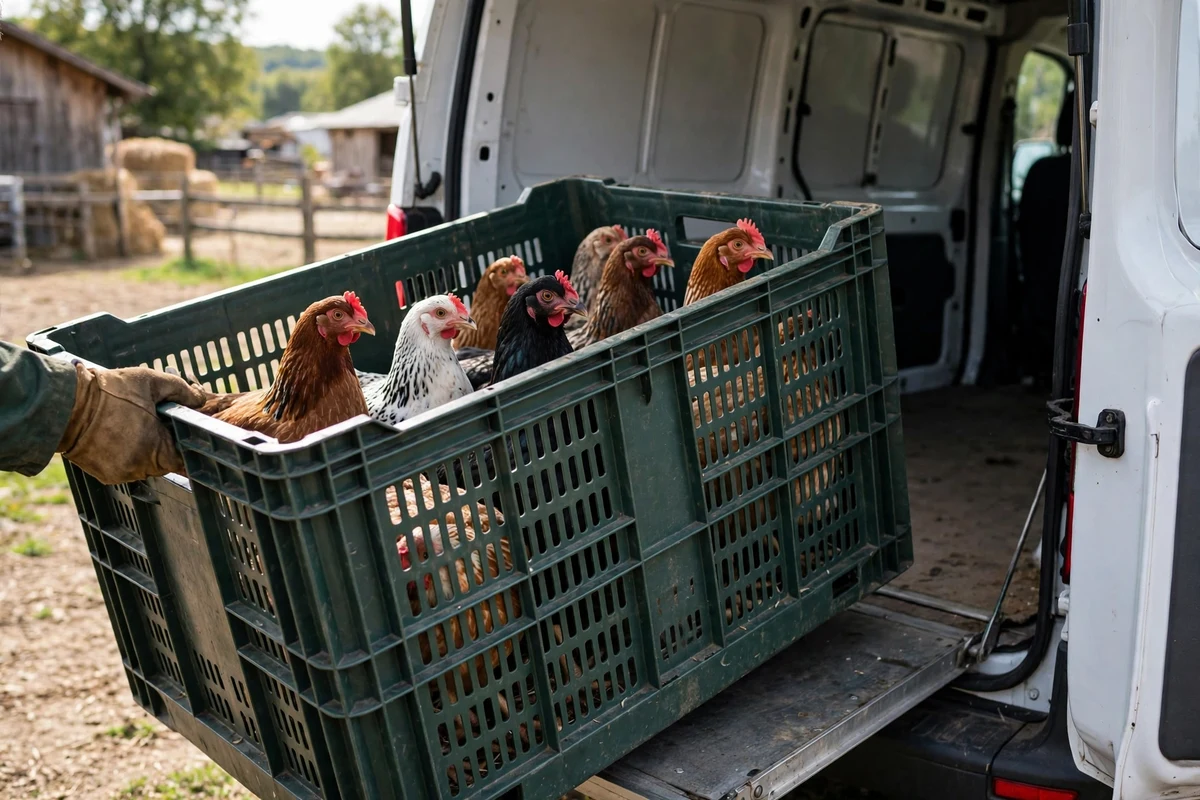
Moving chickens across state lines is governed by animal welfare rules as well as health rules, and the birds must be transported in a way that keeps them safe, fed, watered and ventilated. A bird that arrives stressed, dehydrated or injured is a bird that will fall ill, and a vet will notice.
Use a ventilated crate that is large enough for the birds to stand and turn around, but not so large that they are thrown about. Line it with clean bedding, give the birds water before the journey, and do not feed them a large meal just before travel, because a full crop can cause problems on a bumpy road. In hot weather, travel at night or in the early morning, and stop to check the birds often.
Keep the paperwork with the birds, not in a separate bag, because an inspector who stops you will want to see it at once. Keep a copy for yourself, and keep the seller's and the buyer's details with the birds as well, so the chain of ownership is clear.
Our guide on how to transport chickens in winter explains the practical side of moving birds in cold weather, and our guide on avian influenza in backyard chickens explains the disease that most often changes the entry rules.
What happens if you move birds without paperwork
Moving chickens across state lines without the required paperwork can lead to the birds being turned back, quarantined, or destroyed, and the keeper being fined. The consequences are serious, because the rules exist to protect whole industries, not just one flock.
If you are stopped and you cannot produce a health certificate, the inspector can refuse entry, and you will have to turn around and take the birds home. If the birds are already in the destination state, they can be quarantined, which means kept apart from other birds until they are tested, and the cost of the quarantine falls on you.
In the worst case, if the birds are found to carry a serious disease, they can be destroyed, and the keeper can be fined and banned from moving birds again. That is rare, but it happens, and it is the reason the rules are taken seriously by everyone in the poultry world.
The honest answer is that the paperwork is not hard, once you know what is needed, and it is far easier than dealing with the consequences of moving birds without it. A phone call to the destination state's animal health office, a vet visit for a health certificate, and a check of the NPIP status will cover most moves, and it will protect your birds and your reputation.
Before you travel: a checklist
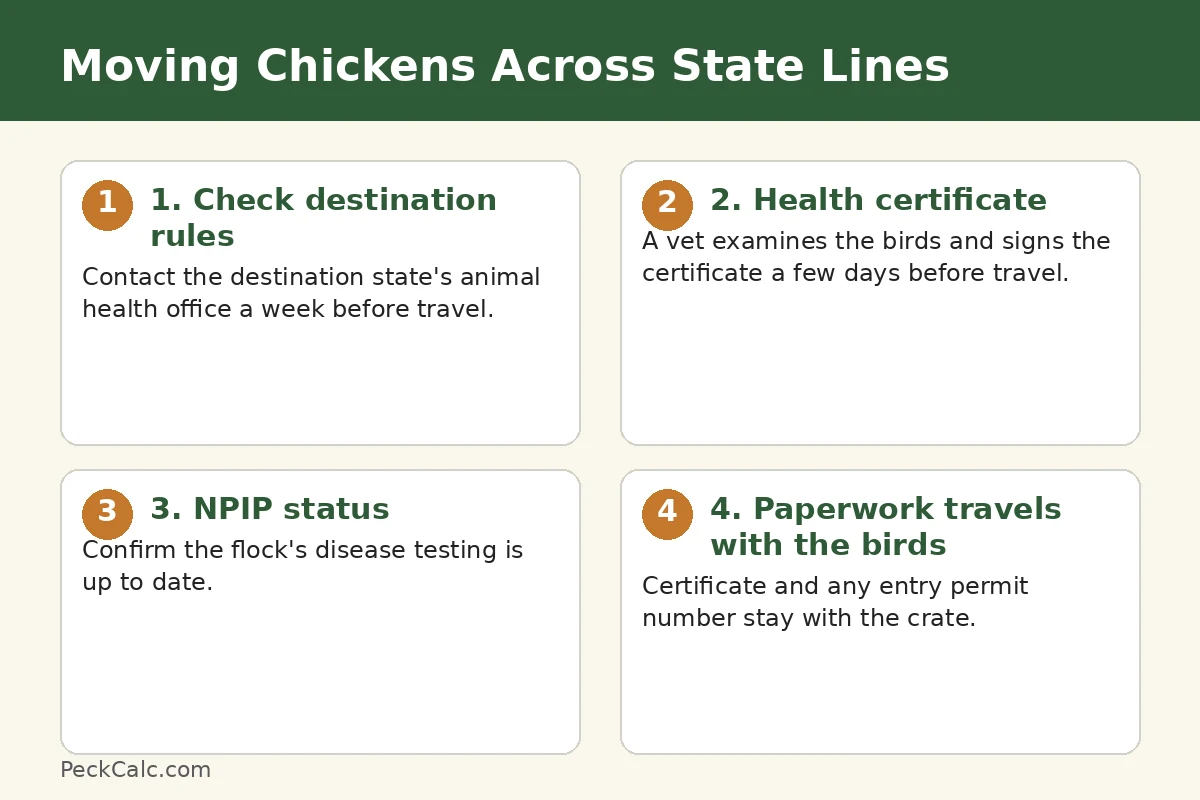
Before you travel with chickens across state lines, check the destination state's rules, get a health certificate from a vet, confirm the NPIP status, and prepare the birds and the crate. A short checklist, done a week before travel, will catch most problems while there is still time to fix them.
Start a week before travel by contacting the destination state's animal health office and asking what is required. Then book a vet visit for a health certificate, and confirm that the birds are healthy and that the flock's testing is up to date. If an entry permit number is needed, apply for it early, because it can take a few days to arrive.
Prepare the birds the day before travel: check them for illness, give them clean water, and keep them in a clean pen overnight. Prepare the crate with clean bedding, and check that it is ventilated, secure, and large enough for the birds. Pack the paperwork with the birds, and keep a copy for yourself.
| Step | When | What to do |
|---|---|---|
| Check destination rules | A week before travel | Contact the destination state's animal health office |
| Health certificate | A few days before travel | Vet examines the birds and signs the certificate |
| NPIP status | Before the vet visit | Confirm the flock's testing is up to date |
| Entry permit number | As soon as you know it is needed | Apply to the destination state |
| Prepare birds and crate | The day before travel | Clean bedding, ventilated crate, water before travel |
| Paperwork with the birds | On the day | Certificate and permit number travel with the birds |
Our guide on backyard chicken laws explains the rules for keeping chickens in the first place, and our guide on do I need a permit to keep chickens explains the local permits that apply to keeping birds at home.
Sources: animal health and poultry movement guidance from the United States Department of Agriculture and the poultry pages at poultry.extension.org. Entry rules vary by state and change with the disease situation; always check with the destination state's animal health office before travelling.
Related tools and guides
For more on the same topic, see Backyard Chicken Laws and Do I Need a Permit to Keep Chickens?.
Frequently asked questions
Do you need a permit to transport chickens across state lines?
No state issues a general transport permit, but most states require a health certificate from a vet, proof of disease testing, and sometimes an entry permit number from the destination state's animal health office. Check with the destination state before you travel.
What is a health certificate for chickens?
A certificate of veterinary inspection, signed by a licensed vet, stating that the birds were examined, appear healthy, and meet the destination state's rules. It is usually valid for a short time, often thirty days, and it must travel with the birds.
What is NPIP and why does it matter for moving chickens?
NPIP is the National Poultry Improvement Plan, a USDA programme in which flocks are tested for pullorum, typhoid and other diseases. Many states accept NPIP certification as proof that birds are safe to enter, and it makes moving birds across state lines much simpler.
Can I move chickens without paperwork?
You can be turned back at the state line, have the birds quarantined, or in the worst case have them destroyed and be fined. The paperwork is not hard once you know what is needed, and it is far easier than dealing with the consequences of moving birds without it.
Do the rules change when there is avian influenza?
Yes. When avian influenza is found in a state, neighbouring states often tighten their entry rules and may ban birds from the affected state entirely. Check the disease situation in both states before you travel, because a ban can appear with little warning.
About the author
John Walker is the founder of PeckCalc and has kept backyard chickens in Dallas, Texas since 2017. He started PeckCalc to give backyard keepers free calculators and guides with every figure traced to a university extension source.