
Does the Egg Float Test Work
 By John Walker · Backyard chicken keeper in Dallas, Texas since 2017
Yes, the egg float test works, but only for measuring age, not for safety. The test works because an egg loses moisture through its shell over time, the air cell inside the egg grows, and the egg becomes more buoyant. A fresh egg lies flat on the bottom of a bowl of water, an egg a week or two old stands on its end, and an old egg floats. That is a reliable guide to how old the egg is, but it does not tell you whether the egg is safe to eat, because an old egg can still be safe, and a fresh egg can still be bad. This guide explains what the test measures, how to do it properly, and what to check instead when safety is the question.
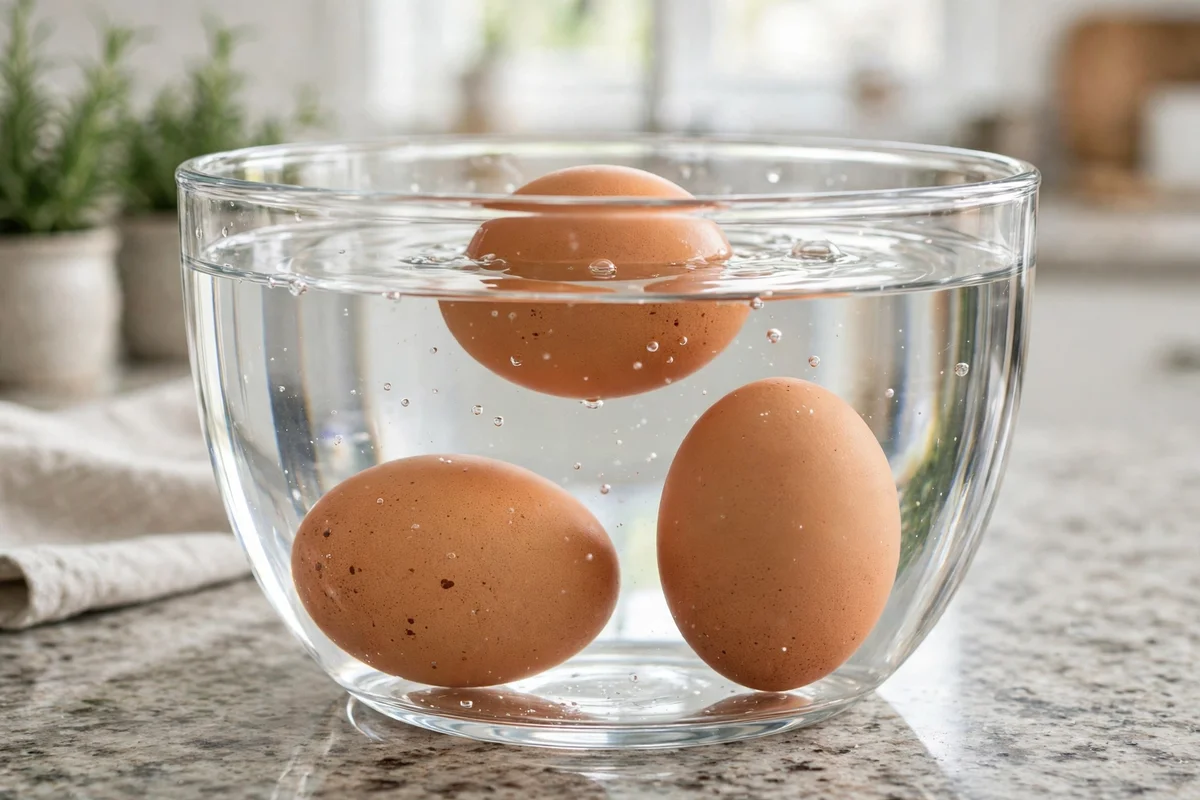
Does the egg float test work?
Yes, the egg float test works as a test of age, and the science behind it is straightforward. An eggshell is porous, with thousands of tiny pores that let moisture escape and air enter. As the egg ages, it loses water through the pores, the contents shrink slightly, and the air cell at the blunt end grows larger.
The larger the air cell, the more buoyant the egg becomes, and the more it tilts or floats in water. That is why the test gives a consistent result: it is measuring the air cell, which grows steadily with age.
The test is reliable enough to be useful, but it is not precise. The rate at which an egg loses moisture depends on storage: an egg kept warm loses moisture faster than an egg kept cold, and an egg with a thin shell loses moisture faster than an egg with a thick shell. Two eggs laid on the same day can float differently if one was kept in the fridge and the other on the counter. The test gives a rough guide to age, not an exact date, and it should be used alongside other checks rather than on its own.
The most important limit is that the test does not measure safety. A floating egg is old, but it may still be safe to eat if it has been stored properly and it smells normal when cracked. A fresh egg that lies flat can still be bad if it was cracked, dirty, or contaminated. The float test tells you how old an egg is, and age is useful information, but it is not a safety test, and it should never be used as the only check.
How to do the float test properly
Fill a bowl or a tall glass with cold water, deep enough to cover the egg completely, and gently lower the egg into the water. Do not drop it, because a cracked egg will sink or float unpredictably, and a crack is a reason to discard the egg anyway.
Watch how the egg sits: a fresh egg lies flat on the bottom, an egg about a week old tilts slightly, an egg two to three weeks old stands upright on its end, and an old egg floats to the surface. The angle of the tilt is a rough guide to age, and the float is a sign that the egg is several weeks old.
Use cold water, because warm water can affect the result slightly, and use a container deep enough that a floating egg has room to rise. Test one egg at a time, and dry the eggs after testing, because a wet egg left damp can pick up bacteria through the pores. Do not test eggs that you plan to store for a long time, because wetting the shell removes some of the bloom and shortens the storage life. The float test is best used on eggs you plan to use soon, when you are unsure how old they are.
The test is most useful when you have a basket of undated eggs and you need to sort them. Float them one by one, use the floating eggs first or discard them, and keep the eggs that lie flat for later. Dating your eggs in pencil when you collect them is a better system, because it gives you the exact age, but the float test is a useful backup when the dates are missing. Our guide on how to tell if eggs are fresh covers the other freshness checks that work alongside the float test.
What the float test cannot tell you
The float test cannot tell you whether an egg is safe to eat, and that is the point most often missed. Safety depends on whether bacteria have entered the egg and grown, and that depends on the shell, the bloom, the storage, and the handling, not on the size of the air cell.
An old egg that has been kept clean and cold can be safe, while a fresh egg that was cracked or laid in a dirty nest box can be unsafe. The float test measures none of that, and a floating egg that smells normal when cracked is usually safe, while a fresh egg that smells bad should be discarded.
The test also cannot tell you whether an egg is fertile, whether it has a blood spot, or whether it is cracked inside the shell. A blood spot does not affect buoyancy, a fertile egg floats the same as an infertile egg, and a hairline crack may not change the result at all. The test is a single measurement, the size of the air cell, and it should not be asked to answer questions it was never designed for. For those questions, crack the egg into a bowl and look at it, because the crack test and the smell test will tell you far more than the float test ever can.
There is one more limit worth knowing: the test does not work well on very fresh eggs that have been washed, because washing removes the bloom and lets water into the pores, which can change the buoyancy. A washed egg may float or sink unpredictably, and the result should not be trusted. The float test is most reliable on unwashed eggs with the bloom intact, which is another reason to avoid washing eggs unless they are dirty.
Float test results: what each position means
An egg that lies flat on the bottom is fresh, usually less than a week old, and it is the best egg in the basket. Use it for any recipe, including meringues and poaching, because the white will be firm and the yolk will sit high.
An egg that tilts slightly, with the blunt end rising, is about one to two weeks old, and it is still good for most cooking, although the white will be a little thinner than a fresh egg.
An egg that stands upright on its end is two to three weeks old, and it is still safe to eat if it smells normal, but it is best used for scrambling and baking rather than for poaching or frying, because the white will spread in the pan. An egg that floats is several weeks old, and it should be cracked into a bowl and checked by smell before use. If it smells normal, it is probably safe, but it is old, and it should be used promptly or discarded. If it smells bad, discard it, no matter what the float test said.
The table below sums up the positions and what they mean, but remember that these are rough guides, not exact dates. Storage, shell thickness, and temperature all affect the result, and two eggs laid on the same day can float differently. Use the float test as a sorting tool, not as a calendar.
| Position in water | Rough age | What to do |
|---|---|---|
| Lies flat on the bottom | Less than 1 week | Fresh, use for any recipe |
| Tilts slightly | 1 to 2 weeks | Good, use for most cooking |
| Stands upright on end | 2 to 3 weeks | Older, best for scrambling and baking |
| Floats at the surface | Several weeks | Crack into a bowl, check by smell, use promptly or discard |
Better ways to check an egg
The crack test is the best single check for an egg, and it tells you more than the float test. Crack the egg onto a flat plate and look at the white and the yolk. A fresh egg has a thick white that stands tall around a high, round yolk.
An older egg has a thin white that spreads flat, and a yolk that sits low and flattens. The crack test shows the condition of the egg directly, rather than inferring it from buoyancy, and it is the check that professional graders rely on most.
The smell test is the best check for safety. Crack the egg into a bowl and smell it before adding it to a recipe. A fresh egg has almost no smell, and a bad egg has a strong, unmistakable smell of sulfur or rot. Trust your nose: if an egg smells bad, discard it, no matter how good it looked in the water. The smell test catches the eggs that the float test misses, and it is the check that matters most when safety is the question.
Candling is a third check, and it is useful if you sell eggs or want to check for blood spots and meat spots before cracking. Hold the egg against a bright light in a dark room and look for shadows in the white and yolk. A blood spot shows as a dark shadow on the yolk, and a meat spot shows as a fleck in the white. Candling takes practice, but it is a useful skill, and our guide on how to candle chicken eggs explains the method.
When to discard an egg
Discard an egg if it smells bad when cracked, if the white is pink, green, or iridescent, if the yolk is broken and mixed with the white in a way that looks wrong, or if the shell is cracked and the contents have leaked.
Discard an egg that has been left out at room temperature for more than two hours after being washed or refrigerated, because the safety margin has passed. And discard an egg that has been in the fridge for more than five weeks, because it is past the point where it can be trusted, even if it looks and smells normal.
Do not discard an egg just because it floats. A floating egg is old, but it may still be safe, and discarding it without checking wastes food. Crack it into a bowl, check the smell, and decide from there. If it smells normal and the white and yolk look normal, it is safe to cook and eat, although it is best used for baking rather than for a fried egg. If it smells bad, discard it, and do not taste it to check, because tasting a bad egg is not a safe test.
The habit that saves the most eggs is dating them. Write the laying date on the shell in pencil when you collect, use the oldest first, and keep the eggs in the fridge in their carton. A dated egg is an egg you can trust, and a basket of dated eggs rarely needs the float test at all. The egg production calculator can help you work out how many eggs your flock produces, so you can plan storage and use around the real numbers. For the full storage method, see our guide on how to store fresh eggs.
Sources: USDA Food Safety and Inspection Service, shell eggs from farm to table and poultry.extension.org.
Related tools and guides
For more on the same topic, see How to Tell If Eggs Are Fresh.
Frequently asked questions
Does the egg float test work?
Yes, for age, not for safety. The test measures the air cell, which grows as the egg loses moisture through the shell, so a fresh egg lies flat, an older egg stands on end, and an old egg floats. It tells you how old an egg is, not whether it is safe to eat.
Is a floating egg bad?
Not necessarily. A floating egg is old, but it may still be safe if it has been stored properly and smells normal when cracked. Crack it into a bowl, check the smell, and decide from there. If it smells bad, discard it. Do not throw away a floating egg without checking it first.
Can a fresh egg fail the float test?
A fresh egg can float if it was washed, because washing removes the bloom and lets water into the pores, which changes the buoyancy. A fresh egg with a thin shell can also tilt sooner than a thick shelled egg. The test is most reliable on unwashed eggs with the bloom intact.
What is the best way to check if an egg is fresh?
Crack it onto a flat plate and look at the white and yolk. A fresh egg has a thick white that stands tall around a high round yolk, while an older egg has a thin white that spreads flat. Combine that with the smell test, which is the best check for safety.
Should I throw away eggs that stand on end in water?
No. An egg standing on end is two to three weeks old and still safe if it smells normal. Use it for scrambling and baking rather than for poaching or frying, because the white will be thinner. Only discard an egg that smells bad or looks wrong when cracked.
About the author
John Walker is the founder of PeckCalc and has kept backyard chickens in Dallas, Texas since 2017. He started PeckCalc to give backyard keepers free calculators and guides with every figure traced to a university extension source.