
Hawk Protection for Chickens: Free-Range Safety
 By John Walker · Backyard chicken keeper in Dallas, Texas since 2017
Hawk protection for chickens starts with one hard fact: a covered run is the only near-guarantee, and everything else reduces risk rather than removing it. Overhead line grids, nearby cover, a guardian rooster, and smart timing together make free-ranging far safer, but a hawk can still strike a bird that is caught in the open.
How do hawks hunt backyard chickens?
Hawks hunt by sight from above, circling high on thermals or perching on a fence, tree or roof, then dropping fast onto a bird that is out in the open. The strike is over in seconds, and a hawk that catches a hen will usually kill it on the spot or carry a smaller bird away.
Larger hens are often eaten where they fall.
Most backyard hawk attacks happen in daylight, especially late morning and early afternoon, when hawks are actively hunting and thermals give them lift. A flock that free-ranges all day without cover is exposed during exactly the hours hawks prefer, and a hawk that succeeds once will return to the same yard, because it now knows where food is.
Hawks are not the only aerial threat. Owls hunt the same way at night, and eagles take larger birds where they live. The defences below work against all three, but the legal rule is the same for each: hawks, owls and eagles are federally protected under the Migratory Bird Treaty Act in the United States, so all protection must be non-lethal. You may scare them, block them and hide your birds from them, but you may not trap, shoot or harm them.
Is a covered run the only reliable hawk protection?
A covered run is the only near-guarantee against hawks, because it puts a physical barrier between the bird of prey and your birds. A roof of half-inch hardware cloth or solid panels stops a diving hawk completely, and it works whether or not anyone is home to watch the flock.
If you lose birds to hawks regularly, a covered run is the fix to build first.
The run does not need to be small or ugly. A tall walk-in run with a mesh roof gives birds room to scratch, dust bathe and forage while staying safe, and it can include bushes, logs and perches inside so the birds still behave naturally. Size it with the chicken run size calculator so the covered area is generous enough that the flock actually uses it instead of crowding at the gate.
A covered run also protects against owls at night and climbing raccoons, which is why it is the centrepiece of our guide on predator proofing a chicken coop. If a fully covered run is not possible, the overhead grids and cover described below are the next best option, but they should be understood as risk reduction, not a guarantee.
How do overhead line grids stop hawks?
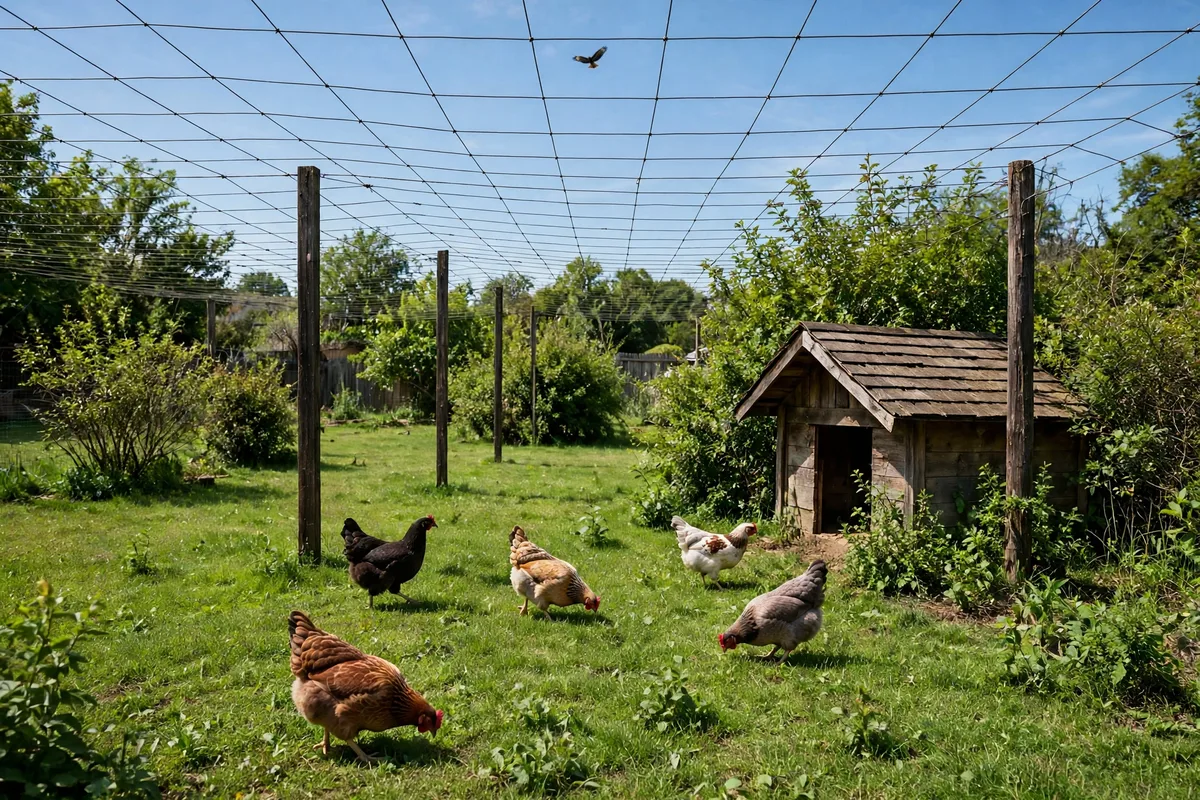
An overhead line grid is a checkerboard of wires, cords or fishing line strung 3 to 6 feet apart. A hawk sees the lines late and will break off rather than risk tangling its wings. The grid does not need to be strong enough to hold a hawk — it needs to be visible enough to make the hawk hesitate.
String the lines between posts, trees or the coop roof, keeping them taut so they do not sag onto the birds. Use dark cord or wire rather than clear fishing line, because the hawk needs to see the grid to avoid it, and clear line can tangle birds of prey that do try to pass. Space the lines 3 feet apart over the areas the flock uses most, and up to 6 feet apart over wider ground where a tighter grid is impractical.
Overhead lines are a compromise, not a replacement for a roof. A determined hawk can still drop through a wide grid, and a hawk that learns the layout may find a gap. Check the lines monthly for sagging and breaks, and tighten or replace them after storms. Combine the grid with ground cover, described next, so a bird that is caught out has somewhere to run.
What cover do chickens need to escape a hawk?
Chickens escape hawks by running for cover, so cover must be within a few seconds of every spot the flock uses. A hen that has to cross thirty feet of open lawn to reach a bush will not make it; a hen that has to cross six feet probably will.
Scatter cover across the ranging area rather than putting it all in one corner.
Good cover includes bushes, low evergreen shrubs, pallets propped on blocks, wooden A-frames, upturned crates, and the coop itself with its pop door open. Aim for cover that a hen can duck under but a hawk cannot follow into, and place it near feeders and dust-bathing spots, because those are the places birds linger in the open. A simple pallet on four concrete blocks makes an instant hidey-hole that costs almost nothing.
Cover also helps against ground predators and heat. Bushes give shade in summer, break up sightlines for dogs and foxes, and give low-ranking birds somewhere to escape a bully. If your yard is mostly open lawn, plant fast-growing shrubs along the ranging area and add temporary shelters this week rather than waiting for the shrubs to grow. Our guide on how to keep chickens cool in summer covers shade in more detail.
Can a rooster protect hens from hawks?
A guardian rooster is a real layer of hawk protection, because a good rooster watches the sky while the hens feed, gives a loud alarm call at the first sign of a hawk, and herds the hens toward cover. the alarm call alone gives hens the seconds they need to run.
The rooster is an alarm, not a bodyguard. A rooster will sometimes attack a hawk, and some do, but a hawk is a far more dangerous fighter, and a rooster that engages one can be killed. Judge a rooster by his alarm call and his herding, not by whether he fights. A rooster that calls loudly and gets the flock under cover has done his job.
Not every rooster is a good guardian, and not every flock can have one. Some roosters are aggressive toward people, some are lazy watchers, and some councils ban roosters outright. Check the rules in our guide on backyard chicken laws before getting one, and read our guide on how to handle an aggressive rooster if yours turns on people. One rooster per 8 to 10 hens is the usual balance.
When are hawks most dangerous, and how should timing change?
Hawks hunt hardest in midday, roughly late morning through early afternoon, when thermals are strongest and their prey is active. Early morning and late evening are quieter. A flock that ranges only in the early morning and late afternoon faces less hawk pressure than one that is out all day.
Use that pattern. Let the flock out after the morning hawk peak has passed, or range them early and bring them into the covered run for the middle of the day. If you work away from home, a covered run for the midday hours and free-ranging when you are home to watch is a practical compromise that keeps losses low without keeping the birds locked up all day.
Season matters too. Hawk pressure often rises in autumn, when young hawks are learning to hunt and migrating hawks pass through, and in winter, when wild prey is scarce. If you notice more hawks circling, tighten the routine for a few weeks: shorter ranging sessions, more cover, and the flock in the covered run on days when a hawk is visibly working the area.
What is a hawk drill, and how do you teach recall?
A hawk drill is a trained recall: the flock learns that a particular call or sound means run to the coop. Start by calling the birds with a treat at the same sound. Once they come reliably, use the same sound when you spot a hawk, and toss treats inside the coop so the birds run in.
Practise the drill when there is no hawk around, so the birds learn the route without panic. After a few weeks most birds will run for the coop at the sound alone, and the habit can save birds when a real hawk appears. Keep the routine short and always reward the birds for coming, so the recall stays strong.
Recall is a backup, not a plan. It depends on you being there to see the hawk and make the call, and a hawk can strike before you notice it. Use recall alongside cover and grids, not instead of them, and never rely on it as the only defence for a flock that ranges while you are away.
What should you do after a hawk attack?
After a hawk attack, keep the flock in the covered run for several days. Use the time to add cover, tighten the overhead grid, and work out where the bird was caught: if it was in the open far from cover, that spot needs a shelter before the flock ranges there again.
Check surviving birds for shock and wounds. A bird that was grabbed but escaped may have puncture wounds that need cleaning, and a bird that saw the attack may hide and refuse to eat for a day. Isolate an injured bird, clean wounds with saline, and call a veterinarian if a wound is deep or the bird is lethargic. The chicken first aid kit guide lists what to keep on hand for exactly this situation.
Do not try to trap, shoot or poison the hawk. Hawks, owls and eagles are federally protected under the Migratory Bird Treaty Act, and harming one carries serious legal consequences. Scare tactics are legal: shouting, waving, a garden hose, or a loud noise will drive a hawk off, and a hawk that is repeatedly disturbed will often move on to easier hunting ground. Report a hawk that is unusually bold around people to your local wildlife office rather than dealing with it yourself.
Sources: the poultry and wildlife guidance at poultry.extension.org and the University of Minnesota Extension poultry pages.
Related tools and guides
For more on the same topic, see Predator Proof Chicken Coop and Chicken Run Size Calculator.
Frequently asked questions
What is the best hawk protection for chickens?
A covered run is the best hawk protection for chickens, because a roof of hardware cloth or solid panels physically stops a diving hawk. Overhead line grids, nearby cover, a guardian rooster and smart timing reduce risk, but only a covered run is a near-guarantee.
How far apart should overhead hawk lines be?
Overhead hawk lines should be 3 to 6 feet apart in a checkerboard over the ranging area, tighter at 3 feet where the flock feeds and dust bathes, and up to 6 feet apart over wider ground. The lines must be visible to the hawk, so use dark cord or wire, not clear line.
Can a rooster protect chickens from hawks?
A rooster helps by watching the sky, giving a loud alarm call and herding hens to cover, which often cuts losses sharply. He is an alarm, not a bodyguard: a hawk is a far more dangerous fighter, and a rooster that attacks one can be killed.
When are hawks most dangerous to chickens?
Hawks are most dangerous in late morning through early afternoon, when thermals are strongest and hawks hunt hardest. Early morning and late evening are quieter, and pressure often rises in autumn and winter when young hawks are learning and wild prey is scarce.
Is it legal to kill a hawk that attacks chickens?
No, hawks, owls and eagles are federally protected under the Migratory Bird Treaty Act in the United States, so only non-lethal protection is allowed. You may scare them off, block them with covers and grids, and hide your birds, but you may not trap, shoot or harm them.
About the author
John Walker is the founder of PeckCalc and has kept backyard chickens in Dallas, Texas since 2017. He started PeckCalc to give backyard keepers free calculators and guides with every figure traced to a university extension source.