
How Far Should a Chicken Coop Be from the Property Line?
 By John Walker · Backyard chicken keeper in Dallas, Texas since 2017
There is no single national answer to how far a chicken coop should be from the property line, because the distance is set by your city or county, not by a federal rule. Typical setbacks in US towns and suburbs run from 10 feet to 50 feet from the property line, with 25 feet a common figure — but some places require much more, and some require almost nothing. The number that matters is the one in your local code, and this guide explains how setbacks work, how to measure them, and how to find your number before you build.
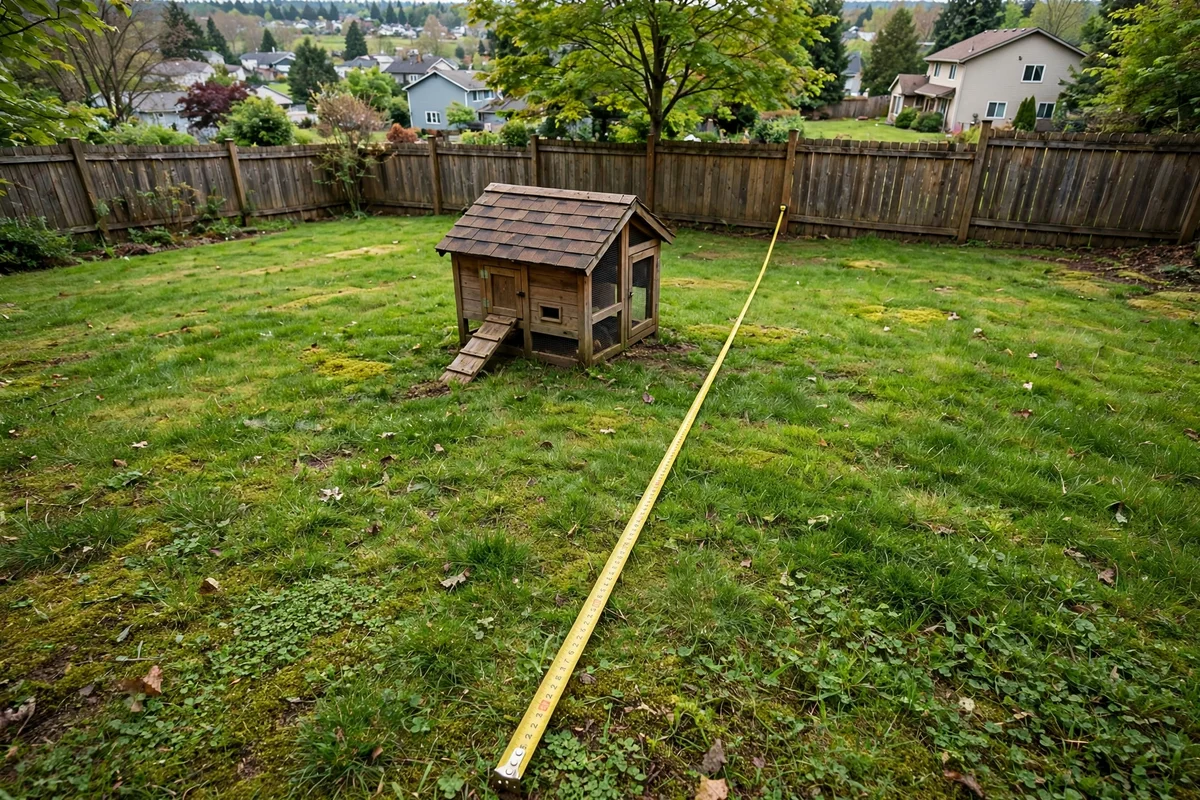
How far should a chicken coop be from the property line?
How far a chicken coop should be from the property line depends on your local code, and US setbacks run from 10 feet to 50 feet, with 25 feet a figure for coops in suburban areas. Some cities require only 10 feet, some require 50 feet or more, and some measure from the neighbour’s house rather than the property line.
There is no national standard, and a figure from another town tells you nothing about your own.
The setback exists for the neighbours’ benefit: it keeps noise, smell and flies away from the boundary, and it gives the keeper room to manage the coop without affecting the property next door. That is why the setback is usually larger for a coop than for a garden shed, and why it is often larger still for the run. A coop that is legal at 10 feet in one town can be a violation at 25 feet in the next, so the first step is always to find your own number.
Do not build first and check later. A coop that is in the wrong place can be ordered to move, and moving a coop is expensive and disruptive. Check the code, measure the ground, and choose the spot before you buy timber. Our guide on backyard chicken laws covers the wider legal picture, and the guide on whether you need a permit to keep chickens covers the permit question that usually goes with the setback.
How setbacks work: coop, run and house
Setbacks usually apply to the coop, the run, or both, and the rules are often different for each. In many codes, the coop — the enclosed structure where the birds sleep — has one setback, and the run — the fenced area where they spend the day — has another, often larger one.
Some codes treat the coop and run as a single structure and apply one setback to both. Read your code carefully to find out which parts it covers.
Some codes also set a distance from the neighbour’s dwelling, not just from the property line. A common pattern is a setback of 25 feet from the property line and 50 feet from any neighbouring house, or a setback that is whichever is greater. That matters on a small lot, where the neighbour’s house may be closer to your coop than the property line is. Measure both distances, and comply with the stricter one.
Other rules can affect the placement too. Some codes limit the coop to the rear yard only, ban coops in the front yard, or require the coop to be behind the house. Some homeowners’ associations have their own rules that are stricter than the city code, and the association’s rules apply as well as the city’s. Check both before you build.
Typical setback ranges in the US
Typical setback ranges in the US fall into three bands. In dense urban areas and inner suburbs, setbacks are often 10 to 25 feet from the property line, because lots are small and a larger setback would make keeping chickens impossible.
In typical suburbs, setbacks of 25 to 50 feet are common. In rural and semi-rural areas, setbacks are often 50 to 100 feet, or there is no setback at all because the lots are large enough that the distance takes care of itself.
Those are ranges, not rules, and the variation is wide. A city that allows chickens may set a 10-foot setback for a coop holding six hens, while the neighbouring city sets 50 feet for the same flock. A county may have no setback for the coop but a 100-foot setback from a well or a waterway. The only way to know your number is to read your own code or to call your planning department and ask.
Be careful with online summaries. A website that lists the setback for your city may be out of date, may be describing a different zone, or may be wrong. The code itself, or a direct answer from the planning department, is the only reliable source. If the planning department gives you an answer by phone, ask for it in writing or note the date, the name of the person you spoke to, and the section of the code they cited.
| Area type | Typical coop setback range | Notes |
|---|---|---|
| Dense urban / inner suburb | 10 to 25 feet | Lots are small; larger setbacks would ban chickens outright |
| Typical suburb | 25 to 50 feet | Most common band; often measured from the property line |
| Semi-rural / large lots | 50 to 100 feet | Sometimes no setback, because lots are large |
| From a neighbour’s house | Often 50 feet or more | Sometimes the stricter rule; measure both |
| From a well or waterway | Often 50 to 100 feet | Separate rule in many codes; check it too |
How to measure the setback
Measure the setback from the property line to the nearest point of the coop or run, in a straight line, at ground level. The property line is the legal boundary of your lot, not the fence — a fence can be inside the boundary, and a hedge can be on either side of it.
If you do not know where your property line is, check your survey, your deed, or the survey markers at the corners of your lot. A fence that is a foot inside the line gives you a foot less than you think.
Use a long tape measure, not a pacing estimate. Walk the line from the boundary to the nearest corner of the coop, and measure the shortest distance — the perpendicular distance, not the distance along a diagonal. If the coop is not square to the boundary, measure from the closest point, because that is the distance the code cares about. Write the measurement down, and take a photo of the tape in place.
Measure twice: once when you choose the spot, and once after the coop is built, to confirm it is where you planned it. A coop that drifts a foot during construction can end up inside the setback, and a foot is enough for a complaint. If the measurement is close to the limit, give yourself a margin — a foot or two extra is cheap insurance against a survey dispute.
What if your yard is too small for the setback?
If your yard is too small for the setback, you have three options: a smaller coop in a compliant spot, a variance, or no chickens. A smaller coop may fit where a large coop does not, and our guide on where to put a chicken coop in your yard covers how to choose the spot.
Use the Chicken Coop Size Calculator to work out the smallest coop that fits your flock, and see if it fits the compliant area.
A variance is a formal exception to the setback, granted by the city or county, usually after a hearing where the neighbours can object. Variances are sometimes granted for a small encroachment — a coop that is 20 feet from the line where 25 is required — and rarely granted for a large one. The process takes weeks or months, costs a fee, and succeeds only if you can show a good reason and the neighbours do not object. It is a real option, but it is not a quick one.
The third option is to accept the limit. A yard that cannot fit a legal coop cannot have chickens, and keeping them anyway risks a complaint, a fine, and an order to remove the birds. That is a worse outcome than not keeping chickens at all, and it is unfair to the birds, who end up being rehomed in a hurry. Check the setback before you buy the birds, not after.
Setbacks, neighbours and complaints
Setbacks exist to protect neighbours, and a coop that complies with the setback is a coop that is much less likely to draw a complaint. But compliance with the setback does not guarantee no complaints: a coop that is legal but smelly, noisy or full of flies will still draw one.
Keep the coop clean, manage the smell, and keep the flock quiet, and the setback will do its job. Our guides on how to keep a chicken coop from smelling and how to stop a rooster crowing cover the two most common complaint triggers.
Talk to your neighbours before you build. A neighbour who knows the coop is coming, who has seen the spot you chose, and who has been offered eggs is a neighbour who is far less likely to complain than one who discovers a coop against the fence one morning. A conversation costs nothing, and it is the best complaint prevention there is.
If a neighbour does complain, check your compliance first. Measure the setback, check the permit, and make sure the coop is where you think it is. If you are compliant, a complaint is easier to answer, and the planning department will usually close it quickly. If you are not compliant, fix it promptly — a small move now is better than a forced removal later.
Sources: legal guidance on this page is general information, not legal advice. For your local rules, check your city or county code, or contact your planning department. General poultry guidance follows the pages at poultry.extension.org.
Related tools and guides
For more on the same topic, see Backyard Chicken Laws and Do I Need a Permit to Keep Chickens?.
Frequently asked questions
How far should a chicken coop be from the property line?
It depends on your local code. Typical US setbacks run from 10 feet to 50 feet from the property line, with 25 feet a common figure in suburbs. Some places require more, some less, and some measure from the neighbour's house instead. Check your own city or county code for the number that applies to you.
Is the setback measured from the fence or the property line?
From the property line, which is the legal boundary of your lot — not the fence. A fence can sit inside the boundary, so check your survey or deed to find the true line, and measure the shortest straight-line distance from it to the nearest point of the coop.
Does the setback apply to the run as well as the coop?
Often yes, and the run setback is sometimes larger than the coop setback. Some codes treat the coop and run as one structure with one setback; others set different distances for each. Read your code to find out which parts it covers.
What if my yard is too small for the setback?
You can try a smaller coop in a compliant spot, apply for a variance — a formal exception that takes weeks or months and needs neighbour support — or accept that the yard cannot legally hold chickens. Do not build first and check later.
Who do I ask about my local setback?
Your city or county planning department. Ask for the section of the code that covers chicken coops, and ask for the answer in writing. Online summaries of local rules are often out of date or wrong.
About the author
John Walker is the founder of PeckCalc and has kept backyard chickens in Dallas, Texas since 2017. He started PeckCalc to give backyard keepers free calculators and guides with every figure traced to a university extension source.