
How Much Feed Do Broiler Chickens Eat Per Day?
 By John Walker · Backyard chicken keeper in Dallas, Texas since 2017
A broiler chicken eats about 15 to 20 grams of feed per day in its first week, rising to about 100 grams per day by four weeks and about 150 to 180 grams per day by six to eight weeks. Broilers are bred to eat and grow fast, and their appetite rises steeply week by week. Offer a complete broiler feed free-choice, keep the feeder full, and use the figures below as a guide for planning how much feed to buy.
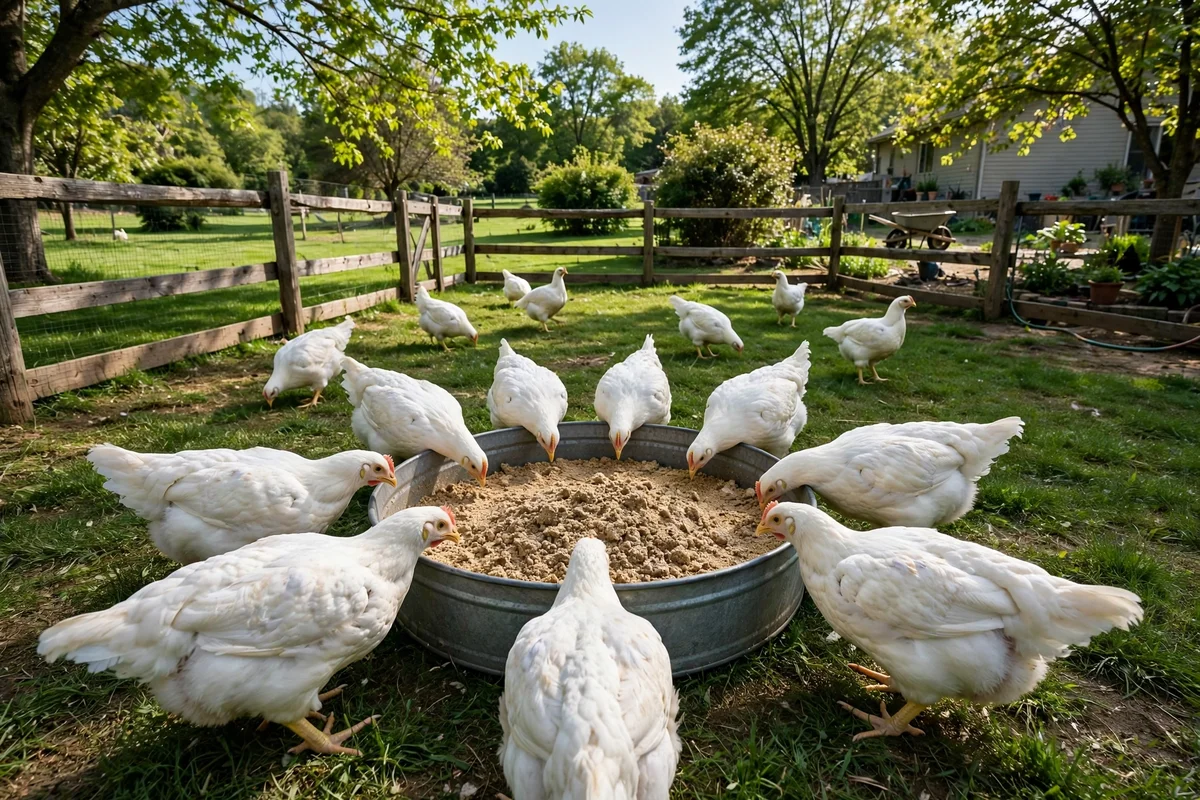
How much feed do broiler chickens eat per day?
A broiler chicken eats about 15 to 20 grams of feed per day in its first week, rising to about 100 grams per day by four weeks and about 150 to 180 grams per day by six to eight weeks.
The amount depends on the breed, the feed, and the temperature, so treat these figures as a planning guide rather than a strict rule: a fast-growing commercial broiler will eat more than a slower-growing heritage bird, and a bird in a cold pen will eat more than one in a warm pen.
Broilers are bred to convert feed into muscle quickly, and their appetite rises steeply week by week. A chick that eats a spoonful a day in its first week will be eating a large handful a day by week six, and the feeder needs to keep up. Offer a complete broiler feed free-choice, keep the feeder full, and check it daily, because a broiler flock can empty a feeder faster than you expect.
Broiler feed intake week by week
The table below gives the usual daily feed intake for a fast-growing broiler, week by week. These are planning figures for a commercial broiler breed on a complete broiler feed, and they will vary with the breed, the feed, and the housing.
A slower-growing breed will eat less at each age, and a bird raised outdoors in cold weather will eat more.
Use the figures to plan how much feed to buy, not to ration the birds. Broilers should have feed available at all times, and the table tells you how fast the feed will disappear, so you can buy the right amount and keep the feeder full.
Broiler daily feed intake by week
The weekly figures add up to roughly 4 to 5 kilograms of feed per bird over a typical six to eight week growing period, though the exact total depends on how long the birds are grown for. Use the feed conversion ratio calculator to check how efficiently your birds are turning feed into weight, and the broiler harvest yield calculator to estimate the dressed weight at harvest.
| Age | Feed per bird per day | Notes |
|---|---|---|
| Week 1 | 15 to 20 grams | Starter feed; small amounts, often |
| Week 2 | 30 to 40 grams | Appetite rises fast |
| Week 3 | 50 to 65 grams | Switch to grower feed |
| Week 4 | 80 to 100 grams | Growth is rapid now |
| Week 5 | 110 to 130 grams | Feeder needs checking daily |
| Week 6 | 130 to 150 grams | Finisher feed |
| Week 7 | 150 to 170 grams | Near harvest weight |
| Week 8 | 160 to 180 grams | Harvest is usually near |
Broiler feed: starter, grower, and finisher
Broiler feed comes in three stages, like layer feed, but with more protein at each stage. Starter feed is fed from day one to about three weeks, and it has the highest protein, about 20 to 23 percent, because the chick is growing fastest.
Grower feed follows from about three to five weeks, and finisher feed from about five weeks to harvest, with the protein falling a little at each stage as the bird's growth slows.
A complete broiler feed at each stage is the simplest way to get the nutrition right, and it is what most backyard broiler keepers use. If you mix your own feed, the chicken feed formulation calculator can help you check the protein level, but a bought broiler ration is the safer option for a first batch. Do not feed broilers layer feed: it has too little protein and too much calcium for a growing meat bird.
Free-choice feeding for broilers
Offer broiler feed free-choice, available at all times, and keep the feeder full. Broilers are bred to eat and grow fast, and restricting feed in the early weeks will slow growth and waste the breed's potential. Some keepers restrict feed in the final weeks to reduce leg problems and sudden death, because a bird that grows too fast can outgrow its legs and its heart, but that is a management choice that needs care, not a rule for beginners.
If you do restrict feed, do it gently and late, not in the first weeks, and watch the birds for signs of stress. A better approach for a first batch is to keep feed available, give the birds plenty of space, and let them move around, because exercise helps their legs cope with their weight. A broiler that can walk to the feeder and back is a healthier bird than one that sits beside it all day.
How much feed to buy for a batch
Plan on roughly 4 to 5 kilograms of feed per bird for a batch grown to six to eight weeks, and buy a little more than you think you need, because the last week is when the birds eat the most and a feeder that runs dry at that stage will cost you growth.
For a batch of ten birds, that means roughly 40 to 50 kilograms of feed in total, split between starter, grower, and finisher.
Buy the starter first, and buy the grower and finisher as the birds reach those stages, so the feed is always fresh. Feed that sits in a bag for months loses its vitamins, and our guide on how long does chicken feed last covers shelf life. Use the chicken feed calculator to check the daily feed for your flock size, and keep the feed stored sealed and dry.
Broilers vs layers: different appetites
Broilers and layers eat very different amounts, because they are bred for different jobs. A laying hen eats about 110 to 140 grams of feed per day, fairly steadily, for her whole laying life, while a broiler eats little in its first week and a great deal by week eight, and then stops, because it is harvested.
The two are not comparable, and a feed plan that works for layers will not work for broilers.
Our guide on how much feed per chicken per day by age covers layer and dual-purpose birds in detail, and this guide covers broilers. If you keep both, feed them separately: the broilers need a high-protein broiler ration, and the layers need a layer ration with calcium, and neither feed is right for the other bird.
When broilers eat less than expected
If your broilers are eating less than the figures above suggest, check the basics first: is the feed fresh, is the feeder big enough for the whole flock, and is the brooder warm enough? Cold birds eat more, not less, so a flock that is eating little in a cold pen may be sick, stressed, or crowded, and a flock that is eating little in a hot pen may simply be hot, because birds eat less when they are heat-stressed.
Check the water too, because a bird that cannot drink will not eat, and a waterer that is empty, dirty, or too high for the birds will cut feed intake fast. If the birds are eating well but not growing, the feed may be wrong, or the birds may have a gut problem, and a veterinarian experienced with poultry can help. Do not try to force growth with extra treats: a broiler that is not growing needs the right feed and good health, not more scratch.
Sources: University of Minnesota Extension — Poultry and poultry.extension.org.
Related tools and guides
For more on the same topic, see How Much Feed Per Chicken Per Day by Age.
Frequently asked questions
How much feed do broiler chickens eat per day?
A broiler chick eats about 15 to 20 grams of feed per day in its first week, rising to about 100 grams per day by four weeks and about 150 to 180 grams per day by six to eight weeks. The amount depends on the breed, the feed, and the temperature, so use these figures as a guide, not a rule.
How much feed does a broiler eat in total?
A broiler eats roughly 4 to 5 kilograms of feed over a typical six to eight week growing period, though the exact amount depends on the breed, the feed, and how long the birds are grown for. Use the feed conversion ratio calculator to check how efficiently your birds are converting feed to weight.
Should broiler feed be available all the time?
Offer broiler feed free-choice, available at all times, and keep the feeder full. Broilers are bred to eat and grow fast, and restricting feed in the early weeks will slow growth. Some keepers restrict feed in the final weeks to reduce leg problems, but that is a management choice, not a rule.
How much protein do broiler chickens need?
Broilers need a higher-protein feed than layers: about 20 to 23 percent protein in the starter, falling to about 18 to 20 percent in the finisher. A complete broiler feed provides this, and it is the simplest way to make sure the birds get enough.
Why are my broilers not growing fast enough?
Slow growth can mean the feed is wrong, the birds are cold, or the feeder is too small for the flock. Check that the feed is a proper broiler ration, that the brooder is warm enough, and that every bird can reach the feeder. If the birds are eating well but not growing, check for disease.
About the author
John Walker is the founder of PeckCalc and has kept backyard chickens in Dallas, Texas since 2017. He started PeckCalc to give backyard keepers free calculators and guides with every figure traced to a university extension source.