
How to Catch a Chicken
 By John Walker · Backyard chicken keeper in Dallas, Texas since 2017
To catch a chicken, do not chase it. Wait until dusk when the bird returns to roost, or lure it with treats, herd it gently into a corner with a helper, and pick it up from behind with both hands holding the wings against its body.
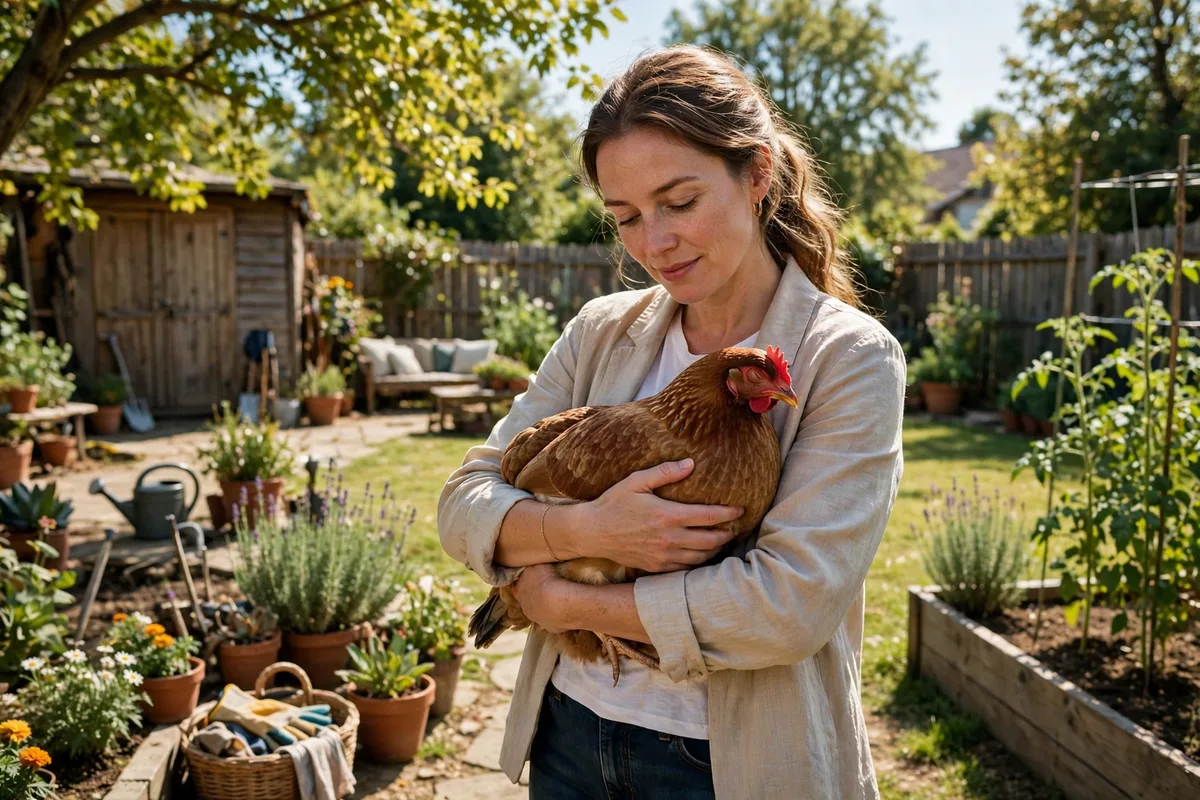
How to catch a chicken: the ground rule
There is one ground rule for catching a chicken: do not scare, hurt or chase it. A chicken can run at about 9 miles per hour, dart in any direction, and fly in a short burst when it is frightened, so chasing it around the garden will tire you out, stress the bird.
The bird is also stronger than it looks when it is panicking, and a frightened chicken can injure itself by crashing into a fence, a wall or a window, or by struggling so hard that it breaks a wing or a leg. The goal is a calm bird, caught gently, and that means patience, not speed.
Most of the time, you do not need to catch the chicken at all. Chickens have a strong homing instinct, and an escaped bird will return to the coop by itself at dusk, when it goes to roost. If there is no emergency, such as a dog, a road or a predator, waiting until dusk is the easiest and kindest option.
Method 1: wait until dusk
The easiest way to catch a chicken is to wait until dusk. Chickens always go to bed around the same time, depending on sunset, and they will find their way home to roost. Once the bird is on the roost, it is sleepy, its vision is poor in the dark, and it is easy to pick up by hand without a chase.
Approach slowly and quietly, with a dim torch or a red-light headlamp rather than a bright white light, because chickens are effectively blind in darkness and a bright light will startle them. Reach over the bird's back, confine the wings with your hands, and lift it gently, holding it close to your body so it feels secure.
If the bird has roosted in a tree outside the coop, wait until it is settled, then sneak up and catch it after dark. If the branch is too high, go to the same area the next night just before dark, and catch the bird on its way up the tree, when it is lower and easier to reach.
Method 2: lure the chicken with treats
If the chicken is tame, or even half tame, treats are the fastest way to get it close enough to catch. Shake a bag of mealworms, scratch grains or cracked corn, call the birds as you normally do at feeding time, and wait. Use the chicken treats calculator to keep the training treats within a sensible daily allowance, so the reward does not unbalance the diet. Chickens that have been trained to come for treats will come running, and a bird that is eating is a bird that is not running away.
Scatter a small trail of treats leading towards you, or towards the coop, and let the bird follow the food. When it is close and busy eating, bend down slowly behind it and scoop it up from under its body, holding the wings against its sides. Do not grab from above, because a hand coming down from above looks like a hawk to a chicken.
Training your flock to come for treats is the best long-term investment in catching them. If you feed grain or treats every day and call the birds as you do, they will quickly learn to come when called, and catching a bird becomes a matter of shaking a bag rather than running around the garden. Our guide to mealworms for chickens explains the treat that works best for training.
Method 3: herd the chicken into a corner
Finding a person to help is the best and fastest way to catch a chicken in the daytime. Two people can herd a bird gently into a corner of the coop or the run, or into a fenced area, by walking slowly towards it with arms stretched out to the sides, reducing the space it can escape into. Move slowly and steadily, and avoid rapid or unexpected movements, because chickens are sensitive to sudden motion.
The key is to reduce the space gradually rather than to rush the bird. Walk towards the chicken, let it move away from you into the corner, and then close the gap slowly until you can reach it. A bird in a corner has nowhere to run, and it will usually freeze or crouch, which is the moment to pick it up.
Do the herding in a small space if you can. A chicken in a large garden has too many escape routes, while a chicken in a run or a coop has few. If the bird is loose in the garden, herd it towards the run or the coop first, using your arms and your body as a moving fence, and catch it once it is in the smaller space.
Method 4: use a box, a blanket or a crate trap
If you are alone and have no one to help, a box or a blanket can make the task manageable. Approach the chicken from behind, throw the box or blanket over the bird, and act quickly so it cannot escape or get too stressed. Once the bird is covered, it will usually calm down in the dark, and you can pick it up from under the cover.
A large box placed over a cornered bird in the coop or the run works the same way: lower it gently over the bird, tuck the flaps in, and lift the box with the bird inside. A crate trap, with irresistible treats inside and a door you can close with a pole or a long stick, is an effective method for a bird that will not come close.
Nets can be dangerous, because a chicken's claws can snag in the netting and cause injury, and a poultry hook or noose should only be used by experts, because in the wrong hands it can break a chicken's leg or neck. For most keepers, a box, a blanket or a crate trap is safer than either of those tools.
How to pick up and hold a chicken safely
The correct way to pick up a chicken is from behind, bending down and scooping it up from under its body. Place one hand over its back, confining the wings, and bring it close to your body with the other hand supporting it from underneath. Hold the wings firmly against the body with your fingers wrapped under it, so the bird cannot flap and injure itself or you.
Never pick up a chicken by one leg, one wing, or the neck, because that can break a bone or dislocate a joint. A bird caught by the legs should be held by both legs in one hand, with the breast supported in the other hand, and carried feet-first out of a cage, but for most backyard handling, the two-handed body hold is safer and calmer.
Hold the bird close to your body, with its head facing away from you or tucked under your arm, and keep your movements slow and steady. A bird that is held securely and calmly will usually settle within a few seconds, while a bird that is held loosely will flap, scratch and panic. Wear gloves if the bird is a rooster or a nervous hen, because spurs and claws can scratch.
How to catch a rooster
Roosters are harder to catch than hens, because they are larger, stronger, more alert, and more likely to stand their ground and fight rather than run. A rooster that feels cornered may spur, peck or jump at you, so wear gloves, long sleeves and eye protection, and do not turn your back on a rooster you are trying to catch.
The best methods for a rooster are the same as for a hen, but with more caution: wait until dusk, when the rooster is on the roost and sleepy, or use a crate trap with treats inside. A box or blanket thrown over a rooster works, but be ready for the bird to struggle hard when it is covered, and hold it firmly once you have it.
If a rooster is aggressive, do not try to catch it alone in the open. Wait until it is in the coop, use a helper, and consider whether the rooster needs to be rehomed rather than caught repeatedly. Our guide to how to handle an aggressive rooster covers the longer-term fixes for a bird that attacks people.
What never to do when catching a chicken
Never chase a chicken around the garden. Chasing tires you and the bird, stresses the bird, makes it more afraid of you, and risks injury to the bird from crashing into fences and walls. A chicken that has been chased will be harder to catch next time, and a flock that is chased regularly will become nervous and hard to handle.
Never grab a chicken by one leg or one wing, and never catch a bird by the neck. Those holds can break bones, dislocate joints, and cause lasting injury, and they are the most common cause of handling injuries in backyard flocks. Always use two hands, support the body, and confine the wings.
Never use a net, a hook or a noose unless you are experienced with the tool. Nets snag claws, hooks can break legs, and a noose can break a neck, and for most keepers the risk is not worth it. A box, a blanket, treats and patience will catch any chicken without those risks.
Catching a chicken that has escaped the garden
If a chicken has escaped into a neighbour's garden, onto a road, or into an area with a dog, the priority is to get it to safety quickly, and herding is usually better than catching. Guide the bird back towards your garden by standing with your arms stretched out and encouraging it to move in the right direction, rather than trying to grab it in an unfamiliar place.
If a dog is the problem, control or confine the dog first, because a chicken will not come towards you while a dog is loose, and a dog that catches a chicken can kill it in seconds. Once the dog is secured, the chicken will usually calm down and can be herded or lured back.
If the bird is on a road, do not chase it into traffic. Wait for a gap, herd it gently towards the verge, and catch it once it is off the road. A chicken on a road is at risk, but a person chasing a chicken into traffic is at risk too, and the bird is more likely to come back to the coop at dusk than to be caught in a panic on the road.
Training your flock to come when called
The best way to catch a chicken is to never need to catch it, because it comes to you. Train your flock from the first weeks by feeding treats at the same time each day and calling the birds with the same sound or word as you do. Chickens learn fast, and within a week or two they will come running when they hear the call.
Use a consistent call and a consistent treat, such as mealworms or cracked corn, and always reward the birds when they come. Do not use the call to catch a bird and then do something unpleasant to it, because the birds will learn that the call means trouble and stop coming.
A flock that comes when called is easier to manage in every way: easier to put away at night, easier to move to a new coop, easier to check for health problems, and easier to catch when one bird needs attention. The few minutes a day spent training pays off for the life of the flock.
Sources: the catching guidance on this page — waiting until dusk, herding into a corner, and holding a bird with both wings confined against its body — reflects extension poultry handling guidance. For handling guidance, see the poultry pages at the University of Minnesota Extension and poultry.extension.org.
Related tools and guides
For more on the same topic, see How to Handle an Aggressive Rooster and Mealworms for Chickens.
Frequently asked questions
What is the easiest way to catch a chicken?
Wait until dusk, when the chicken returns to the coop to roost. Once it is on the roost, it is sleepy and its vision is poor in the dark, so you can pick it up by hand without a chase. Use a dim torch or a red-light headlamp rather than a bright white light.
Should I chase a chicken to catch it?
No, never chase a chicken. A chicken can run at about 9 miles per hour and fly in a short burst, so chasing tires you out, stresses the bird, risks injury, and makes the bird harder to catch next time. Herd it gently, lure it with treats, or wait until dusk.
How do you hold a chicken safely?
Scoop it up from behind with both hands, one hand over its back confining the wings and the other supporting it from underneath, and hold it close to your body. Never pick a chicken up by one leg, one wing or the neck, because that can break a bone.
How do you catch a chicken that escaped the garden?
Herd it gently back towards your garden with your arms stretched out, rather than trying to grab it in an unfamiliar place. If a dog is loose, confine the dog first, and if the bird is on a road, wait for a gap and herd it to the verge before catching it.
How can I train my chickens to come when called?
Feed treats at the same time each day and call the birds with the same sound or word as you do. Chickens learn fast, and within a week or two they will come running when they hear the call. Always reward them when they come, and never use the call to do something unpleasant.
About the author
John Walker is the founder of PeckCalc and has kept backyard chickens in Dallas, Texas since 2017. He started PeckCalc to give backyard keepers free calculators and guides with every figure traced to a university extension source.