
How to Make Hollandaise Sauce With Fresh Eggs
 By John Walker · Backyard chicken keeper in Dallas, Texas since 2017
How to make hollandaise sauce with fresh eggs is a skill worth learning, because the sauce turns a plain breakfast into something special, and fresh backyard eggs make it richer and more golden than shop eggs. Hollandaise is a warm emulsion of egg yolk, butter, and lemon juice, and it takes about ten minutes to make. This guide gives you the step-by-step method, the common mistakes, and how to fix a sauce that splits.

How to make hollandaise sauce with fresh eggs
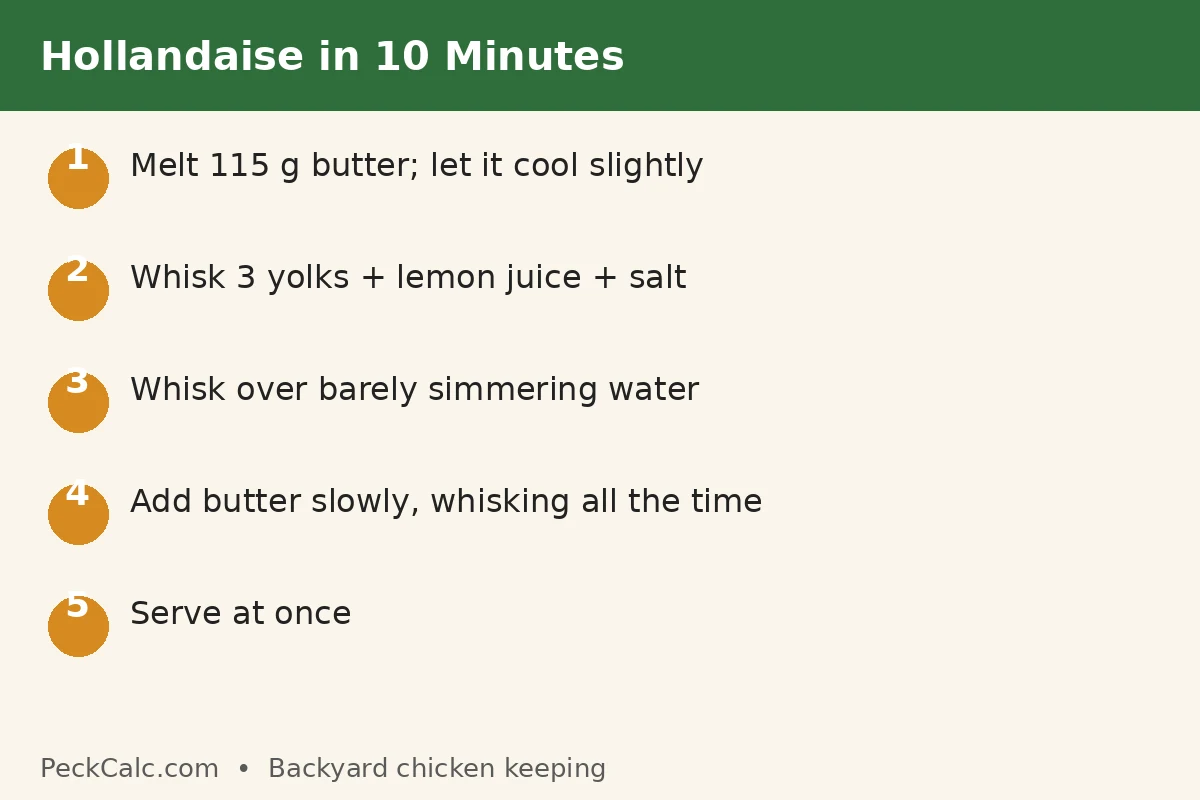
To make hollandaise sauce with fresh eggs, start by melting 115 grams of unsalted butter in a small pan, and let it cool slightly. Put three egg yolks in a heatproof bowl, add a tablespoon of lemon juice and a pinch of salt, and whisk them together until the mix is pale and slightly thick.
Set the bowl over a pan of barely simmering water, so the bowl sits above the water and does not touch it. Whisk the yolks constantly for two to three minutes, until they are thick enough to coat the back of a spoon. Then add the warm butter very slowly, a thin stream at a time, whisking all the time, until the sauce is thick and glossy.
Take the bowl off the heat, taste the sauce, and add more lemon juice or salt if needed. Serve the sauce at once, because it thickens as it cools and it does not reheat well. The whole process takes about ten minutes, and the result is a smooth, golden sauce that is worth the effort.
Why fresh eggs make better hollandaise
Fresh eggs make better hollandaise because the yolks are firmer, the whites are thicker, and the yolk membrane is stronger. A fresh yolk holds together well when you separate it, and it emulsifies cleanly with the butter. An old yolk is weaker, and it is more likely to break and mix with the white, which makes the sauce thinner.
Backyard eggs also tend to have deeper orange yolks, because the hens eat grass and a varied diet. The colour of the yolk does not change the taste, but it makes the sauce look richer and more golden, which is part of the pleasure of hollandaise. A pale yolk makes a pale sauce, and a deep yolk makes a golden one.
Freshness also matters for safety, because hollandaise is only lightly cooked. The yolks are warmed, not boiled, so they do not reach a temperature that kills all bacteria. Use eggs that are fresh, clean, and from hens you know, and eat the sauce the same day. If you are serving children, pregnant women, or older people, use pasteurised eggs instead.
The blender method: a faster hollandaise
The blender method is a faster way to make hollandaise, and it is a good choice if you find the bowl method tricky. Put three egg yolks, a tablespoon of lemon juice, and a pinch of salt in a blender, and blend for a few seconds until the mix is pale.
Melt the butter until it is hot and bubbling, but not brown.
With the blender running, pour the hot butter in a slow, thin stream through the lid. The heat of the butter cooks the yolks as it blends, and the sauce thickens in under a minute. Stop as soon as the sauce is thick and glossy, because blending too long can make it too thick or cause it to split.
The blender method is quicker and easier, but the sauce is slightly less smooth than the bowl method, and it is harder to control the thickness. It is a good method for a weekday breakfast, while the bowl method is better when you want the smoothest result. Both methods use the same ingredients, and both take about ten minutes.
What to serve with hollandaise sauce
Hollandaise sauce is best known on eggs Benedict, where it is poured over a poached egg and ham on a toasted muffin. The rich sauce, the runny yolk, and the salty ham work together, and the dish is a classic for a reason. It is also good on eggs Florentine, where spinach replaces the ham.
The sauce is also good on vegetables, especially asparagus, broccoli, and green beans. A spoonful of hollandaise turns a plain vegetable into a proper side dish, and it is a good way to use up a glut of garden vegetables. It is also good on fish, especially salmon and cod, and on roast chicken.
Hollandaise is a rich sauce, so a little goes a long way. A few spoonfuls per person is enough, and the rest of the plate should be lighter, with salad or vegetables to balance the richness. Serve it at once, because it does not keep well and it thickens as it cools.
How to fix hollandaise sauce that splits
Hollandaise splits when the emulsion breaks, and the sauce turns into a greasy liquid with lumps of egg. The most common cause is adding the butter too fast, or letting the bowl get too hot. If the sauce splits, do not throw it away, because it can usually be saved in a minute.
To fix a split sauce, put a fresh egg yolk in a clean bowl, add a teaspoon of warm water, and whisk it until it is pale. Then add the split sauce very slowly, a spoonful at a time, whisking all the time, until the sauce comes back together. This works because the fresh yolk gives the emulsion a new base to hold onto.
If the sauce is too thick, whisk in a teaspoon of warm water at a time until it is the right consistency. If it is too thin, whisk it over the heat for a minute longer, but keep the heat low, because too much heat will split it again. A sauce that is too hot will also taste eggy, so keep the water barely simmering, not boiling.
Hollandaise safety with fresh eggs
Hollandaise is only lightly cooked, so egg safety matters. The yolks are warmed to around 60 degrees Celsius, which is not hot enough to kill salmonella reliably. This is why fresh, clean eggs from a known flock are important, and why the sauce should be eaten the same day it is made.
Do not keep hollandaise in the fridge and reheat it the next day, because reheating does not make it safe, and the sauce will split when it is warmed again. Make only as much as you need, and throw away any leftover sauce. A small batch with three yolks is enough for two to four people, and it is better to make a fresh batch than to keep an old one.
If you are serving the sauce to children, pregnant women, older people, or anyone with a weak immune system, use pasteurised eggs. Pasteurised eggs have been heated to kill bacteria, and they work just as well in hollandaise. They cost more, but they are the safe choice for vulnerable people.
Hollandaise variations to try
Bearnaise sauce is the best-known variation, and it replaces the lemon juice with a reduction of white wine vinegar, shallots, and tarragon. The method is the same, but the flavour is herbal and savoury, and it is a classic with steak. It takes a little longer, because the vinegar reduction needs to be made first.
Mustard hollandaise adds a teaspoon of Dijon mustard to the yolks, and it gives the sauce a sharper, more savoury taste. It is good on fish and on roast vegetables. A hollandaise with a pinch of cayenne or smoked paprika adds warmth, and it is good on eggs Benedict with a spicy twist.
You can also make a lighter hollandaise by replacing half the butter with warm water or stock, but the sauce will be thinner and less rich. This is a useful trick if you want the flavour without all the fat, but it is not a true hollandaise. The classic version, with all butter, is the one to learn first.
What to do with leftover hollandaise
Leftover hollandaise is hard to store, because it splits when it cools and it does not reheat well. The best plan is to make only as much as you need, and to use any leftover sauce at once. A spoonful of hollandaise is good on a sandwich, on toast, or stirred into mashed potato.
and these uses are better than trying to save it.
If you must keep it, put it in a small bowl, cover it with cling film pressed onto the surface, and keep it in a warm place for no more than an hour. Do not put it in the fridge, because the cold will make it split, and do not reheat it in a pan, because the direct heat will break it. Warm it very gently over a bowl of warm water, whisking all the time.
The honest answer is that hollandaise is a make-and-eat sauce, and it is best enjoyed fresh. If you often have leftover yolks, our what to do with extra egg yolks guide gives you other recipes that use yolks and keep better.
Sources: National Center for Home Food Preservation and USDA Food Safety and Inspection Service, shell eggs from farm to table.
Related tools and guides
For more on the same topic, see How to Freeze Fresh Eggs.
Frequently asked questions
How to make hollandaise sauce with fresh eggs?
Whisk three yolks with lemon juice and salt in a bowl over barely simmering water until thick, then add 115 grams of warm melted butter very slowly, whisking all the time. Serve at once. The whole process takes about ten minutes.
Why does my hollandaise sauce split?
Usually because the butter was added too fast, or the bowl got too hot. Fix it by whisking a fresh yolk with a teaspoon of warm water in a clean bowl, then adding the split sauce slowly, a spoonful at a time, until it comes back together.
Is hollandaise safe with fresh backyard eggs?
Hollandaise is only lightly cooked, so use fresh, clean eggs from a known flock and eat the sauce the same day. For children, pregnant women, older people, or anyone with a weak immune system, use pasteurised eggs instead.
Can I make hollandaise in a blender?
Yes. Blend three yolks, lemon juice, and salt, then pour hot melted butter in a slow stream with the blender running. The sauce thickens in under a minute. It is quicker than the bowl method, but slightly less smooth.
How long does hollandaise sauce keep?
It does not keep well. Serve it at once, and throw away leftovers. It splits when it cools and does not reheat safely. Make only as much as you need, using three yolks for two to four people.
About the author
John Walker is the founder of PeckCalc and has kept backyard chickens in Dallas, Texas since 2017. He started PeckCalc to give backyard keepers free calculators and guides with every figure traced to a university extension source.