
How to Protect Chickens From Skunks?
 By John Walker · Backyard chicken keeper in Dallas, Texas since 2017
How to protect chickens from skunks? Skunks are a nuisance predator for chicken keepers, because they eat eggs and chicks, and they can kill a hen if they get the chance, although they rarely do. A skunk is a slow, waddling animal with poor eyesight, but it has a good sense of smell, and it will find a coop with eggs in it and come back night after night. The bigger risk from a skunk is not the chickens, but rabies, because skunks are one of the main carriers of rabies in North America. This guide explains how skunks hunt, how to keep them out, and what to do if one gets into the coop.
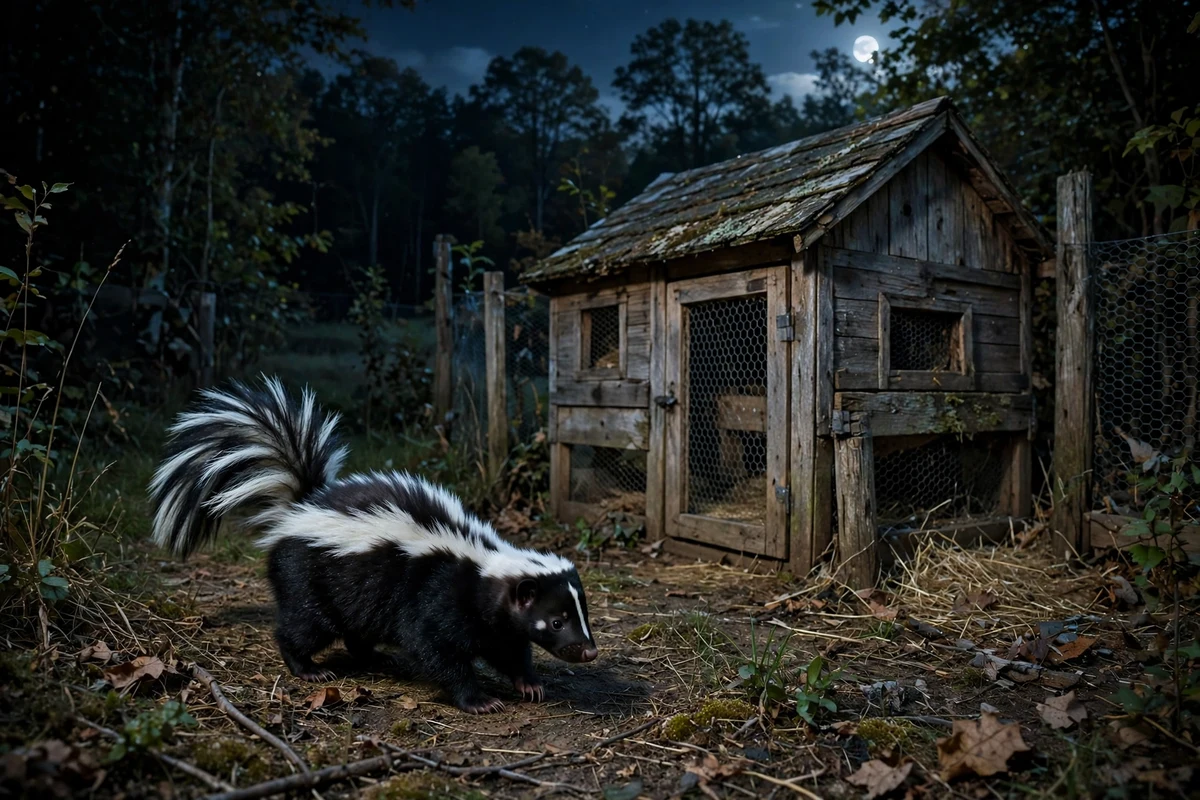
How to protect chickens from skunks?
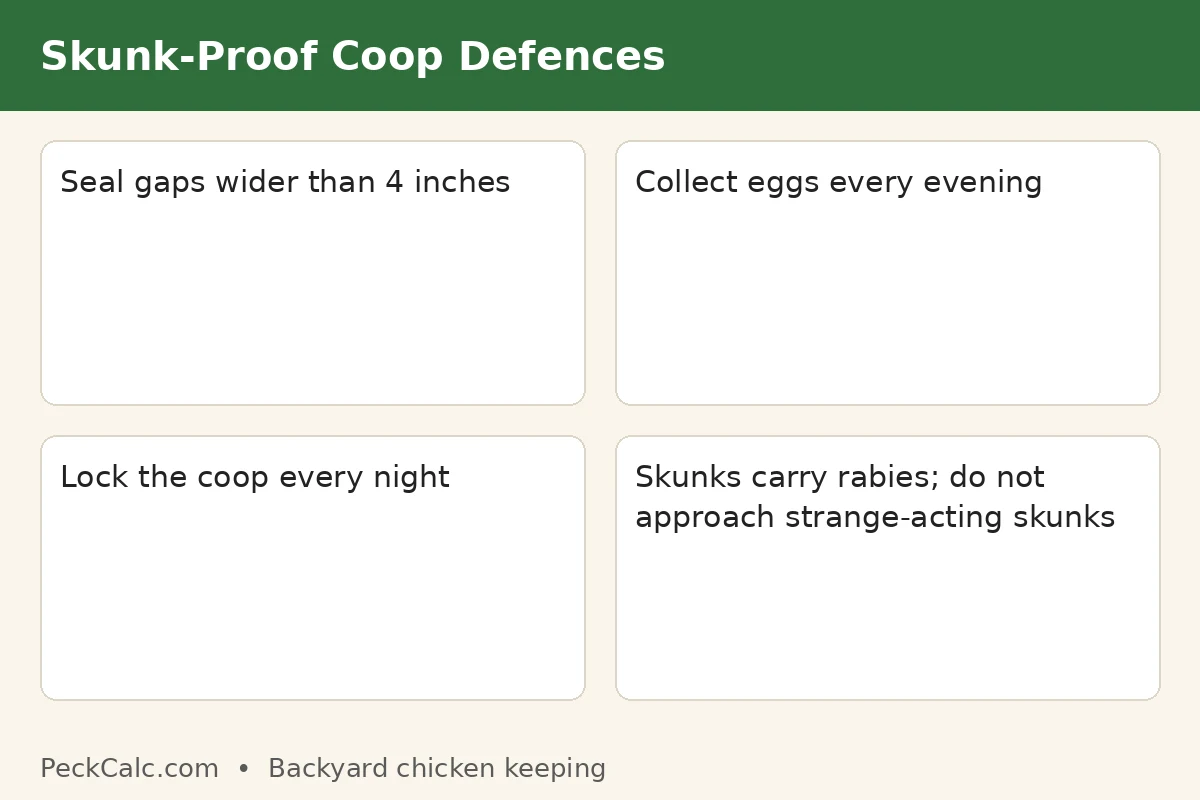
The short answer is to seal the coop and collect the eggs daily, because a skunk is after the eggs and the chicks, not the adult hens. Seal every gap wider than four inches, because a skunk can squeeze through a gap that size, and use half-inch hardware cloth on windows, vents, and the run.
Lock the coop every night, because skunks hunt at night, and collect the eggs every evening, because a nest full of eggs is what draws a skunk in the first place.
Skunks are nocturnal, which means they are active at night, and they are most likely to visit a coop in the hours after dark. A skunk will visit night after night, and it will remember where the eggs are, so if it finds eggs once, it will come back. The only defence is to make the coop so tight that the skunk cannot get in, and to remove the eggs before nightfall, so there is nothing to attract it.
Do not leave feed out at night, because skunks will eat chicken feed as well as eggs, and a feeder full of feed is an invitation. Store feed in metal bins with tight lids, inside a locked shed, and clean up spilled feed every evening. Keep the run clear of fallen fruit and pet food, because skunks will eat those too. A clean coop, with no eggs and no feed left out, is much less attractive to a skunk.
Egg and chick eaters first: do skunks kill adult hens?
Skunks are egg and chick eaters first, and they rarely kill adult hens. A skunk will eat eggs, breaking them open and licking out the contents, and it will eat chicks, which are small and defenceless. An adult hen is large, strong, and able to peck and fight back, and
a skunk, which is slow and short-sighted, will usually avoid a fight with an adult hen. That is why a skunk attack often looks like missing eggs and dead chicks, with the adult hens unharmed.
But a skunk can kill an adult hen if it gets the chance, especially a hen that is broody, sick, or asleep, and a skunk that is cornered in the coop can bite and scratch in self-defence. A skunk that finds a hen on the nest at night may kill her to get to the eggs underneath, and a skunk that is hungry enough will attack a hen that cannot escape. The risk is low, but it is not zero, and it is a reason to lock the coop every night.
The signs of a skunk attack are distinctive. Skunks eat eggs by breaking a small hole in the shell and licking out the contents, leaving the shell mostly intact, while a raccoon or a rat will carry the egg away or smash it. Skunks also leave a smell, because they spray when they are frightened, and a coop that smells of skunk in the morning has had a visitor. If you find broken eggshells with a small hole, and the hens are unharmed, the predator was probably a skunk.
Rabies: the bigger risk from skunks
The bigger risk from a skunk is rabies, because skunks are one of the main carriers of rabies in North America. Rabies is a viral disease that affects the brain, and it is fatal once symptoms appear, in animals and in people.
A skunk with rabies may act strangely, wandering in daylight, showing no fear of people, staggering, or drooling, and it may bite without provocation. A rabid skunk is dangerous, and it should not be approached.
If you see a skunk acting strangely, do not go near it, and do not try to scare it away. Go inside, lock the doors, and call animal control or your local wildlife service at once. They can trap the skunk and test it for rabies, and they can advise you on what to do. If a skunk has bitten a hen, the hen may have been exposed to rabies, and you should call a vet, because the hen may need to be quarantined or put down, and the vet can advise on the risk to you and your family.
If you are bitten or scratched by a skunk, wash the wound at once with soap and water, and seek medical care immediately, because rabies treatment must start quickly. Tell the doctor that you were bitten by a skunk, and that the skunk may have had rabies. Rabies is preventable if treatment starts early, but it is fatal if it is left too late, so do not delay. Keep pets vaccinated against rabies, and keep them away from skunks.
Sealing gaps and securing the coop
Skunks can squeeze through a gap four inches wide, which is larger than the gap a mink or a weasel needs, but smaller than most keepers think. Seal every gap wider than four inches in the coop walls, the floor, and the roof, using wood, metal, or cement.
Use half-inch hardware cloth on windows, vents, and the run, and attach it with screws and washers, not staples, because a skunk can push staples out.
The coop door should fit tightly, with no gap at the bottom, and it should be locked every night with a latch that a skunk cannot open. A skunk is not as clever as a raccoon, and it cannot open a complex latch, but it can push open a door that is not latched, and it can lift a loose board. Check the door every evening, and make sure it is closed and locked before you go to bed.
The run should be covered with hardware cloth as well, and the base should have an apron of hardware cloth buried around it, so the skunk cannot dig under. Skunks are good diggers, and they will dig under a fence if the ground is soft. An apron of hardware cloth, laid flat on the ground and buried under soil, will stop them. Our guide on predator-proofing a chicken coop covers the full method.
| Predator | Gap it fits through | Main target |
|---|---|---|
| Skunk | 4 inches | Eggs and chicks |
| Raccoon | 4 inches, but opens latches | Adult hens and eggs |
| Mink | 1 inch | Whole flock |
| Weasel | Half an inch | Whole flock |
| Rat | Half an inch | Eggs and chicks |
Relocation is often illegal: what to do instead
Many keepers want to trap a skunk and move it somewhere else, but relocation is often illegal, and it is usually a bad idea even where it is allowed. In many states, it is illegal to trap and relocate a skunk without a permit, because skunks carry rabies, and moving
a rabid skunk can spread the disease to a new area. In other states, relocation is allowed, but the skunk must be released within a short distance, and it will often come back, because it knows where the food is.
Trapping a skunk is also unpleasant, because a trapped skunk will spray, and the smell can linger for days, and a trapped skunk can bite if it is handled. A live trap must be checked every day, and the skunk must be handled carefully, wearing gloves and a mask, and the trap must be disinfected afterwards. It is a job for a professional, not for a keeper, and it is better to call animal control or a wildlife removal service.
The best answer is to make the coop secure and let the skunk move on, rather than trying to remove it. A secure coop protects the hens and the eggs, and the skunk will find food elsewhere. If a skunk is visiting every night and the coop is secure, call animal control, and they can advise you on what to do and may be able to trap the skunk for you. Do not trap a skunk yourself without knowing the local rules.
What to do if a skunk gets into the coop
If a skunk gets into the coop, do not try to chase it out yourself, because a skunk that is cornered will spray, and the smell is awful, and a skunk that feels threatened may bite. Open the coop door from outside, using a long stick or a rope, and let the skunk leave on its own.
Stand back, and do not block its way out, because a skunk that cannot escape will panic and spray.
After the skunk has gone, check the hens for injuries, and separate any that are hurt into a warm, quiet hospital pen. Skunk bites can become infected, so clean the wounds with warm water and call a vet, because antibiotics may be needed. Collect the eggs, clean up any broken shells, and check the coop for gaps, because the skunk got in through a gap, and it will come back through the same gap if you do not fix it.
If the skunk sprayed in the coop, the smell will linger, and the hens may be stressed. Air the coop out, remove the soiled bedding, and replace it with fresh bedding. Wash the coop with warm soapy water, and let it dry before you put the hens back in. The smell will fade in a few days, but the hens may be reluctant to go back in, so keep them in the run until the smell has cleared.
Sources: poultry.extension.org and University of Minnesota Extension, poultry resources.
Related tools and guides
For more on the same topic, see Predator-Proofing a Chicken Coop.
Frequently asked questions
How to protect chickens from skunks?
Seal every gap wider than four inches, use half-inch hardware cloth on windows, vents, and the run, and lock the coop every night. Collect eggs every evening, because a nest full of eggs draws skunks in, and do not leave feed out at night. Store feed in metal bins inside a locked shed.
Do skunks kill adult chickens?
Rarely. Skunks are egg and chick eaters first, and an adult hen is large and strong enough to fight back. But a skunk can kill a broody, sick, or sleeping hen, especially if it is after the eggs underneath her. Lock the coop every night to keep skunks out.
How can I tell a skunk ate my eggs?
Skunks break a small hole in the shell and lick out the contents, leaving the shell mostly intact. Raccoons and rats carry eggs away or smash them. A coop that smells of skunk in the morning has had a visitor, because skunks spray when frightened.
Do skunks carry rabies?
Yes. Skunks are one of the main carriers of rabies in North America. A skunk with rabies may wander in daylight, show no fear of people, stagger, or drool. Do not approach it. Call animal control at once, and seek medical care immediately if you are bitten or scratched.
Can I trap a skunk and move it somewhere else?
Relocation is often illegal, because skunks carry rabies and moving one can spread the disease. In many states you need a permit, and a relocated skunk often comes back. Call animal control or a wildlife removal service instead, and make the coop secure so the skunk moves on.
About the author
John Walker is the founder of PeckCalc and has kept backyard chickens in Dallas, Texas since 2017. He started PeckCalc to give backyard keepers free calculators and guides with every figure traced to a university extension source.