
How to Rotate Chickens on Fresh Pasture
 By John Walker · Backyard chicken keeper in Dallas, Texas since 2017
How to rotate chickens on fresh pasture is a practical skill for any keeper with land, because moving the flock to new grass regularly keeps the pasture healthy, cuts parasite numbers, and gives the birds fresh forage to eat. A flock that stays on the same patch year after year will strip the grass bare, turn the ground to mud, and build up worm eggs and coccidia in the soil, while a flock that moves every week or two will leave the grass to recover and will stay healthier. This guide explains how to plan a rotation, how big each paddock should be, how long to rest the grass, and what equipment you need.
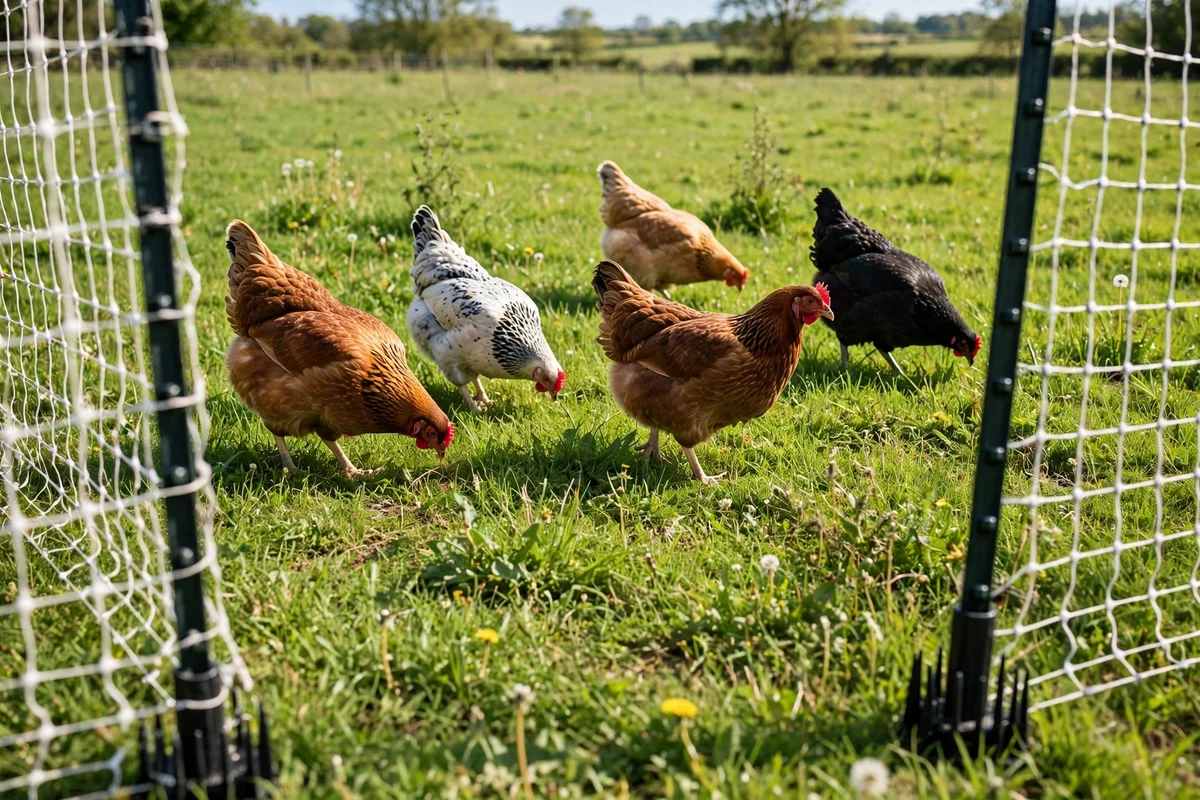
Why rotate chickens on fresh pasture?
Rotating chickens on fresh pasture keeps the grass healthy, because the birds get fresh forage to eat and the grass gets time to recover after grazing. A flock that stays on one patch will eat the grass down to the roots, scratch up the soil, and leave bare, muddy ground that takes months to recover.
Rotation also cuts parasite numbers, because worm eggs and coccidia oocysts build up in soil where birds have been for a long time, and moving the flock to fresh ground breaks the cycle. The old ground, left to rest in sunlight, will see most parasite eggs die off within a few weeks, especially in dry, sunny weather.
Fresh pasture gives the birds better nutrition, because grass, clover, and insects are rich in vitamins and protein, and a hen that forages on fresh grass will lay eggs with deeper yolks and better flavour. The birds also get exercise and mental stimulation from exploring new ground, which keeps them healthy and reduces boredom.
Rotation is a form of good land management, and it turns the flock from a problem into a benefit, because the birds fertilise the ground with their droppings, control insects, and keep the grass short. A well rotated flock improves the pasture over time, rather than destroying it.
How to rotate chickens on fresh pasture: planning
Start by dividing your land into paddocks, separate areas of pasture that the flock uses in turn, and aim for at least four, so each one gets a long rest while the others are in use. Four paddocks is a good minimum, and six or eight is better, because a longer rest is better for the grass.
Size each paddock to feed the flock for a week or two, and the exact size depends on the number of birds, the quality of the grass, and the season. A rough guide is 10 square feet of pasture per bird per day, but this varies widely, and a keeper should watch the grass and move the birds when it is eaten down, rather than following a fixed calendar.
Plan the rotation so that the birds move in order, from one paddock to the next, and each paddock is rested for at least three to four weeks before the birds return. In the growing season, grass recovers in three weeks, but in dry or cold weather it takes longer, and the rest period should be extended.
Keep a simple map of the paddocks and a record of when each one was used, so you can see the pattern and plan ahead. Our chicken flock planner can help you work out how many birds your land can support, and how much space each paddock needs.
Paddock size and stocking density
Paddock size depends on the flock, the grass, and the length of stay, and a small flock on good grass needs less space than a large flock on poor grass. A flock of 12 hens on lush pasture can use about 100 square metres for a week, while the same flock on thin grass would need twice that.
Stocking density is the number of birds per area, and a high density will strip the grass quickly, while a low density will leave the grass to grow tall and go to seed. The aim is a density that keeps the grass short but not bare, and that leaves the ground covered, so that the soil does not dry out or turn to mud.
A movable coop, sometimes called a chicken tractor, makes rotation easy, because the coop and the run move together to the next paddock, and the birds are always on fresh ground. A fixed coop with a fenced run needs separate paddocks with gates, and the birds are moved by opening a gate and closing the old one.
Our chicken stocking density calculator can help you work out how many birds a paddock can support, and it is worth doing the maths before you start, because overstocking is the most common mistake in pasture rotation.

How long to rest pasture between grazings
Pasture should rest for at least three to four weeks between grazings, and longer in dry or cold weather, because the grass needs time to regrow and the parasite eggs need time to die off. A rest of three weeks is enough in the growing season, when grass grows fast, but a rest of six weeks is better in winter.
The rest period is also the time when the droppings break down and fertilise the soil, and the grass uses the nutrients to grow. A paddock that is rested properly will come back greener and thicker than before, while a paddock that is grazed too soon will stay thin and patchy, and the grass will not recover.
Watch the grass to judge the rest, because the height is a better guide than the calendar. Grass that is at least 15 centimetres tall is ready to graze, while grass that is short and thin needs more time, and the keeper should wait until it has recovered before moving the birds back.
If a paddock is badly damaged, with bare patches and mud, it may need a longer rest, or reseeding with grass and clover, before it can be grazed again. A damaged paddock is a sign that the rotation was too fast, or the stocking density was too high, and the plan should be adjusted.
Fencing and equipment for rotation
Movable electric poultry netting is the most common fencing for rotation, because it is light, easy to move, and keeps chickens in and predators out. The netting is about a metre high, it is supported by posts, and it can be set up in minutes, which makes moving the flock a quick job.
A movable coop or chicken tractor is the other key piece of equipment, because it houses the birds and moves with them to the next paddock. The coop should be light enough to move by hand or with a small vehicle, and it should have a solid roof, nest boxes, and perches, so the birds are comfortable wherever it is placed.
Feed and water need to move with the flock, and the waterer should be placed in the shade, so the water stays cool, while the feeder should be under cover, so the feed stays dry. A movable feeder and waterer, or a feeder and waterer that are carried to the new paddock, are both practical options.
Keep the fencing and the coop in good repair, and check them each time you move, because a fence with a gap or a coop with a loose board is a predator risk. A rotation system is only as safe as its weakest point, and a quick check at each move is worth the time.
Common mistakes in pasture rotation
The most common mistake is moving the birds too slowly, so that the grass is eaten bare and the ground turns to mud, and the paddock takes months to recover. Move the birds when the grass is eaten down to about 8 centimetres, not when it is bare, because a grazed paddock recovers far faster than a stripped one.
Another mistake is resting the pasture for too short a time, so that the birds return to a paddock before the grass has recovered and before the parasite eggs have died. A short rest is little better than no rest, and the keeper should wait until the grass is tall and thick before moving the birds back.
A third mistake is overstocking, where too many birds are kept on too little land, and the rotation cannot keep up with the damage. If the grass cannot recover, reduce the flock, increase the paddock size, or add more paddocks, because the land sets the limit on how many birds it can support.
Finally, many keepers forget to provide shade and shelter in each paddock, and the birds suffer in hot sun or heavy rain. A movable shelter, or a tree in each paddock, gives the birds a place to rest, and it makes the rotation work in all weather.
Sources: University of Georgia Cooperative Extension, pastured poultry and poultry.extension.org.
Related tools and guides
For more on the same topic, see How to Build a Chicken Coop: A Step-by-Step Guide.
Frequently asked questions
How do you rotate chickens on fresh pasture?
Divide the land into at least four paddocks, move the flock to a new paddock every week or two, and rest each paddock for at least three to four weeks before the birds return. Use movable electric netting and a movable coop to make the moves easy.
How big should a pasture paddock be for chickens?
It depends on the flock, the grass, and the length of stay. A rough guide is 10 square feet of pasture per bird per day, but watch the grass and move the birds when it is eaten down to about 8 centimetres, rather than following a fixed calendar.
How long should pasture rest between grazings?
At least three to four weeks in the growing season, and longer in dry or cold weather. Grass that is at least 15 centimetres tall is ready to graze, while short, thin grass needs more time to recover.
Does pasture rotation reduce worms in chickens?
Yes. Worm eggs and coccidia build up in soil where birds have been for a long time, and moving the flock to fresh ground breaks the cycle. Resting the old ground in sunlight kills most parasite eggs within a few weeks.
What fencing is best for rotating chickens?
Movable electric poultry netting is the most common choice, because it is light, easy to move, and keeps chickens in and predators out. A movable coop or chicken tractor that moves with the flock is the other key piece of equipment.
About the author
John Walker is the founder of PeckCalc and has kept backyard chickens in Dallas, Texas since 2017. He started PeckCalc to give backyard keepers free calculators and guides with every figure traced to a university extension source.