
How to Tell a Chicken's Age: Physical Signs
 By John Walker · Backyard chicken keeper in Dallas, Texas since 2017
How to tell a chicken's age honestly starts with an admission: there is no exact way to age an adult chicken, and anyone who claims to know a hen's age to the month from looking at her is guessing. What you can do is place a bird in an age band using physical signs — and the best single marker is the texture of the scales on her shanks.
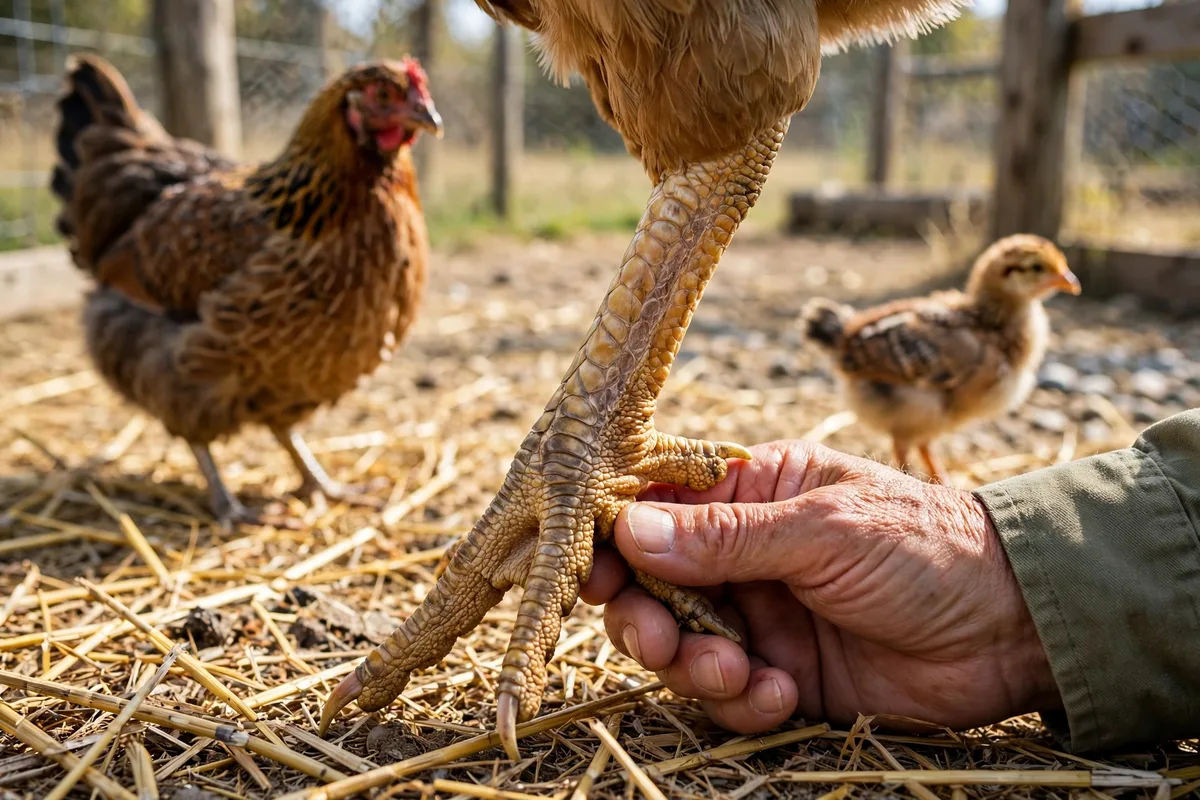
Can you tell a chicken's exact age by looking?
You cannot tell a chicken's exact age by looking, because chickens do not carry a reliable visual record of their years. A well-fed three-year-old hen can look younger than a hard-moulting eighteen-month-old, and breed, diet, laying history and living conditions all change how a bird looks.
Any method that claims an exact age from appearance alone is overstating what the signs can do.
What the physical signs can do is place a bird in a broad band: young pullet, bird in its first laying year, mature adult, or old hen. That is usually enough for the decision that matters, which is whether a bird you are buying is a young layer with years ahead of her or an old hen near the end of her productive life.
This guide is about physical signs. It is different from our guide on how long chickens live, which covers lifespan and the human-years equivalence — this guide is about what you can see and feel on the bird in front of you, and how much each sign can actually be trusted.
Why are shank scales the best age marker?
Shank scales are the best single marker of a chicken's age, because the scales on the legs change predictably over a bird's life. A young bird's shanks are smooth, with flat, tight, glossy scales that lie evenly against the leg.
As the bird ages the scales grow thicker, rougher and more raised, and in old birds they lift, crack, and sometimes fall off, leaving bare patches on the shank.
The bands are broad but useful. Smooth, glossy scales with no lifting suggest a bird under about 18 months. Scales that are visibly thicker and rougher, with some lifting at the edges, suggest a bird of two to three years. Scales that are heavily raised, cracked, or missing in patches suggest a bird over three years old, and a bird with very rough, almost bark-like shanks is almost certainly an old hen.
Check both legs, and check in good light. Scaly leg mites also raise and roughen the scales, so a bird with mites can look older than it is — if the scales are crusty and lifted with a powdery look, treat for mites first and judge age after the scales recover. Our guide on how to treat mites and lice in chickens covers the treatment. Shank colour is not an age marker: leg colour fades with laying, not with years, and it returns when laying stops.
What does spur length tell you about a chicken's age?
Spur length proves maturity, but it is a poor clock. Spurs grow on roosters and, less often, on hens, and they start as small bumps on a young bird, grow into short points in the first year, and lengthen and curve with age.
A bird with no spur at all is young or female; a bird with a long, curved, sharp spur is certainly an adult — but how old an adult, the spur will not say precisely.
The reason spurs are unreliable as an age marker is that spur growth varies enormously by breed, by individual, and by whether the bird has been kept on hard ground that wears the spur down. Some roosters grow long spurs by eighteen months; others of the same breed take three years. A spur that has been trimmed or broken tells you nothing at all.
Use spurs as a supporting sign, not a primary one. Long spurs plus rough shank scales plus a pale comb is a consistent picture of an old bird; long spurs on their own, with smooth scales and a bright red comb, is a young adult with fast-growing spurs. Never judge age from spurs alone, and never buy a bird on the strength of a spur measurement.
What does comb colour tell you — and what does it not?
Comb colour tracks laying status, not years, and that distinction catches many buyers out. A hen in full lay has a large, bright red, soft comb, because laying hormones drive blood to the comb. A hen that has stopped laying — because she is moulting, broody, or in winter — has a smaller, paler, drier comb.
The comb changes with the laying cycle in a matter of weeks, so it says nothing reliable about how many years the bird has lived.
A pale comb on a hen that should be laying is a useful clue, but it points at health or laying status, not age. It can mean the bird is moulting, stressed, parasitised, or simply not laying at the moment — and a bird that is not laying because she is old looks exactly the same as a bird that is not laying because she is moulting. Comb colour tells you to ask more questions; it does not answer them.
Comb size is similarly unreliable. Some breeds have large combs at six months; some old hens keep small combs all their lives. Judge the comb for what it is — a gauge of current laying and condition — and use the shanks for age. For more on laying patterns, see our guide on why chickens are not laying eggs.
How do vent and pelvic bones show whether a hen is laying?
The vent and pelvic bones show whether a hen is in lay, which is often the question behind the age question. A laying hen has a large, moist, pink vent and pelvic bones that are wide apart — two to three fingers' width between the two pointed bones on either side of the vent.
A hen that is not laying has a small, dry, pale vent and pelvic bones close together, often less than a finger apart.
This is a practical test a buyer can do in seconds, and it is more useful than guessing age: a hen with a wide pelvic spread and a moist vent is laying now, whatever her age, while a hen with a narrow spread is not. But it says nothing about how long she will keep laying — a three-year-old hen in lay today may lay for another year, or she may stop next month.
Handle the bird gently and with clean hands, and do not press hard. The test is a light touch: two fingers laid across the pelvic bones, feeling the gap. If you are buying birds, ask the seller to show you, and compare several birds in the flock — the differences between a laying hen and a non-layer are obvious once you have felt both.
| Sign | Young bird | Mature bird | Old bird |
|---|---|---|---|
| Shank scales | Smooth, glossy, flat | Thicker, some lifting | Raised, cracked, missing patches |
| Spurs | Small bumps or none | Short points | Long, curved, sharp |
| Comb | Small, growing, reddening | Large, bright red in lay | Often pale and dry when not laying |
| Vent and pelvic bones | Small, narrow | Moist vent, 2 to 3 fingers apart in lay | Narrow when laying stops |
| Feathering | Fresh, tight, glossy | Good condition in lay | Worn, dull, slow to regrow after moult |
No single sign gives an exact age. Shank scales are the best marker; the rest support the picture or show laying status.
What other signs help place a chicken's age?
Feather condition gives supporting evidence. Young birds have tight, glossy, unbroken feathers; older birds often have worn, dull feathers, broken feather shafts. But feather condition is also affected by diet, housing, and pecking from flockmates, so a hen with ragged feathers may be a bullied young bird rather than an old one.
Body weight and shape help too. A pullet approaching lay is lean and light; a hen in her first laying year is well-fleshed and active; an old hen often feels light and bony, with a prominent keel bone and less muscle over the breast. Weight is best judged by handling the bird, not by looking, because feathers hide a great deal.
Behaviour is the weakest sign of all, but it adds context. Young birds are quick, curious and flighty; old hens are slower, calmer, and more likely to be at the bottom of the pecking order. None of this proves age on its own, but a slow, thin bird with rough shanks and a pale comb is a consistent picture of an old hen, while a quick, glossy bird with smooth shanks is a consistent picture of a young one.
How do you avoid being sold an old hen as a young layer?
Buy from a reputable source, and ask direct questions: how old are the birds, when did they start laying, and can you see the rest of the flock? A seller who will not answer, or who claims every bird is exactly six months old, is a warning sign.
Ask to handle the birds yourself, and check the shanks, the vent and the pelvic bones on several birds before choosing.
Be wary of a flock where every bird looks identical in age and condition — a genuine flock has variation, and a batch of identical-looking birds may have been sorted to hide the old ones. Compare the birds with each other: the ones with the smoothest shanks and the brightest combs are the youngest, and the ones with rough shanks and pale combs are the oldest, whatever the seller says.
Pay a fair price for what you are getting. Point-of-lay pullets are worth more than spent hens, and a seller offering supposed point-of-lay birds at a spent-hen price is either generous or misleading. If you want guaranteed young birds, buy day-old chicks or point-of-lay pullets from a hatchery with a known hatch date, and use the first egg calculator to know when to expect the first eggs.
How does age affect what a hen needs from you?
Young pullets need grower feed until they start laying, then layer feed with enough calcium for shells. Old hens need the same layer feed while they are laying, but they benefit from extra protein during moulting and from easy access to feed and water, because they move more slowly and compete less well at the feeder.
An old hen that is losing weight may need a separate feeding spot where younger birds cannot push her away.
Old hens also need more shelter and more attention to health. They feel the cold more, they are slower to recover from illness, and they are more likely to have worn feet, overgrown beaks, or arthritis. Check old birds weekly rather than monthly, keep perches low so they can reach them, and make sure the coop is dry and draught-free — the how to keep chickens warm in winter guide covers the details.
Finally, remember that an old hen is not a failed hen. A three- or four-year-old bird that lays three eggs a week is still earning her keep, and many keepers value old hens for their calm temperament and their role in teaching younger birds. Age changes what a hen needs and what she gives, but it does not make her worthless — judge her by condition and laying, not by the calendar alone.
Sources: the poultry management guidance at poultry.extension.org and the University of Minnesota Extension poultry pages.
Related tools and guides
For more on the same topic, see How Long Do Chickens Live? and First Egg Calculator.
Frequently asked questions
Can you tell a chicken's exact age by looking at it?
No, there is no exact way to tell a chicken's age by looking. Physical signs can place a bird in a broad band — young pullet, first laying year, mature adult, or old hen — but breed, diet and laying history all change how a bird looks.
What is the best way to tell a chicken's age?
Shank scale texture is the best single marker: smooth, glossy scales suggest a bird under about 18 months, thicker rougher scales suggest two to three years, and raised, cracked or missing scales suggest a bird over three years old.
Does spur length tell you a chicken's age?
Spur length proves maturity only. A long curved spur means the bird is certainly an adult, but spur growth varies by breed and individual, and spurs wear down on hard ground, so they cannot give a precise age.
Does a pale comb mean a hen is old?
No, comb colour tracks laying status, not years. A hen in lay has a large bright red comb, while a hen that has stopped laying for moulting, broodiness or winter has a smaller paler comb. A pale comb means she is not laying now, not that she is old.
How can you tell if a hen is laying right now?
A laying hen has a large, moist, pink vent and pelvic bones two to three fingers wide apart. A hen that is not laying has a small, dry, pale vent and pelvic bones close together, often less than a finger apart.
About the author
John Walker is the founder of PeckCalc and has kept backyard chickens in Dallas, Texas since 2017. He started PeckCalc to give backyard keepers free calculators and guides with every figure traced to a university extension source.