
How to Tell If Chicks Are Too Hot or Too Cold
 By John Walker · Backyard chicken keeper in Dallas, Texas since 2017
How to tell if chicks are too hot or too cold is one of the first skills a new chicken keeper learns, because baby chicks cannot regulate their own body temperature, and the brooder must do it for them. The chicks themselves will tell you what they need, if you know how to read them: chicks that are too hot spread out to the edges of the brooder, pant with their beaks open, and hold their wings away from their bodies, while chicks that are too cold huddle together under the heat lamp, pile on top of each other, and cheep loudly and constantly. This guide covers the signs, the temperatures, the fixes, and the huddling problem in full, including the risk of piling and smothering.
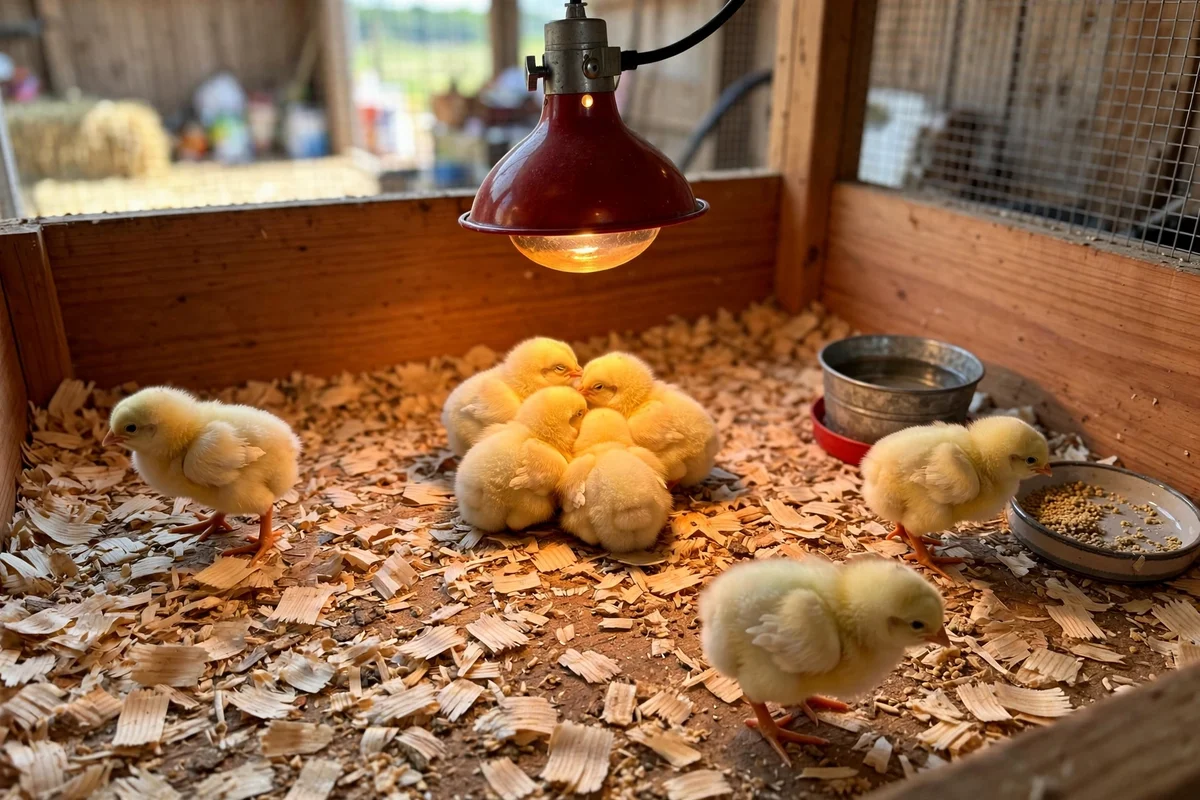
How to tell if chicks are too hot or too cold?
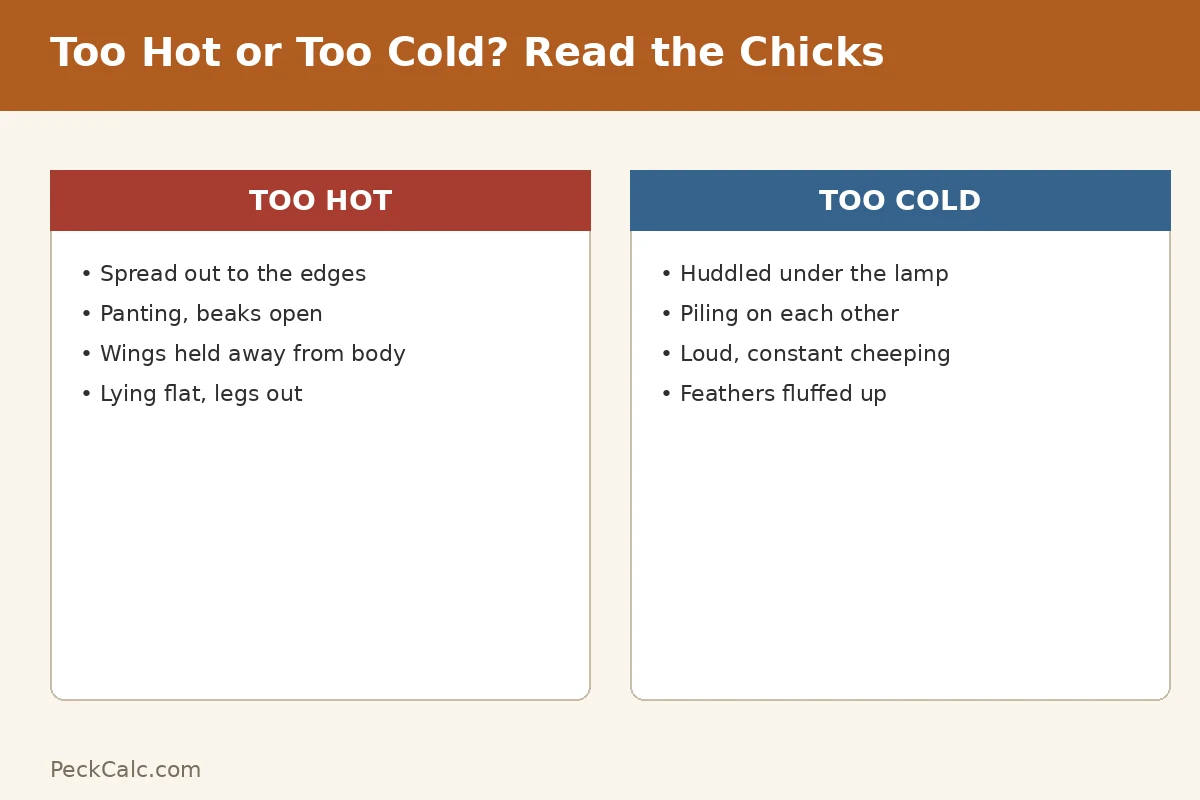
You can tell if chicks are too hot or too cold by watching where they sit and how they behave: chicks that are too hot spread out to the cool edges of the brooder, pant with open beaks, and hold their wings away from their bodies.
While chicks that are too cold huddle tightly under the heat lamp, pile on top of each other, and cheep loudly without stopping.
Chicks that are comfortable spread out evenly, eat, drink, and sleep in short bursts.
The brooder should have a warm end and a cool end, so the chicks can choose where to sit, and their choice is the best thermometer you have. A chick that is too hot will move away from the heat, and a chick that is too cold will move towards it, and if the brooder is set up correctly, the chicks will sort themselves out. A brooder with no cool end gives the chicks no choice, and that is when trouble starts.
The signs appear quickly, within minutes of a temperature change, so check the brooder often in the first few days, especially at night when the room cools down. A chick that is too cold will chill fast, and a chilled chick can die within hours, so the first week is the critical period, and the keeper's attention matters most then.
A thermometer in the brooder helps, but the chicks are the better guide, because a thermometer measures the air in one spot, while the chicks tell you how the whole brooder feels. Use both: set the temperature by the guide below, and then watch the chicks and adjust.
Signs chicks are too hot
The signs that chicks are too hot are panting with the beak open, holding the wings away from the body, spreading out to the far edges of the brooder, and lying flat with the legs stretched out. The chicks may also drink a lot of water, eat less, and seem lethargic, and their droppings may become watery.
Panting is the clearest sign, because chicks do not normally breathe with their beaks open. A chick that is panting is trying to lose heat, and it needs a cooler brooder at once. The wings held away from the body are another cooling behaviour, because the skin under the wings is bare and loses heat quickly when it is exposed to the air.
Chicks that are too hot will move as far from the heat lamp as they can, and they will crowd into the cool corners of the brooder. If the whole brooder is hot, the chicks will have nowhere to go, and they will lie flat and pant, which is a sign of serious overheating. Overheating can kill chicks quickly, especially in a small brooder with no ventilation.
To fix an overheated brooder, raise the heat lamp, switch to a lower wattage bulb, or turn the lamp off for a while, and make sure the brooder has ventilation and a cool end. Offer cool, fresh water, and check the chicks every half hour until they are behaving normally again. Do not put ice in the water, because very cold water can chill a small chick.
Signs chicks are too cold
The signs that chicks are too cold are huddling tightly together under the heat lamp, piling on top of each other, cheeping loudly and constantly, and standing with their feathers fluffed up and their heads tucked in. The chicks may also stop eating and drinking, and they may feel cold to the touch when you pick them up.
Loud, constant cheeping is the clearest sign of cold, because a comfortable chick cheeps softly and intermittently, while a cold chick cheeps loudly and without stopping. The cheeping is a distress call, and it means the chick is cold and needs heat at once. A brooder full of loudly cheeping chicks is a brooder that is too cold.
Huddling is normal in small amounts, because chicks sleep in a pile for warmth, but tight huddling under the lamp, with the chicks pressed together and not moving, is a sign that the brooder is too cold. The chicks are trying to share body heat, and they will stay in the pile until the temperature rises.
To fix a cold brooder, lower the heat lamp, check that the bulb is working, and make sure there is no draught. Add bedding for insulation, and check the room temperature, because a brooder in a cold garage will need more heat than one in a warm house. Warm the chicks by cupping them gently in your hands, and do not put a cold chick straight under a very hot lamp, because the sudden change can shock it.
Why are my chicks huddling together?
Chicks huddle together for warmth, comfort, and security, and a small amount of huddling is normal, especially when they sleep. Baby chicks sleep in a pile, with their heads resting on each other, and they huddle under the heat lamp when they are cold, in a corner when they are frightened, and together at night when the room cools down.
Huddling becomes a problem when the chicks pile on top of each other, because the chicks at the bottom of the pile can be smothered, and piling is a real cause of death in young chicks. Piling happens when the brooder is too cold, when there is a draught, when the chicks are frightened by a loud noise or a sudden light, or when the brooder is too small and the chicks have nowhere else to go.
The signs of dangerous piling are a tight, tall pile of chicks that does not break up, chicks at the bottom that are not moving, and loud, distressed cheeping from the pile. If you see a pile, break it up gently with your hands, warm the chicks, and fix the cause: raise the temperature, block the draught, and give the chicks more space.
To prevent piling, keep the brooder at the right temperature, make sure there is no draught, give the chicks enough space, and use a heat plate rather than a lamp if you can, because a heat plate gives the chicks a warm surface to huddle under without a bright light that can frighten them. A brooder with a warm end and a cool end, and enough space for all the chicks to sit without piling, is the best prevention.
Brooder temperatures by week
Brooder temperatures start at about ninety-five degrees Fahrenheit, or thirty-five degrees Celsius, in the first week, and they drop by five degrees Fahrenheit, or about three degrees Celsius, each week, until the chicks are fully feathered at about six weeks and no longer need extra heat.
The temperature is measured at chick level, under the heat source, and the brooder should have a cooler end where the temperature is lower.
The weekly guide is a starting point, not a rule, because the chicks' behaviour matters more than the thermometer. If the chicks are huddling, raise the temperature, and if they are panting, lower it, whatever the thermometer says. The room temperature, the size of the brooder, and the number of chicks all affect the temperature the chicks actually feel.
A heat lamp is the traditional heat source, but a heat plate is safer and more natural, because it mimics a mother hen and the chicks can huddle under it without a bright light. A heat plate also uses less electricity and cannot start a fire if it falls, which is a real risk with a heat lamp. Whichever you use, secure it firmly so it cannot fall into the bedding.
By six weeks, the chicks should be fully feathered and ready to go outside, provided the weather is mild and the coop is dry and draught-free. Move them out gradually, starting with a few hours outside in the day, and bring them in at night for the first few days, until they are used to the outdoor temperature.
Fixing a brooder that is too hot or too cold
Fixing a brooder that is too hot or too cold starts with the heat source: raise the lamp or switch to a lower wattage bulb if the chicks are hot, and lower the lamp or switch to a higher wattage bulb if the chicks are cold.
A small change, a few inches up or down, can make a big difference to the temperature at chick level.
Check the brooder size as well, because a brooder that is too small will overheat, and a brooder that is too large will have cold corners. The brooder should be large enough for the chicks to move away from the heat, and small enough that the heat reaches the chicks. As the chicks grow, they will need a larger brooder, so plan to move them to a bigger space at two to three weeks.
Check for draughts, because a draught can chill chicks even in a warm brooder, and a draught at chick level is worse than a draught at the top of the brooder. Block any gaps at the base of the brooder, and keep the brooder away from doors and windows that open. A brooder in a garage needs more protection from draughts than one in a house.
Finally, check the bedding, the water, and the feed, because a brooder that is too hot will dry out the bedding and the water, and a brooder that is too cold will make the chicks stop eating and drinking. Keep the water fresh and at room temperature, keep the feed available at all times, and check the chicks often in the first week, when they are most vulnerable.
| Age | Temperature under heat | Behaviour to expect |
|---|---|---|
| Week 1 | 95 F / 35 C | Sleep in a pile; eat and drink often |
| Week 2 | 90 F / 32 C | More active; explore the brooder |
| Week 3 | 85 F / 29 C | Feathers growing; less huddling |
| Week 4 | 80 F / 27 C | Active; use the cool end |
| Week 5 | 75 F / 24 C | Mostly feathered |
| Week 6 | 70 F / 21 C | Fully feathered; ready for outside |
Sources: poultry.extension.org.
Related tools and guides
For more on the same topic, see How to Raise Baby Chicks.
Frequently asked questions
How to tell if chicks are too hot or too cold?
Chicks that are too hot spread out, pant with open beaks, and hold their wings away from their bodies. Chicks that are too cold huddle under the lamp, pile up, and cheep loudly without stopping.
Why are my chicks huddling together?
Chicks huddle for warmth, comfort, and security, and a small amount is normal. Tight piling is dangerous, because chicks at the bottom can be smothered. Break up piles, warm the chicks, and fix the cold or draught that caused it.
Can chicks smother each other by piling?
Yes. Piling is a real cause of death in young chicks. It happens when the brooder is too cold, draughty, frightening, or too small. Give the chicks the right temperature, space, and a heat plate if you can.
What temperature should a brooder be in the first week?
About ninety-five degrees Fahrenheit, or thirty-five degrees Celsius, under the heat source, with a cooler end where the chicks can move away. Drop the temperature by five degrees each week.
Do chicks need heat at night?
Yes, in the first weeks. Chicks cannot regulate their own temperature, and they need heat day and night until they are fully feathered at about six weeks.
About the author
John Walker is the founder of PeckCalc and has kept backyard chickens in Dallas, Texas since 2017. He started PeckCalc to give backyard keepers free calculators and guides with every figure traced to a university extension source.