
Largest Chicken Breeds
 By John Walker · Backyard chicken keeper in Dallas, Texas since 2017
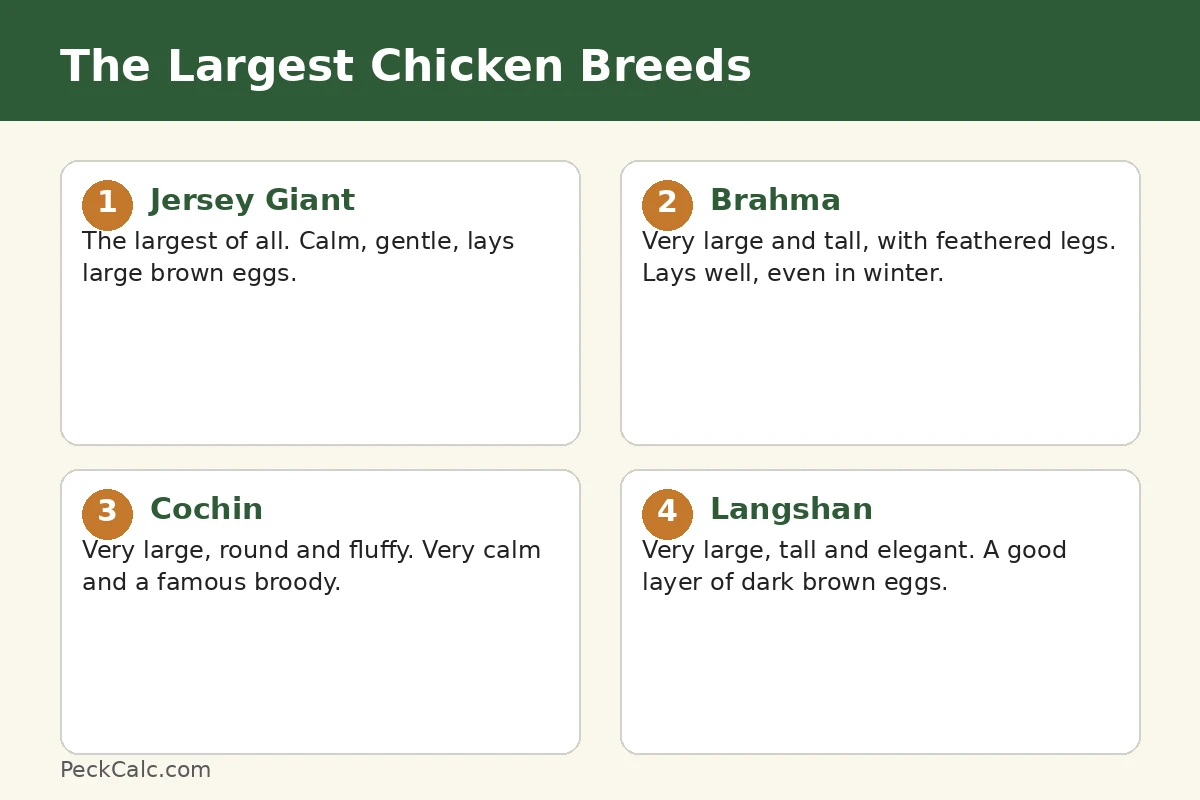
The largest chicken breeds are gentle giants, birds that can weigh as much as a small dog and stand taller than a knee, and they are kept for their size, their calm nature and their dual-purpose value. The Jersey Giant is the largest of all, followed by the Brahma, the Cochin and the Langshan, and each one has its own strengths. This guide compares the biggest breeds, explains how big they really get, and covers the housing, feeding and care that a giant bird needs.
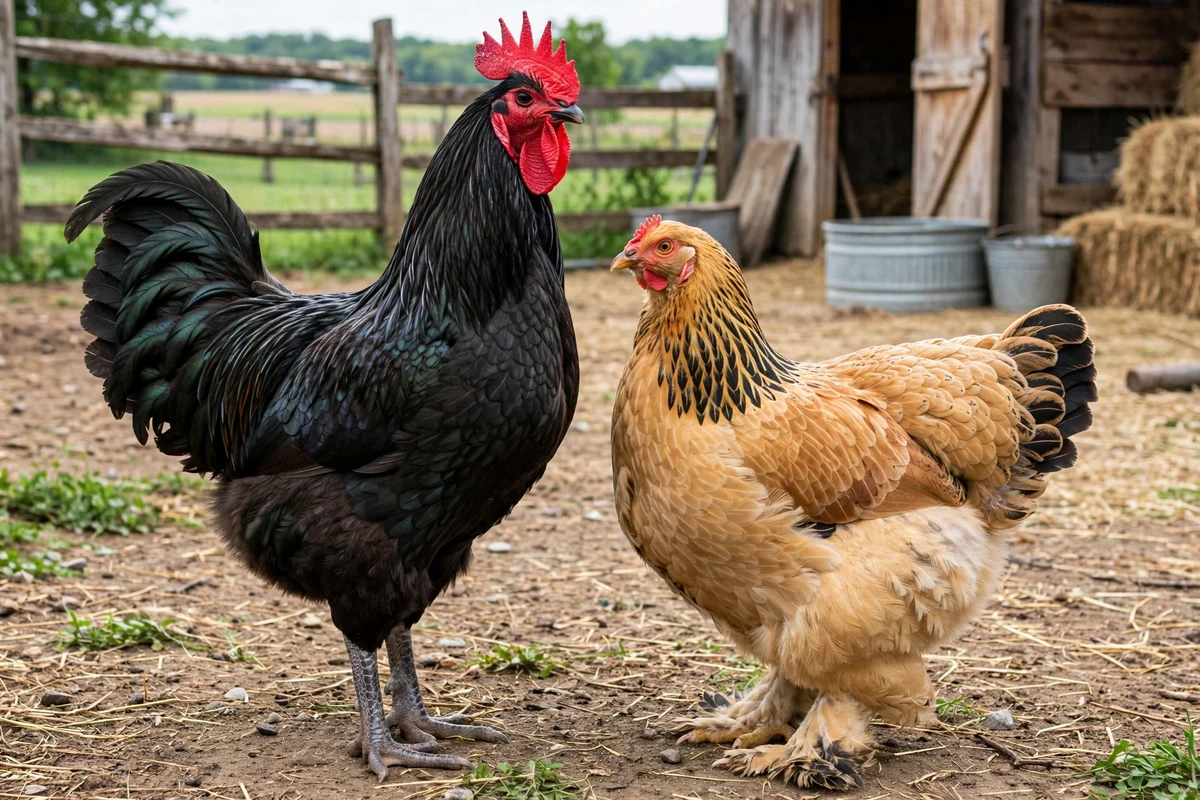
Largest chicken breeds: the giants
The largest chicken breeds are the Jersey Giant, the Brahma, the Cochin and the Langshan, and they are all dual-purpose birds, which means they are kept for both eggs and meat. They are calm, hardy and slow to mature, and they need more space, more feed and stronger housing than a normal bird.
Dual-purpose means a breed that lays a reasonable number of eggs and also grows large enough to be worth eating, and the giant breeds are the best example. They were developed in the days when a flock had to do both jobs, and they are still valued for that reason, even though most keepers now keep them as pets and layers.
The Jersey Giant is the largest chicken breed, and it was developed in New Jersey in the late 1800s as a replacement for the turkey, which is why it grows so large. The Brahma, the Cochin and the Langshan all came from Asia, and they were the wonder birds of the Victorian poultry fancy, when giant chickens were a craze.
Giant breeds grow slowly. A normal layer is full-grown in five or six months, but a Jersey Giant can take a year or more to reach its full size, and it eats a great deal while it grows. That slow growth is part of the cost of keeping a giant, and it is worth knowing before you buy.
Jersey Giant: the largest of all
The Jersey Giant is the largest chicken breed, with cocks growing to a large size and hens only a little smaller, and it is a calm, friendly bird that lays large brown eggs. It was developed in the United States as a meat bird, and it is still the biggest breed you can buy.
Jersey Giants are black, white or blue, with clean legs and a single comb, and they have a long, broad body that looks more like a small turkey than a chicken. They are slow to mature, taking a year or more to reach full size, and they eat more than a normal bird, because they are building a much larger body.
Despite their size, Jersey Giants are gentle. They are calm, easy to handle, and good with children, and they are not bullies in a mixed flock, though their sheer size can intimidate smaller birds. They are hardy in cold weather, because their large bodies hold heat well, and they are reasonable layers, giving a good number of large brown eggs.
Their size brings practical problems. They need a large coop with a low roost, because a heavy bird that jumps down from a high roost can injure its legs, and they need a strong run, because a large bird can push through a flimsy fence. They also need more feed, and they are more prone to leg problems if they grow too fast on a rich diet. Our guide on Jersey Giant chickens covers the breed in full.
Brahma, Cochin and Langshan
Brahma, Cochin and Langshan are the other giant breeds, and each one has its own look: the Brahma is tall and heavily feathered, the Cochin is round and fluffy, and the Langshan is tall and elegant. All three are calm, hardy and good layers for their size.
The Brahma is a tall, powerful bird with feathered legs and feet, a small pea comb, and a calm, almost regal manner. It comes in light, dark and buff colours, and it is a good layer of brown eggs, even in winter, which is unusual for a large breed. Brahmas are one of the most popular giant breeds, because they are beautiful, gentle and hardy.
The Cochin is a round, fluffy bird with heavily feathered legs and feet, and it looks like a ball of feathers with a beak. It is very calm and very broody, which makes it a good mother, but it is not a heavy layer, and its feathered feet need care in wet weather, because the feathers collect mud and can harbour mites.
The Langshan is a tall, elegant bird with clean legs, a long body and a tail carried high. It is a good layer of dark brown eggs, and it is more active than the Brahma or the Cochin, which means it forages well and needs a little more space. It is less common than the Brahma, but it is worth seeking out for its looks and its laying.
How big do they really get?
Giant chicken breeds grow much larger than a normal layer, and the difference is easy to see when a Jersey Giant stands next to a Leghorn. A giant cock can stand taller than a knee, and a giant hen can outweigh a normal hen by half as much again or more.
Size is measured in weight and in height, and both matter. A Jersey Giant cock is the heaviest, and a Brahma cock is nearly as heavy, while a Cochin is shorter and rounder, so it looks smaller even though it weighs a great deal. The Langshan is the tallest, with long legs and a high tail, so it looks larger than it weighs.
Giant breeds also take longer to grow. A normal layer reaches full size in five or six months, but a giant can take nine months to a year, and a Jersey Giant can take even longer. That slow growth means the birds eat a great deal of grower feed, and they do not start laying until later than a normal pullet, which is a cost worth budgeting for.
Use the chicken coop size calculator to work out how much space a giant flock needs, because the standard allowance for a normal bird is not enough. A giant needs more floor space, more roost space, a larger nest box, and a stronger door, because it is heavier and it pushes harder than a normal bird.
Temperament and eggs
Giant chicken breeds are calm, gentle and easy to handle, and they are among the best breeds for families with children. They are not flighty, they do not panic easily, and they are less likely to be aggressive than many smaller breeds.
Their calm nature is one reason they are so popular, and it is also a practical advantage: a calm bird is easier to handle, easier to check for illness, and less likely to injure itself by panicking. A giant hen that trusts you will let you pick her up, check her feet, and look at her vent without a struggle, which makes routine care much easier.
Giant breeds lay a reasonable number of eggs, and the eggs are large and brown. A Brahma or a Jersey Giant may lay a good number of eggs in a year, which is fewer than a Leghorn but more than a Cochin, and they often lay through the winter, when lighter breeds stop. The eggs are large, with strong shells, and they are good for eating and for baking.
Giant hens are often broody, especially Cochins and Brahmas, and they make good mothers, because their large bodies can cover many eggs and keep the chicks warm. A broody giant is a formidable sight, and she will defend her nest fiercely, so give her a quiet corner and leave her alone while she sits.
Housing, feeding and care for giants
Giant chicken breeds need a large, strong coop with low roosts, a big run, plenty of feed and a close eye on their legs. Their size is their charm, and it is also their main care problem, because everything they use must be built for a heavier bird.
Build the coop strong, with a low roost no higher than knee height, and a ramp so the birds can walk up instead of jumping. A heavy bird that jumps down from a high roost can injure its legs, and leg injuries are the most common health problem in giant breeds. Use a thick, flat roost that the bird can grip without curling its toes hard, and put deep, soft bedding underneath to cushion landings.
Feed a complete feed suited to the bird's age, and do not overfeed, because a giant that grows too fast can develop leg problems. Grower feed for young birds, layer feed for laying hens, and a close eye on weight are the essentials. A giant eats more than a normal bird, so budget for a larger feed bill, and keep oyster shell available for the hens.
| Breed | Size | Eggs | Temperament |
|---|---|---|---|
| Jersey Giant | Largest of all | Large brown, good number | Calm, gentle, hardy |
| Brahma | Very large, tall | Brown, good number, lays in winter | Calm, regal, hardy |
| Cochin | Very large, round and fluffy | Brown, fewer, very broody | Very calm, excellent mother |
| Langshan | Very large, tall and elegant | Dark brown, good number | Calm, active, good forager |
Check the legs and feet often, because feathered legs can hide mites and mud, and heavy birds are more prone to bumblefoot, which is an infection of the foot pad. Our guides on Brahma chickens and chicken breed size chart cover the breeds and the sizes in more detail, and our guide on best dual-purpose chicken breeds explains where the giants fit into a flock kept for both eggs and meat.
Sources: breed background from the poultry pages at poultry.extension.org and the University of Minnesota Extension. Breed sizes and standards vary by country; check your national breed club for the current standard.
Related tools and guides
For more on the same topic, see Brahma Chickens and Jersey Giant Chickens.
Frequently asked questions
What is the largest chicken breed?
The Jersey Giant is the largest chicken breed, with cocks growing larger than any other breed. Brahmas, Cochins and Langshans are the other giant breeds, and all four are calm, hardy, dual-purpose birds kept for both eggs and meat.
How big do Jersey Giants get?
Very big. A Jersey Giant cock is the heaviest chicken you can buy, and a hen is only a little smaller. They grow slowly, taking a year or more to reach full size, and they need a large coop, a low roost and more feed than a normal bird.
Are large chicken breeds good layers?
Reasonably good. Giant breeds lay a good number of large brown eggs, and Brahmas and Jersey Giants often lay through the winter, when lighter breeds stop. They lay fewer eggs than a Leghorn, but the eggs are larger, and the birds also make good mothers.
Are giant chicken breeds friendly?
Yes. Giant breeds are calm, gentle and easy to handle, and they are among the best breeds for families with children. They are not flighty, they do not panic easily, and they are less likely to be aggressive than many smaller breeds.
What housing do large chicken breeds need?
A large, strong coop with a low roost and a ramp, deep soft bedding, a big run, and larger nest boxes. Heavy birds that jump from high roosts can injure their legs, so keep the roosts low and the bedding deep, and check the legs and feet often.
About the author
John Walker is the founder of PeckCalc and has kept backyard chickens in Dallas, Texas since 2017. He started PeckCalc to give backyard keepers free calculators and guides with every figure traced to a university extension source.