
Redcap Chickens: The Derbyshire Breed Guide
 By John Walker · Backyard chicken keeper in Dallas, Texas since 2017
Redcap chickens, properly called Derbyshire Redcaps, are a rare English breed known for one striking feature: a huge rose comb that can be more than twice as long as it is wide. They are active, hardy foragers and good layers of white eggs, but they are hard to find, because few breeders keep them. This guide explains the breed's history, looks, temperament, and what it takes to keep Redcaps.
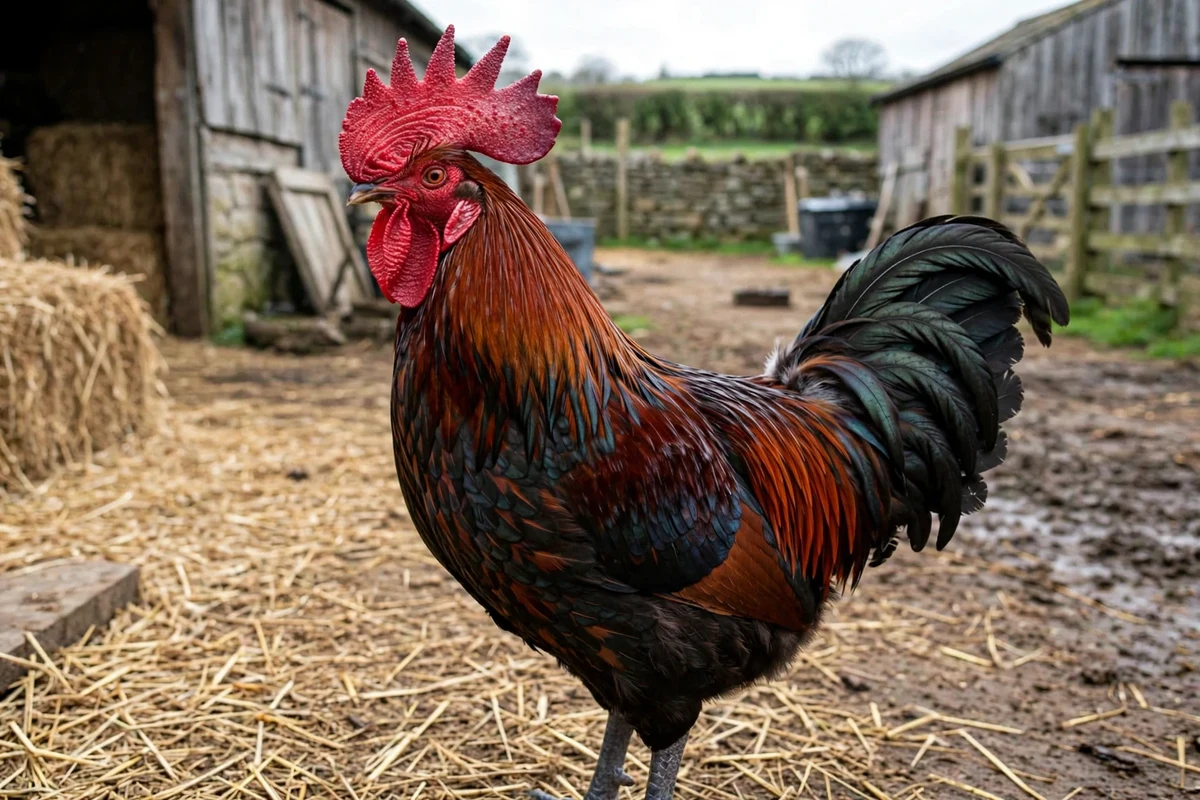
What are Redcap chickens?
Redcap chickens are an English breed from Derbyshire, and they are one of the oldest breeds in Britain. They were kept by farmers in the Peak District for eggs and meat, and they were valued for their hardiness and their ability to forage on rough ground.
The breed is now rare, and it is on the watchlist of the Rare Breeds Survival Trust.
The breed is named for its comb, which is a large rose comb that is much longer than it is wide. The comb is the biggest of any breed, and it is the feature that defines a Redcap. A good Redcap comb is wide, flat, and covered in small points, and it ends in a spike that points backwards.
Redcaps are a medium to large breed, with hens weighing around 2.5 kilograms and roosters around 3 kilograms. They are active and alert, and they do best in a free range system where they can forage. They are not a good choice for a small pen, because they need room to move.
The Redcap comb: the breed's signature
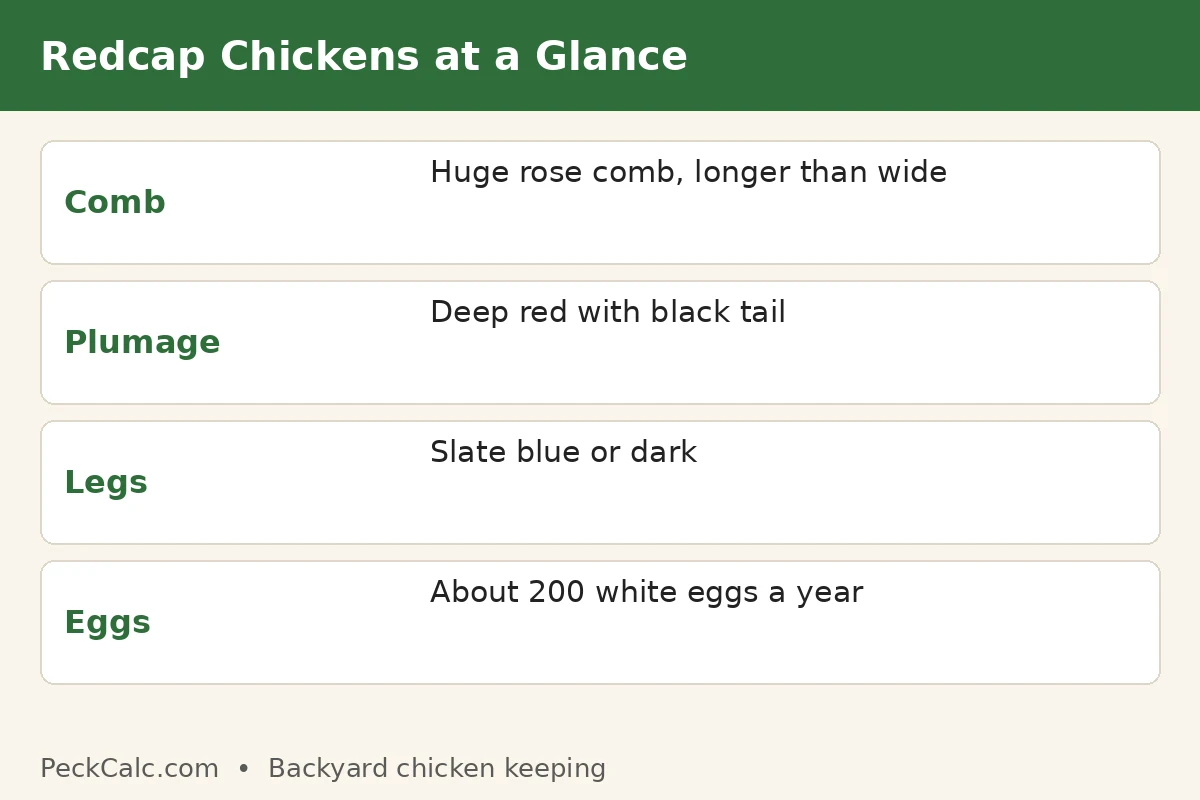
The Redcap comb is a rose comb, which is a low, flat comb that sits close to the head, but in the Redcap it is very large. The breed standard calls for a comb that is more than twice as long as it is wide.
and the best birds have a comb that is wide at the front and narrows to a spike at the back.
The comb is red, and it should be smooth and free of lumps. The surface is covered in small, even points, and the spike at the back should point straight backwards. A comb that is too small, or that has a side sprig, is a fault, and the bird should not be bred from if you want to keep the breed true.
The large comb is a sign of health and vigour, but it can be a problem in cold weather, because a big comb is more likely to get frostbite. In a cold climate, protect the comb with petroleum jelly on frosty nights, and make sure the coop is dry and draught free. A frostbitten comb is painful, and it can become infected.
What do Redcap chickens look like?
A Redcap chicken has rich, dark plumage, with a deep red body and black tail and wings. The feathers are close and glossy, and the bird looks smart and well turned out. The legs are slate blue or dark, and the beak is dark horn. The eyes are red or bay, and the face is red.
The hens are smaller than the roosters, and their plumage is a softer red, with less black in the tail. The roosters have a more striking pattern, with a deep red saddle and hackle, and a black tail with a green sheen. Both sexes have the large rose comb, but the rooster's comb is bigger and more prominent.
Redcaps are sometimes confused with other red breeds, such as the Rhode Island Red, but the comb gives them away. A Rhode Island Red has a single comb, while a Redcap has a large rose comb. The body shape is also different, because the Redcap is longer and more active in build.
Redcap chicken temperament and behaviour
Redcap chickens are active, alert, and independent, and they are excellent foragers. They like to roam over a wide area, scratching for insects and seeds, and they will range further than most breeds if they are allowed to. They are hardy birds, and they cope well with rough weather and poor ground.
The hens are not lap chickens, and they do not like to be handled much. They are calm with people they know, but they are wary of strangers, and they will keep their distance. The roosters are alert and protective, and they will sound the alarm if a hawk or a fox is near, which makes them good flock guardians.
Redcaps are good fliers, and they will fly over a low fence to get to better foraging. A fence of at least 1.8 metres is needed, and a covered run is better if you live near a road. They are also noisy when they are startled, so they are not the best choice for a small garden in a built-up area.
How many eggs do Redcap chickens lay?
Redcap hens lay around 200 white eggs a year, which is a good number for a heritage breed. The eggs are medium to large, white, and well shaped, and the hens lay steadily through spring and summer. They slow down in winter, and they may stop altogether in the coldest months.
The hens rarely go broody, which is good if you want eggs, because a broody hen stops laying. If you want to hatch Redcap chicks, you will need an incubator or another broody hen, because the Redcap hens are not reliable sitters. The chicks grow fast and feather up quickly, and they are hardy from a young age.
Redcap hens start laying at around 20 to 24 weeks old, which is normal for a heritage breed. Feed a good layer feed with oyster shell, and the shells will be strong and the yolks deep yellow. The hens are good layers for their size, and they keep laying well into their second and third years.
How to keep Redcap chickens
Redcap chickens need space, and this is the most important part of keeping them. Give each bird at least 4 square metres of run space, and more if you can, because they are active foragers. A small run will make them bored and stressed, and they will feather peck and fight.
Free range is best, with a secure coop for the night.
The coop should be dry, well ventilated, and draught free, because the large comb is prone to frostbite. Give each bird 25 to 30 centimetres of roost space, and make sure the roost is strong enough to hold their weight. The nest boxes should be dark and private, and one box for every four hens is enough.
Feed a good quality layer feed, and let the birds forage for grass, insects, and seeds. Redcaps are good at finding their own food, but they still need a balanced feed as the main part of their diet. Our chicken feed calculator can help you work out how much feed your flock will need.
Check the large rose comb in cold weather, and smear a little petroleum jelly on it before a frosty night to guard against frostbite. A dry, draught-free coop matters more than extra heat, because damp air and draughts cause frostbite faster than cold air alone.
Why Redcap chickens are rare
Redcap chickens are rare because they were never a commercial breed, and they were kept only by a small number of farmers in Derbyshire. When farming changed and commercial hybrids took over, the Redcap almost disappeared, and it was saved only by a few dedicated breeders who kept the bloodline alive.
The breed is now on the watchlist of the Rare Breeds Survival Trust, which means there are only a small number of breeding birds left. The trust works to save rare breeds by supporting breeders and encouraging keepers to take them on. Keeping Redcaps is a way to help save a piece of farming history.
Finding Redcap chicks can be hard, because few hatcheries stock them. You will usually need to buy from a breeder, and you may need to join a waiting list. Check that the breeder is honest about the bloodline, and ask to see the parent birds before you buy, so you can check the comb and the plumage.
Are Redcap chickens right for you?
Redcap chickens are right for you if you have space, you like a rare and striking breed, and you want a good layer of white eggs. They are hardy, active, and good foragers, and they are a talking point in any flock. Keeping them also helps save a rare breed, which is a good reason on its own.
They are not right for you if you have a small backyard, if you want a friendly lap chicken, or if you want the maximum number of eggs. Redcaps are independent birds, they need room to roam, and they lay fewer eggs than a commercial hybrid. A small garden flock will be happier with a calmer breed.
If you decide to keep Redcaps, buy from a breeder who can show you the parent birds, and check the comb carefully before you pay. A good breeder will answer your questions, and will tell you honestly about the breed's needs. Our best chicken breeds for beginners guide can help you compare breeds.
Sources: poultry.extension.org and USDA Animal and Plant Health Inspection Service.
Related tools and guides
For more on the same topic, see How to Freeze Fresh Eggs.
Frequently asked questions
What are Redcap chickens?
Redcap chickens, properly Derbyshire Redcaps, are a rare English breed from Derbyshire, known for a huge rose comb that is more than twice as long as it is wide. They are active foragers and good layers of white eggs, and they are on the Rare Breeds Survival Trust watchlist.
How many eggs do Redcap chickens lay?
Around 200 medium to large white eggs a year. They lay steadily in spring and summer, slow down in winter, and rarely go broody. They start laying at 20 to 24 weeks old.
What is special about the Redcap comb?
It is the largest rose comb of any breed, wide and flat with small points and a spike at the back. The comb is the feature that defines the breed, but it can get frostbite in cold weather, so protect it on frosty nights.
Are Redcap chickens friendly?
They are calm with people they know but independent and wary of strangers, and they do not like to be handled much. They are excellent foragers and good flock guardians, and they range further than most breeds.
Why are Redcap chickens rare?
They were never a commercial breed and were kept by only a few farmers in Derbyshire. When commercial hybrids took over, the breed almost disappeared. Few hatcheries stock them, so you usually need to buy from a breeder and may join a waiting list.
About the author
John Walker is the founder of PeckCalc and has kept backyard chickens in Dallas, Texas since 2017. He started PeckCalc to give backyard keepers free calculators and guides with every figure traced to a university extension source.