
Rhode Island Red vs Plymouth Rock
 By John Walker · Backyard chicken keeper in Dallas, Texas since 2017
Rhode Island Red vs Plymouth Rock is a classic comparison, because both breeds are American dual-purpose birds, bred in the cold north-east of the United States, and both are among the most popular backyard breeds in the world. They look very different: the Rhode Island Red is a deep mahogany red, while the Plymouth Rock is barred, with black and white stripes. They lay differently too: the Rhode Island Red lays more eggs, while the Plymouth Rock is calmer and friendlier. This guide compares the two breeds side by side, so you can choose the one that suits your flock, your climate, and your family.
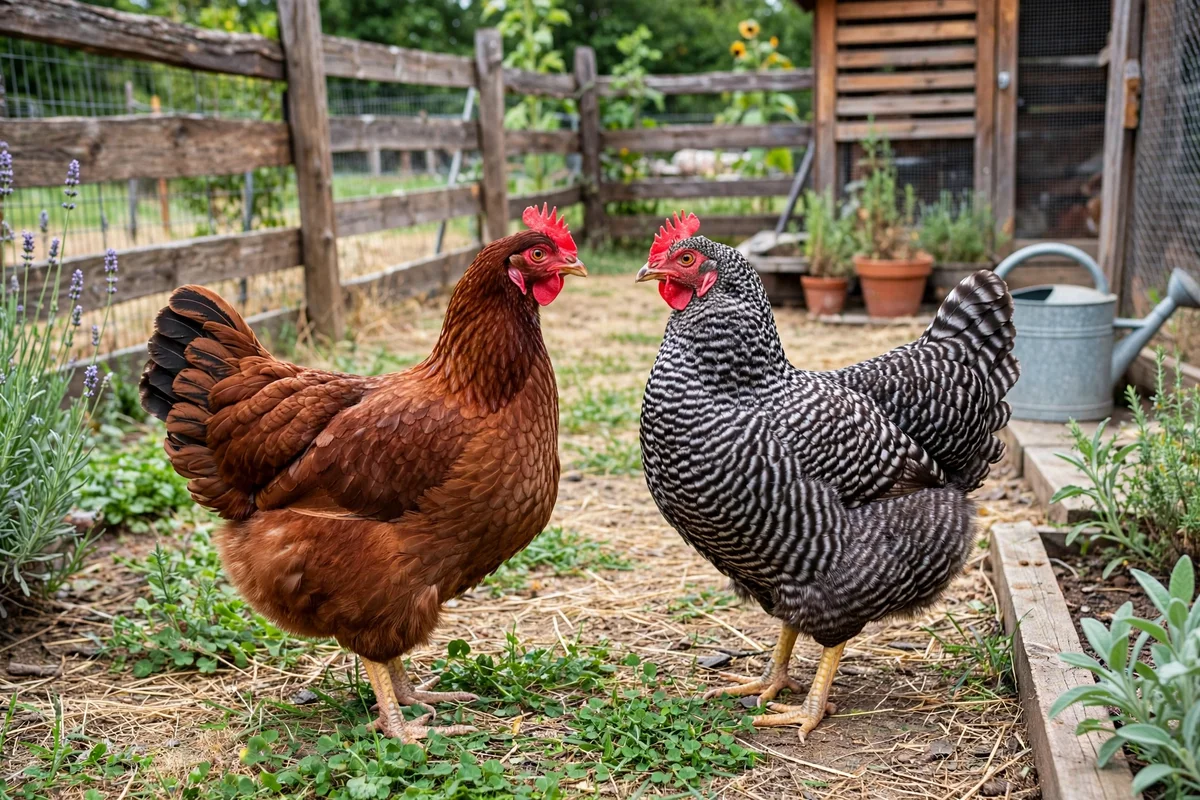
Rhode Island Red vs Plymouth Rock: the quick answer
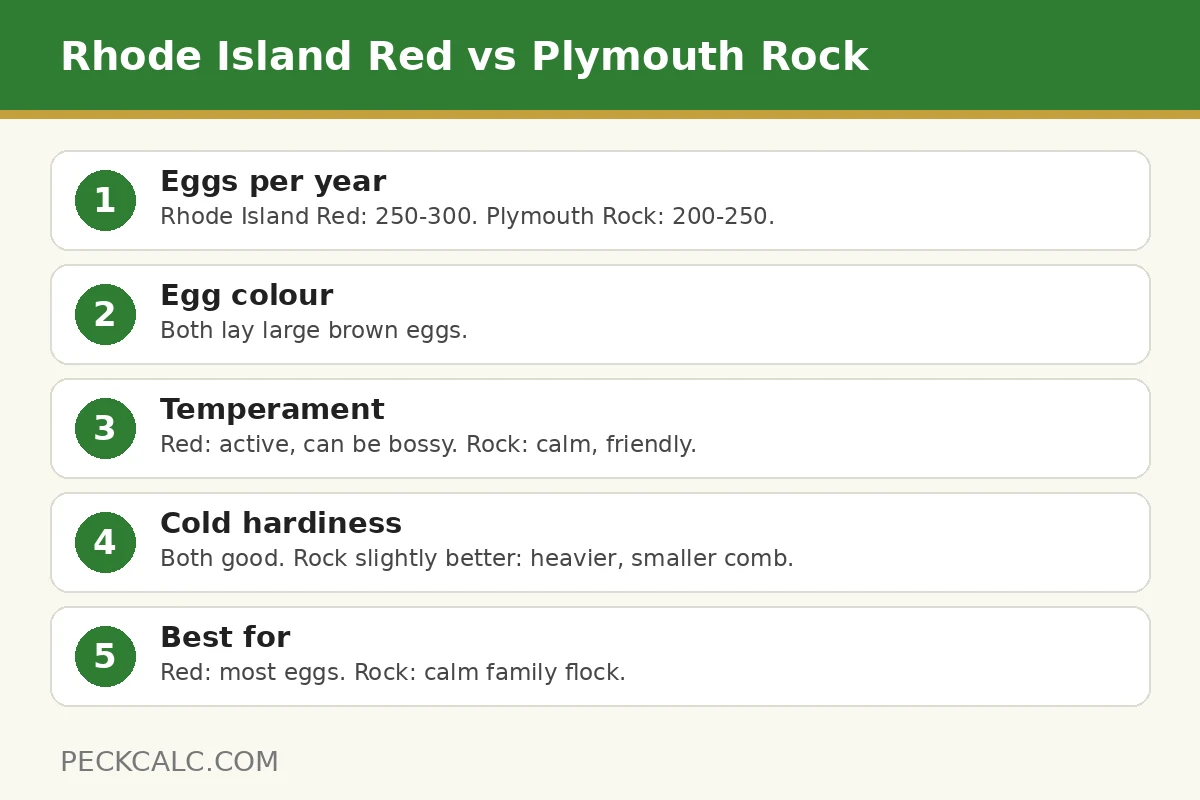
Rhode Island Reds lay more eggs, about 250 to 300 large brown eggs a year, while Plymouth Rocks lay about 200 to 250. Both are good layers, but the Rhode Island Red is the better layer, and it is the breed to choose if eggs are your first priority.
Plymouth Rocks are calmer and friendlier, and they are better with children and in a small backyard. Rhode Island Reds are more active and can be bossy, especially the cockerels, and they need a keeper who is firm with them. If temperament is your first priority, choose the Plymouth Rock.
Both breeds are cold hardy, because they were bred in the cold north-east of the United States, and both do well in a cold climate. Plymouth Rocks are slightly better in the cold, because they are heavier and have a smaller comb, which is less at risk of frostbite.
Both breeds are good for beginners, and both are dual-purpose, meaning they are kept for eggs and meat. The choice comes down to what you value most: the most eggs, or the calmest bird. Most keepers who want both will keep a few of each, because the two breeds live well together.
History of the two breeds
The Rhode Island Red was bred in Rhode Island in the late 1800s, from a mix of Asian and European breeds, and it was bred for laying and for meat. It became one of the most popular breeds in the world, and it is still one of the most common backyard breeds today.
The Plymouth Rock was bred in Massachusetts in the mid-1800s, and it was one of the first American breeds to be standardised. The barred pattern, with black and white stripes, is the most common variety, and it is the variety most keepers mean when they say Plymouth Rock.
Both breeds were bred for the same purpose: a hardy, dual-purpose bird that could lay well in a cold climate and provide meat for the table. They were bred before the modern hatchery breeds, and they are still valued for their hardiness, their laying, and their calm temperament.
The two breeds are often kept together, because they are similar in size and temperament, and they live well in a mixed flock. A keeper who keeps both will get the best of both: the Rhode Island Red eggs, and the Plymouth Rock calm.
Looks: red vs barred
Rhode Island Reds are a deep mahogany red, with a rich, dark red colour all over the body, and a slightly darker tail. The red is the same in both sexes, and the cockerels are a little brighter than the hens. The comb is a single comb with five points, and the legs are yellow.
Plymouth Rocks are barred, meaning they have black and white stripes all over the body, and the stripes are the same in both sexes. The barred pattern is created by a gene that stops the black pigment in bands, and it is the most distinctive feature of the breed. The comb is a single comb, and the legs are yellow.
The two breeds are easy to tell apart, because the red and the barred pattern are so different. A keeper who keeps both will never confuse them, and the barred pattern is the easiest way to tell a Plymouth Rock from any other breed.
Both breeds are medium to large, with the hens weighing about 3 kilograms and the cockerels weighing about 3.5 to 4 kilograms. The Plymouth Rock is slightly heavier, and it has a broader body, while the Rhode Island Red is slightly lighter and more upright.
Laying: which breed lays more eggs?
Rhode Island Reds lay more eggs, with about 250 to 300 large brown eggs a year, and they are one of the best laying dual-purpose breeds. A Rhode Island Red hen will lay five to six eggs a week in the laying season, and she will lay well through the winter, when many breeds stop.
Plymouth Rocks lay about 200 to 250 large brown eggs a year, with four to five eggs a week in the laying season. They are good layers, but they are not as prolific as Rhode Island Reds, and they take a longer break in winter.
Both breeds start laying at about five to six months of age, and both lay large brown eggs. The eggs are the same colour and size, and the only difference is the number: the Rhode Island Red lays more, and the Plymouth Rock lays fewer but steadier.
The Rhode Island Red is the better choice if eggs are your first priority, and the Plymouth Rock is the better choice if you want a steady layer that is also a calm, friendly bird. A keeper who wants both can keep a few of each, and the flock will lay well and be calm. Our guides on Rhode Island Red chickens and Plymouth Rock chickens explain each breed in full.
| Trait | Rhode Island Red | Plymouth Rock |
|---|---|---|
| Eggs per year | 250 to 300 | 200 to 250 |
| Egg colour | Brown | Brown |
| Body weight | 2.5 to 3.5 kg | 3 to 4 kg |
| Temperament | Active, can be bossy | Calm, friendly |
| Cold hardiness | Good | Very good |
| Broodiness | Rare | Occasional |
| Best for | Most eggs | Calm family flock |
Temperament: which breed is friendlier?
Plymouth Rocks are calmer and friendlier, and they are better with children and in a small backyard. They are curious, gentle, and easy to handle, and they will come for treats and enjoy being held. A Plymouth Rock hen is a good choice for a family with children.
Rhode Island Reds are more active and can be bossy, especially the cockerels, and they need a keeper who is firm with them. The hens are friendly enough, but they are more independent than Plymouth Rocks, and they are less likely to enjoy being held.
The difference is most obvious in the cockerels. A Rhode Island Red cockerel can be aggressive, especially in the breeding season, and he needs a keeper who is confident and firm. A Plymouth Rock cockerel is usually calmer, and he is a better choice for a keeper who is new to cockerels.
Both breeds do well in a mixed flock, and they live well together. A keeper who keeps both will find that the Plymouth Rocks are the calm birds, and the Rhode Island Reds are the active birds, and the flock will be lively and interesting.
Which breed should you choose?
Choose the Rhode Island Red if you want the most eggs, if you have a large run, and if you are confident with a more active breed. A Rhode Island Red flock will lay well, and it will be a productive flock, but it needs a keeper who is firm and who gives it space.
Choose the Plymouth Rock if you want a calm, friendly flock, if you have children, or if you are a beginner. A Plymouth Rock flock will lay well, and it will be a calm, easy flock to keep, and it is the better choice for a first flock.
Choose both if you want the best of both breeds, because the two live well together and the flock will lay well and be calm. A mixed flock of Rhode Island Reds and Plymouth Rocks is a common choice, and it is a good one.
Our guide on best dual-purpose chicken breeds explains the other dual-purpose breeds, and our chicken flock planner helps you work out how much space your flock needs. Whichever breed you choose, you will have a hardy, productive bird that is well suited to a backyard flock.
Sources: poultry.extension.org and University of Minnesota Extension, poultry resources.
Related tools and guides
For more on the same topic, see Rhode Island Red Chickens.
Frequently asked questions
Which lays more eggs, Rhode Island Red or Plymouth Rock?
Rhode Island Reds lay more eggs, about 250 to 300 a year, while Plymouth Rocks lay about 200 to 250. Both are good layers, but the Rhode Island Red is the better layer, and the Plymouth Rock is the calmer bird.
Which breed is friendlier?
Plymouth Rocks are calmer and friendlier, and they are better with children. Rhode Island Reds are more active and can be bossy, especially the cockerels, and they need a keeper who is firm with them.
Which breed is better in cold weather?
Both breeds are cold hardy, because they were bred in the cold north-east of the United States. Plymouth Rocks are slightly better in the cold, because they are heavier and have a smaller comb, which is less at risk of frostbite.
Are Rhode Island Reds and Plymouth Rocks good for beginners?
Yes, both breeds are good for beginners, and they are among the most popular backyard breeds. Plymouth Rocks are the better choice for a first flock, because they are calmer, while Rhode Island Reds are better for a keeper who wants the most eggs.
How can I tell a Rhode Island Red from a Plymouth Rock?
Rhode Island Reds are a deep mahogany red, while Plymouth Rocks are barred, meaning they have black and white stripes. The barred pattern is the easiest way to tell them apart, and it is the same in both sexes.
About the author
John Walker is the founder of PeckCalc and has kept backyard chickens in Dallas, Texas since 2017. He started PeckCalc to give backyard keepers free calculators and guides with every figure traced to a university extension source.