
When Do Chicks Start Perching
 By John Walker · Backyard chicken keeper in Dallas, Texas since 2017
Chicks start perching at around two to four weeks old, first on low objects in the brooder and later on proper roost bars. Perching is natural roosting behaviour, and it is a good sign that a chick is developing normally. Give them a low, safe perch from about two weeks old so they can practise without falling far.
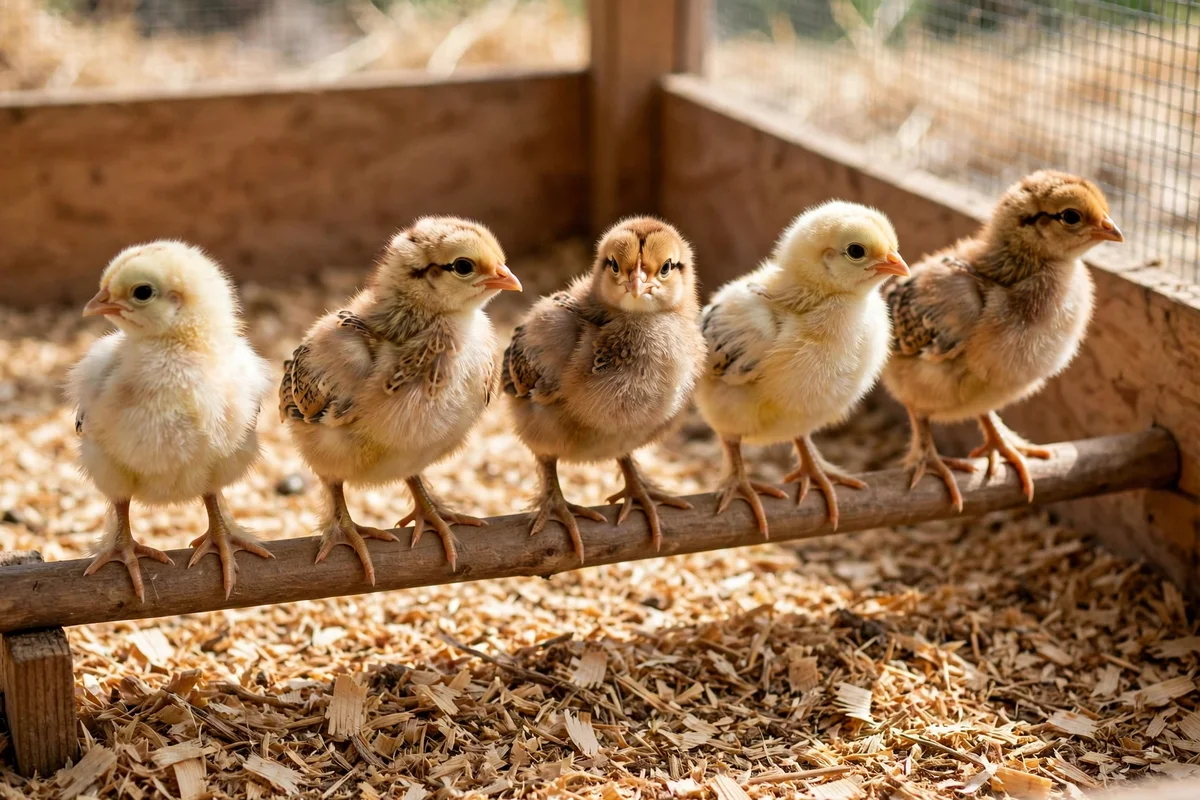
When do chicks start perching?
Most chicks start trying to perch at around two to four weeks old, first hopping onto low objects like the edge of the feeder, a small branch or a brick, and then onto a proper low perch. The exact age varies by breed and by individual: light, active breeds often perch earlier, while heavier breeds take a little longer.
Perching follows feathering. Chicks need wing feathers for balance and leg strength to grip, and both develop in the second and third weeks. A chick that is still mostly in down will not perch, and that is normal: perching comes when the body is ready for it, not before.
Give chicks the chance to practise by putting a low perch in the brooder from about two weeks old, and let them work it out in their own time. Forcing a chick onto a perch, or putting the perch too high, risks falls and frightens birds that are not ready yet.
What a first perch should look like
A first perch should be low, stable and easy to grip: a piece of wood about an inch wide, a small branch, or a short length of dowel, set only a few inches above the bedding. Chicks that fall from a low perch land on soft bedding and try again, while chicks that fall from a high perch can hurt themselves and lose confidence.
Keep the perch away from the heat lamp, so chicks do not overheat while sitting on it, and away from the waterer, so droppings do not fall into the water. A perch across one end of the brooder, in the cooler part, works well, and a second low perch gives more chicks a place to sit at once.
Check the perch is stable and cannot roll or tip when a chick lands on it. A perch that wobbles will put chicks off perching altogether, and a perch that rolls can trap a small foot. Fix it firmly in place and check it every few days as the chicks grow heavier.
How perching develops week by week
In the first week chicks stay on the brooder floor, sleeping in a pile under the heat and exploring on foot. Wing feathers appear in the first few days, and by the end of the second week chicks start hopping onto low objects and testing their balance with short, fluttery jumps.
By three to four weeks, most chicks are using a low perch regularly, and some will sleep on it at night instead of on the floor. This is a good sign: it shows their legs and wings are developing well, and it prepares them for roosting in the coop, where hens sleep on bars above the floor.
By five to six weeks, chicks should be confident perchers, able to hop up and down without fuss and to balance through the night. If your chicks are moving to the coop at this age, read our guide on when chicks can go outside first, and check the coop roost bars are low enough for young birds to reach.
Perching and roost space in the coop
Adult hens need roost bars that are wide enough to grip comfortably and spaced so birds do not crowd each other, and young birds moving into the coop need lower bars they can reach easily. A bar set too high for young pullets means they sleep on the floor, where they are colder and more exposed to draughts and parasites.
Work out how much roost space your flock needs with the roost space calculator, which uses your flock size to give a starting figure. Allow extra space for young birds that are still clumsy, and check that the bars are higher than the nesting boxes, because hens should roost on bars, not sleep in the boxes.
Roost bars should be made of wood rather than metal or plastic, because wood is easier to grip, does not get cold in winter, and does not cause foot problems. A rounded or flat-topped bar about two inches wide suits most breeds, and the bars should be set level so no bird ends up sleeping on a slope.
What if a chick will not perch?
Some chicks are simply slower than others, and a chick that is healthy, eating well and growing normally but perching a week later than its flockmates is usually nothing to worry about. Heavier breeds, late hatchers and chicks that were chilled early on can all be a little behind, and they catch up in their own time.
Check the perch itself before worrying about the chick. A perch that is too high, too thin, too slippery or too close to the heat lamp will be ignored by the whole group, not just one bird, and fixing the perch usually fixes the problem. Lower it, widen it or move it to a cooler spot and watch what happens.
A chick that never perches and also looks unwell, with drooping wings, a hunched back or a reluctance to move, should be checked over properly. Our guide on how to tell if a chicken is sick explains the signs to look for, and a poultry veterinarian can help if the chick is not improving.
Encouraging chicks to perch safely
Put the perch in early, keep it low, and let the chicks discover it on their own. Scattering a little feed near the perch draws them to it, and a perch near the feeder gives them a reason to hop up and down throughout the day.
Do not place chicks on the perch yourself: a chick that is put on a perch before it is ready will flutter off and may avoid the perch afterwards.
Add a second perch at a slightly different height once the chicks are using the first one, so they can practise hopping between levels. This builds the balance and leg strength they need for the coop roost, and it gives lower-ranking chicks a place to sit away from the birds that dominate the top perch.
The table below shows the usual perching timeline. Treat it as a guide, not a deadline: healthy chicks that are a little early or a little late are still normal, and the brooder setup matters more than the exact week.
For the wider picture of how chicks grow, including feathering and the move to the coop, see our guide on when baby chicks get their feathers.
| Chick age | Perching behaviour | What to provide |
|---|---|---|
| Week 1 | Stay on the floor | No perch needed yet |
| Week 2 | Hop onto low objects | Low perch a few inches up |
| Weeks 3 to 4 | Use a low perch regularly | Stable perch, second perch if space allows |
| Weeks 5 to 6 | Sleep on the perch | Perches at different heights, ready for the coop |
Sources: poultry.extension.org and University of Minnesota Extension poultry pages.
Related tools and guides
For more on the same topic, see How to Raise Baby Chicks.
Frequently asked questions
When do chicks start perching?
Chicks usually start trying to perch at two to four weeks old, first on low objects in the brooder and later on proper roost bars. Give them a low perch from two weeks old so they can practise safely.
How old are chicks when they feather out?
Most chicks start with wing feathers in the first week, then tail and back feathers, and they are mostly feathered by five to six weeks. The head and neck are the last to feather out.
What should I use as a first perch for chicks?
A low perch, a small branch or a brick works well as a first perch. Keep it low, stable and wide enough for small feet, and place it away from the heat lamp so chicks do not overheat while perching.
What if my chick will not perch at all?
Some chicks are just slower, especially heavier breeds and late hatchers. Give them a lower perch and more time, and check that nothing is blocking the perch. A chick that never perches and also looks unwell should be checked over.
Is perching normal for baby chicks?
Yes, perching is natural roosting behaviour and a good sign that a chick is developing normally. Wild chickens roost in trees at night, and domestic chicks keep the same instinct from a young age.
About the author
John Walker is the founder of PeckCalc and has kept backyard chickens in Dallas, Texas since 2017. He started PeckCalc to give backyard keepers free calculators and guides with every figure traced to a university extension source.