
Why Do Chickens Fight at Bedtime?
 By John Walker · Backyard chicken keeper in Dallas, Texas since 2017
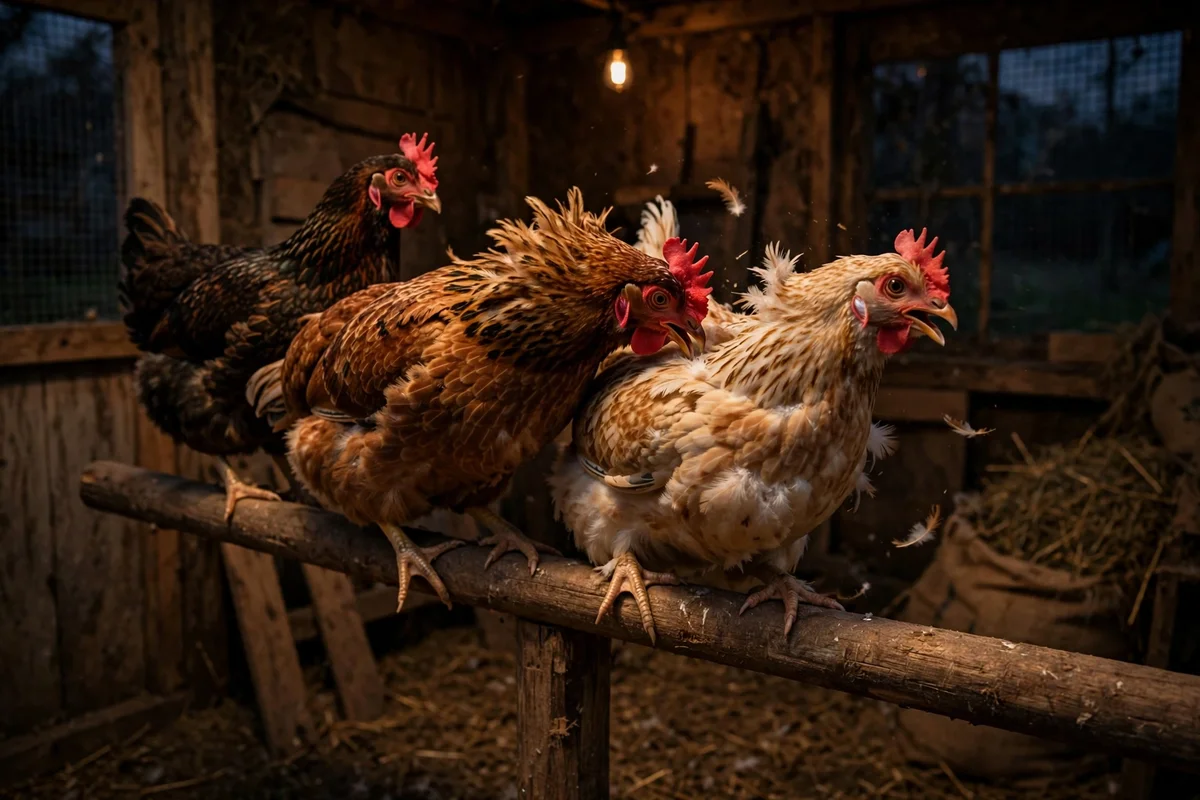
Why do chickens fight at bedtime? Chickens fighting at bedtime is a common and often noisy problem, and it is usually about the roost, not about a serious aggression problem. As dusk falls, the flock goes into the coop to roost, and the birds squabble over the best spots on the perch, with pecking, chasing and loud complaining. The fighting is mostly about the pecking order and about roost space, and it is worst when the roost is too short, too low, or when a new bird has joined the flock. This guide explains why chickens fight at bedtime and how to calm the roost.
Why do chickens fight at bedtime?
Chickens fight at bedtime because the roost is where the pecking order is settled each night, and the best spots on the perch are worth fighting over. The highest, warmest, safest spot on the roost is the most desirable, and the top-ranking birds claim it, while the lower-ranking birds are pushed to the edges or to a lower roost.
The squabbling is the flock sorting itself out, and it happens every evening, with the same birds in the same order, once the hierarchy is established.
The fighting is worst at dusk, because the birds are tired, they are competing for a place to sleep, and they are in a confined space. A flock that is peaceful during the day, foraging and dust bathing together, can become noisy and aggressive at bedtime, because the roost is a small space and the birds must settle close together. The squabbling is usually brief, with pecking, chasing and complaining, and it settles once the birds are in place.
The fighting is also worst when the roost is too short, because there is not enough space for every bird, and the lowest-ranking birds have nowhere to go. A roost that is too short forces the birds to crowd together, and the crowding causes pecking and chasing. A roost that is too low, or at the same height as the nest boxes, can also cause fighting, because the birds are competing for a place that is not clearly the best, and the hierarchy is not settled by height.
The short answer is that bedtime fighting is usually normal roost-time squabbling, driven by the pecking order and by roost space, and it is not the same as a serious aggression problem. The rest of this guide explains the causes in detail, how to tell normal squabbling from a problem, and how to calm the roost.
Pecking order and the roost
The pecking order is the social hierarchy of the flock, and it determines who eats first, who drinks first, and who gets the best roost spot. The top-ranking bird, usually an older hen or the rooster, gets the highest, safest spot, and the lowest-ranking bird gets the edge or the lowest roost.
The order is established by pecking, chasing and posturing, and it is reinforced every day, but it is most visible at bedtime, when the birds must settle close together.
A stable pecking order means a calm bedtime, because the birds know their place and they go to it without a fight. A new bird, a removed bird, or a change in the flock will disrupt the order, and the bedtime fighting will increase until the new order is settled, which can take a week or two. A flock that has recently had a bird added or removed will be noisier at bedtime, and the keeper should expect it and give it time.
The rooster, if there is one, usually roosts in the middle or at the highest point, and he will break up fights between the hens, or he will join in if the fight is over his position. A rooster that is aggressive at bedtime may be a rooster that is asserting his dominance, and a keeper should watch whether the rooster is causing the problem or solving it. A good rooster will keep the peace, while a bad rooster will make it worse.
Our guide on chicken pecking order explains the hierarchy in detail, and it is a useful companion to this guide. The pecking order is not a problem to be solved, but a natural social structure to be managed, and the bedtime squabbling is part of how it works. A keeper who understands the order will be less worried by the noise, and will know when the fighting is normal and when it is not.
Roost space: the most common cause of bedtime fights
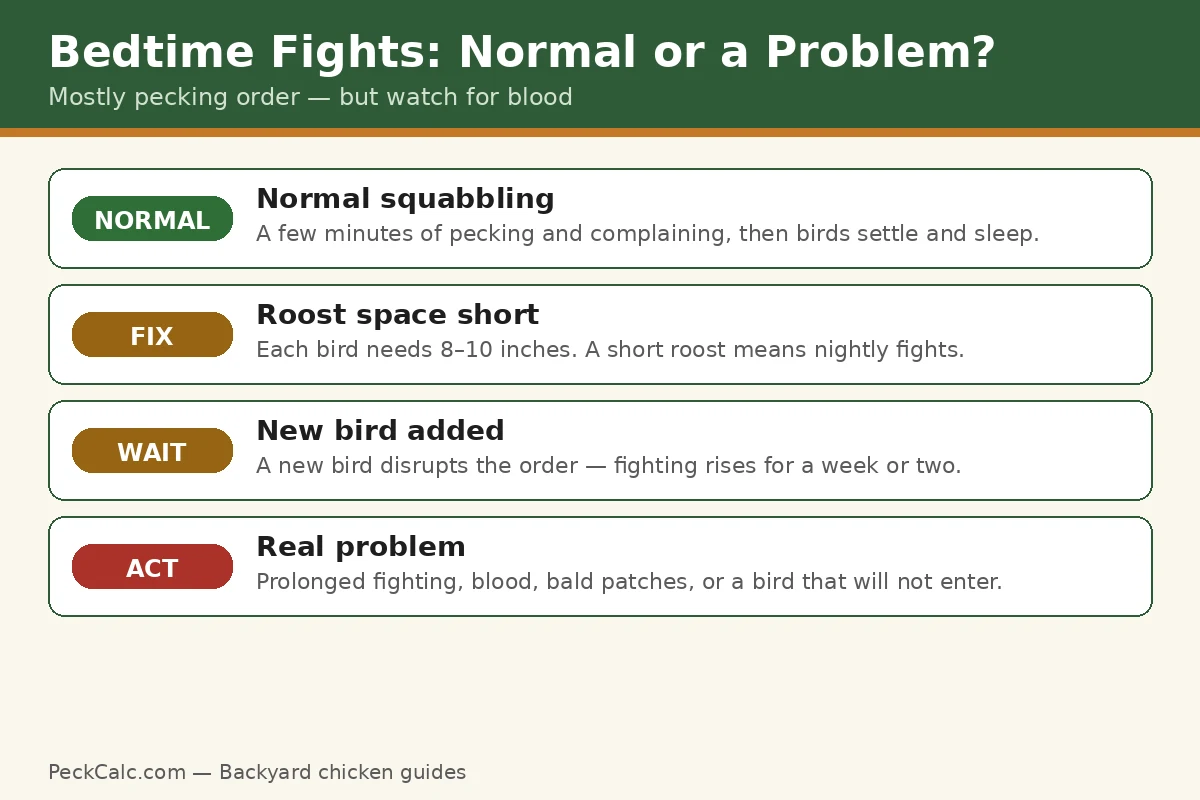
Roost space is the most common cause of bedtime fighting, and it is the easiest to fix. Each bird needs about eight to ten inches of roost space, and a roost that is too short will force the birds to crowd together, with the lowest-ranking birds pushed off the end or onto a lower roost.
The crowding causes pecking, chasing and squabbling, and the birds will be stressed and restless all night.
Measure your roost and count your birds, and work out whether there is enough space. A flock of ten hens needs about 80 to 100 inches of roost, which is about seven to eight feet, and a flock of twenty hens needs twice that. If the roost is too short, add another roost bar, or lengthen the existing one, so that every bird has a place. A second roost, at the same height as the first, is better than a lower roost, because a lower roost is a less desirable place and the birds will fight over the higher one.
The roost should also be wide and flat, about two inches wide, so that the birds can sit comfortably and cover their feet. A narrow or round roost is uncomfortable, and a bird that cannot sit comfortably will move, peck and squabble, disturbing the birds around it. A comfortable roost is a quiet roost, and a roost that is the right width and the right length will settle the flock faster.
Use our roost space calculator to work out the roost space your flock needs, and check the coop against the result. A roost that is long enough, wide enough and high enough is the foundation of a calm bedtime, and a roost that is too short is the most common reason for a noisy one.
Normal squabbling vs a real problem
Normal bedtime squabbling is brief, noisy and harmless, with pecking, chasing and complaining that settles within a few minutes once the birds are in place. The birds will peck at each other, jostle for position, and make a lot of noise, but they will not draw blood, and they will settle down to sleep once the order is established.
A keeper who watches the flock at bedtime will see the same pattern every night, with the same birds in the same places, and the noise will stop once the birds are settled.
A real problem is different: the fighting is prolonged, violent, or it causes injury, with blood, bald patches, or a bird that is afraid to go into the coop at all. A bird that is being bullied will hide in a corner, sleep in a nest box, or refuse to go into the coop, and it may stop laying, lose weight, or become ill from stress. A bird that is bleeding, or that has a wound, needs to be separated and treated, and the cause of the bullying needs to be found.
The causes of a real problem are usually overcrowding, a lack of roost space, a new bird that has not been introduced properly, or a bird that is ill or weak and is being picked on. An ill bird is often targeted by the flock, because the flock senses weakness, and a bird that is being bullied may actually be ill. Check any bird that is being targeted for signs of illness, and separate it if it is injured or unwell.
The table below compares normal squabbling with a problem, so that you can tell them apart. If the fighting is normal, give it time and fix the roost space, and the flock will settle. If it is a problem, separate the injured bird, find the cause, and act on it, because a problem that is ignored will get worse, not better.
| Sign | Normal squabbling | Real problem |
|---|---|---|
| Duration | A few minutes at dusk | Prolonged, through the night |
| Injury | No blood, no wounds | Blood, bald patches, wounds |
| Settling | Birds settle and sleep | Bird hides, will not enter coop |
| Pattern | Same birds, same places nightly | One bird always targeted |
| Cause | Pecking order, roost space | Overcrowding, illness, bad introduction |
How to calm bedtime fighting
The first step is to give the birds enough roost space, because a roost that is long enough is the single most effective fix. Add a roost bar, lengthen the existing one, or add a second roost at the same height, so that every bird has eight to ten inches of space.
A flock with enough roost space will still squabble, but it will settle faster and with less noise, because the birds are not competing for a scarce place.
The second step is to make the roosts the same height, because birds will fight over the highest roost and ignore a lower one. If you have two roosts at different heights, the birds will crowd onto the higher one and fight, while the lower one sits empty. Two roosts at the same height, side by side, will be used equally, and the flock will spread out. A single, long roost is better than two roosts at different heights.
The third step is to let the birds go to bed in daylight, rather than in the dark. Chickens need light to find their roost, and a flock that is shut into a dark coop will stumble, bump into each other, and fight in the confusion. Leave the coop door open until dusk, so that the birds can go in while it is still light, and close the door once they are settled. A pop hole that is open at dusk is a calm bedtime, while a coop that is shut too early is a noisy one.
Finally, give the flock time to settle after a change. A new bird, a new roost, or a new coop will all cause extra fighting for a week or two, while the flock works out the new order. Do not intervene in every squabble, because the birds need to settle the order themselves, and a keeper who breaks up every fight will prolong the process. Intervene only if a bird is injured or is being relentlessly bullied, and otherwise let the flock sort it out.
Introducing new birds without bedtime battles
Introducing a new bird is the most common cause of a sudden increase in bedtime fighting, because the new bird disrupts the pecking order and must find its place. A new bird should be introduced gradually, with a period of quarantine, followed by a period where the new bird can see and hear the flock but cannot be reached.
And then a supervised introduction. A bird that is simply put into the coop at bedtime will be attacked, because the flock sees it as an intruder in their sleeping space.
Introduce the new bird during the day, in the run, where there is space to escape, and let the flock meet the new bird in the open before they meet it in the coop. A new bird that is introduced in the run, with space to run away, will be pecked but not cornered, and the flock will accept it faster. A new bird that is introduced at bedtime, in a confined coop, will be trapped and may be seriously injured.
Add more than one bird at a time if you can, because a single new bird is an easy target, while two or three new birds can support each other and the aggression is spread. A group of new birds is less vulnerable than a lone bird, and the flock will accept a group faster than an individual. If you can only add one bird, give it extra space, extra roost, and a hiding place in the coop, so that it can escape if it is chased.
Watch the flock at bedtime for the first week after an introduction, and be ready to separate the new bird if it is being seriously bullied. A new bird that is bleeding, that will not eat, or that will not enter the coop needs to be separated and reintroduced more slowly. Patience is the key: a slow introduction is a successful introduction, and a rushed one is a recipe for a bedtime battle.
Chickens fighting at bedtime: the bottom line
Chickens fight at bedtime because the roost is where the pecking order is settled each night, and the best spots are worth fighting over. The fighting is usually normal, brief and harmless, and it settles once the birds are in place.
It is worst when the roost is too short, when a new bird has joined, or when the flock is overcrowded, and the fix is usually more roost space, roosts at the same height, and time for the flock to settle.
Normal squabbling is a few minutes of pecking and complaining that stops once the birds are settled, with no blood and no injury. A real problem is prolonged, violent, or it causes injury, with a bird that hides, will not enter the coop, or stops laying. A real problem needs intervention: separate the injured bird, find the cause, and fix it, whether it is overcrowding, a bad introduction, or an illness.
Give the flock enough roost space, make the roosts the same height, let the birds go to bed in daylight, and introduce new birds gradually during the day. These are simple steps, and they will calm most bedtime fighting. A flock with a good roost and a stable order is a flock that goes to bed quietly, and a keeper who understands the pecking order will not worry about the noise.
If a bird is injured, separate it and treat it, and see our guide on chicken first aid kit for what to do. For more on the pecking order, see our guide on chicken pecking order, and for roost space, use our roost space calculator.
Sources: poultry.extension.org.
Related tools and guides
For more on the same topic, see Why Do Chickens Sleep in Nest Boxes?. Browse the full list in our guides hub.
Frequently asked questions
Why do my chickens fight at bedtime?
Chickens fight at bedtime because the roost is where the pecking order is settled each night, and the best spots are worth fighting over. It is usually normal squabbling, and it is worst when roost space is short or a new bird has joined.
Is bedtime fighting normal for chickens?
Yes, a few minutes of pecking, chasing and complaining at dusk is normal, and it settles once the birds are in place. It becomes a problem only if it is prolonged, violent, or causes blood, bald patches or a bird that will not enter the coop.
How much roost space do chickens need?
Each bird needs about 8 to 10 inches of roost space. A flock of ten hens needs about 7 to 8 feet of roost. A roost that is too short is the most common cause of bedtime fighting.
How do I stop chickens fighting on the roost?
Give them enough roost space, make all roosts the same height, and let them go to bed in daylight. Introduce new birds gradually during the day, and give the flock time to settle after any change.
Should I separate a chicken that is bullied at bedtime?
Separate a bird only if it is injured, bleeding, or being relentlessly targeted. A bird that is pecked a few times at bedtime is normal, but a bird that hides, will not enter the coop, or stops laying needs help and a check for illness.
About the author
John Walker is the founder of PeckCalc and has kept backyard chickens in Dallas, Texas since 2017. He started PeckCalc to give backyard keepers free calculators and guides with every figure traced to a university extension source.