
Why Do Chickens Lay Fewer Eggs in Autumn?
 By John Walker · Backyard chicken keeper in Dallas, Texas since 2017
Chickens lay fewer eggs in autumn because two things happen at once: the days shorten, which tells the hen's body to rest, and the annual molt begins, which diverts protein from eggs to feathers. Either one alone would cut laying, and together they can stop it entirely for weeks. This is the autumn mechanism — different from the winter stop, which is driven by cold and darkness alone.
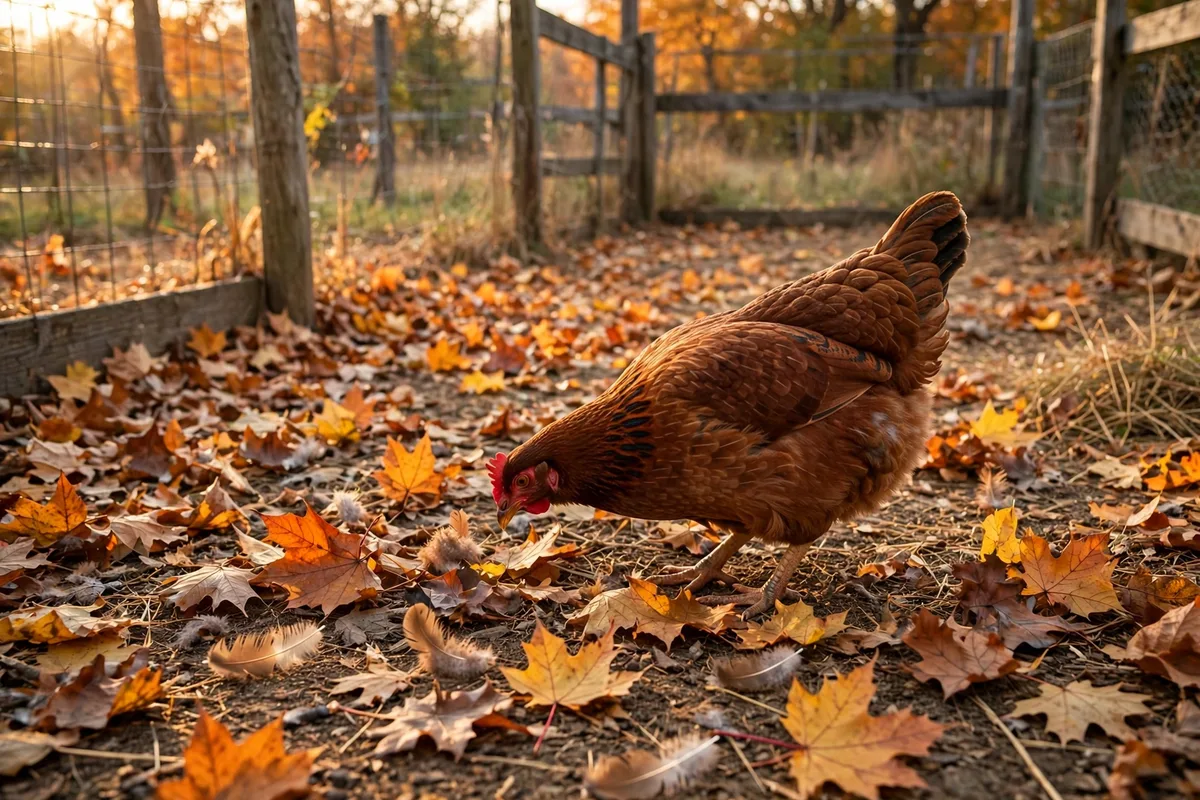
Why do chickens lay fewer eggs in autumn?
Chickens lay fewer eggs in autumn because the shortening days and the annual molt arrive together, and both shut egg production down. As the days get shorter, the hen's brain receives less light, and the hormones that drive laying fall away.
At the same time, the molt begins, and the protein that would have gone into eggs is diverted to growing new feathers. A hen cannot make feathers and eggs at the same time, so laying falls, and in many flocks it stops altogether for a few weeks.
The two causes are linked by the same seasonal signal. Shortening days trigger the molt, and the molt and the laying drop are both responses to the same change in light. That is why the autumn drop is so sharp: it is not one cause but two, arriving together, and the flock that was laying five eggs a day in August can be laying one egg a day by October. The drop is normal, and it is not a sign that the feed is wrong or the birds are ill, though it is worth checking the feed and the light before you assume it is only the season.
This guide is about the autumn mechanism specifically: the photoperiod and the molt overlapping. For the winter stop, when the days are at their shortest and the cold adds its own pressure, see our guide on why chickens stop laying eggs in winter, which covers the cold and darkness of midwinter. The two pages are companions: this one explains the autumn fall, that one explains the winter stop, and the difference between them is the molt, which is an autumn event.
| Autumn factor | What it does to laying | When it peaks |
|---|---|---|
| Shortening days | Less light means fewer laying hormones | September to November, as days shrink |
| The annual molt | Protein diverted from eggs to feathers | September to November, during feather loss |
| Cooler nights | Birds burn feed to stay warm, less left for eggs | October onwards |
| Less foraging | Fewer insects and greens, less variety | Autumn, as the garden dies back |
| Stress of the season | Wind, rain, and shorter days unsettle the flock | All autumn |
The photoperiod: how daylight controls laying
The photoperiod is the length of the day, and it is the main control on a hen's laying. A hen needs about 14 to 16 hours of light a day to lay well, and when the day falls below that length, the hen's brain reduces the hormones that drive egg production.
In September, when the days are still long, the effect is small, but by October, when the days have shortened by two hours or more, the effect is large, and by November the flock may have stopped laying altogether.
The light works through the hen's eyes and brain. Light falling on the retina triggers the release of hormones that stimulate the ovary, and darkness switches them off. That is why a hen that is shut in a dark coop all day will stop laying even in summer, and why a hen with a light in the coop will keep laying into the winter. The light does not need to be bright: a single low-wattage bulb is enough, and the chicken coop lighting calculator works out the hours you need for your latitude and the time of year.
The change in light is gradual, but the effect on laying is not. A hen will lay well until the day falls below about 14 hours, and then her production will drop sharply, because the hormonal system has a threshold. That is why the autumn drop often seems sudden: the flock is laying well one week, and the next week the egg basket is half empty, and the keeper wonders what went wrong. Nothing went wrong: the days crossed the threshold, and the flock responded. Our guide on why a chicken lays eggs irregularly explains the daily rhythm that sits underneath this seasonal change.
The molt overlap: why autumn is worse than winter
The molt overlap is what makes autumn worse than winter for laying, because in autumn the hen is dealing with two demands at once. The molt takes protein for feathers, and the shortening days take away the hormonal drive for eggs, and the hen cannot do both.
In winter, the molt is over, and the only problem is the light and the cold, so a hen with supplementary light will lay again in winter. In autumn, the molt is still going on, and no amount of light will make a molting hen lay, because her body is busy growing feathers.
The overlap lasts six to twelve weeks, depending on the breed and the hen's age. A young hen in her first autumn may skip the molt altogether and keep laying, because she is still growing her first adult feathers and has not settled into the yearly cycle. An older hen will molt hard, stop laying completely, and not return to lay until the molt is finished and the days are lengthening again. That is why a flock of mixed ages lays more steadily through autumn than a flock of the same age: the young birds carry the egg supply while the older birds molt.
Feed is the factor you can control during the overlap. A hen growing feathers needs extra protein, and a hen that is short of protein will molt slowly and return to laying late. Switch the flock to a feed with around 18 to 20 percent protein when the molt starts, and keep it up until the feathers are complete. Our guide on do chickens lay eggs while molting covers the feeding and care of a molting hen in detail, and the molting calculator helps you work out where your flock is in the cycle.
What actually helps in autumn
What actually helps in autumn is protein, light, and patience, in that order. Protein helps the molt finish faster, because feathers are mostly protein and a hen that is well fed will regrow her feathers sooner than a hen that is short of it.
Light helps laying return once the molt is over, because a hen needs 14 to 16 hours of light to lay well, and a light on a timer in the early morning will give her those hours. Patience helps because neither protein nor light will make a molting hen lay, and the flock will return to laying on its own schedule once the feathers are back.
Add light gradually, and only after the molt is well underway. A light added too early, while the hen is still losing feathers, will not bring the eggs back, and it may stress the bird. Wait until the new feathers are growing in, then add light in the early morning, increasing by no more than half an hour a week. A single low-wattage bulb on a timer is enough, and the light should come on in the morning rather than the evening, so the birds go to roost naturally at dusk. The chicken feed calculator helps you check that the flock is getting enough feed for the molt and the cold.
Keep the routine steady. A flock that is moved, disturbed, or mixed with new birds in autumn will lay even less, because stress adds to the seasonal drop. Leave the flock alone, keep the feed and water right, and let the season run its course. A keeper who chases the autumn drop with supplements, new feeds, and constant changes will spend money and stress the birds, and the eggs will still come back on the same schedule as they would have anyway.
When the autumn drop is not normal
The autumn drop is not normal when a hen that was laying steadily stops suddenly and shows other symptoms. A hen that stops eating, looks hunched or fluffed up, has a pale comb, or has diarrhoea is not just responding to the season: she is ill, and she needs attention.
A hen that loses feathers in patches with red or sore skin is not molting: she has parasites or is being bullied, and the cause needs to be found and fixed. Our guide on why chickens are not laying eggs walks through the full checklist in order.
Check the feed and the water before you blame the season. A flock that has run out of oyster shell will lay thin-shelled eggs and then stop, a flock with a frozen or dirty drinker will stop eating and laying, and a flock on stale or mouldy feed will go off lay quickly. These are problems that look like a seasonal drop but are not, and they are easy to fix once you find them. Check the feed, the water, and the light, and if all three are right and the hens are molting, the drop is the season and the eggs will return.
Age is the explanation most keepers overlook. A hen over three years old will lay fewer eggs in autumn than she did in her first year, and her post-molt recovery will take longer. That is normal ageing, and the answer is to add young pullets to the flock each year, so the egg supply does not depend on old hens. The egg production calculator gives you a realistic baseline for your flock's age and breed, and the chicken flock planner helps you plan the mix of ages that keeps eggs coming all year.
Planning for next autumn
Planning for next autumn starts with the flock's age balance. A flock of hens all the same age will all molt at once and all stop laying at once, and the egg supply will dry up for weeks. A flock with a spread of ages, with a third of the
birds in their first year, a third in their second, and a third older, will always have some birds laying, because the young birds molt lightly or not at all, and the older birds molt at different times. Add a few pullets each spring, and the autumn drop will be a dip rather than a cliff.
Plan the light as well. If you want winter eggs, set the lighting up in September, before the days get short, and leave the timer alone until spring. A light that is set up in September and left alone will give the flock a steady 14 to 16 hours of light all winter, and the laying will recover once the molt is over. A light that is added in December, when the days are already short, will take weeks to have an effect, and the flock will have lost a month of laying by then.
Keep a record of the autumn drop each year. Write down when the laying fell, when it stopped, and when it came back, and after two or three years you will know your flock's pattern. That record is the best guide you have to when to add light, when to add pullets, and when to expect the eggs back, and it will save you from worrying about a drop that happens every year at the same time. Our fall chicken care checklist covers the autumn preparation step by step, and it is worth working through it every September.
Sources: photoperiod effects on laying and molt nutrition follow university extension poultry guides. For feeding and housing guidance, see the poultry pages at the poultry.extension.org and the University of Minnesota Extension.
Related tools and guides
For more on the same topic, see Why Chickens Stop Laying Eggs in Winter and Why Are My Chickens Not Laying Eggs?.
Frequently asked questions
Why do chickens lay fewer eggs in autumn?
Because shortening days reduce the hormones that drive laying, and the annual molt diverts protein from eggs to feathers at the same time. Together they can stop laying entirely for weeks.
Is it normal for chickens to stop laying in autumn?
Yes. Most hens stop or slow sharply in autumn because of the molt and the shortening days. A flock that stops laying in October and restarts in late winter or spring is following the normal cycle.
How can I get my hens laying again in autumn?
Feed extra protein during the molt, then add supplementary light to give 14 to 16 hours a day. Light will not help while the hen is still molting — wait until the new feathers are growing in.
Do pullets lay through autumn?
Often yes. Pullets in their first autumn frequently skip a full molt and keep laying through the winter, which is why adding young birds each year keeps eggs coming.
When is the autumn egg drop not normal?
When a hen stops eating, looks hunched or ill, has a pale comb, or loses feathers in patches with sore skin. Check feed, water, and parasites first, and see a vet if the bird looks unwell.
About the author
John Walker is the founder of PeckCalc and has kept backyard chickens in Dallas, Texas since 2017. He started PeckCalc to give backyard keepers free calculators and guides with every figure traced to a university extension source.
About the author
John Walker is the founder of PeckCalc and has kept backyard chickens in Dallas, Texas since 2017. He started PeckCalc to give backyard keepers free calculators and guides with every figure traced to a university extension source.