
Are Automatic Chicken Coop Doors Worth It?
 By John Walker · Backyard chicken keeper in Dallas, Texas since 2017
Automatic chicken coop doors are worth it for keepers who are regularly away at dawn or dusk, who want consistent predator protection at night, or who keep chickens where a late closing means a lost bird. They are not worth it for a keeper who is always home at dusk, whose coop door is already easy to reach, or who expects a cheap door to work without maintenance. The value is in the consistency, not in the gadget.
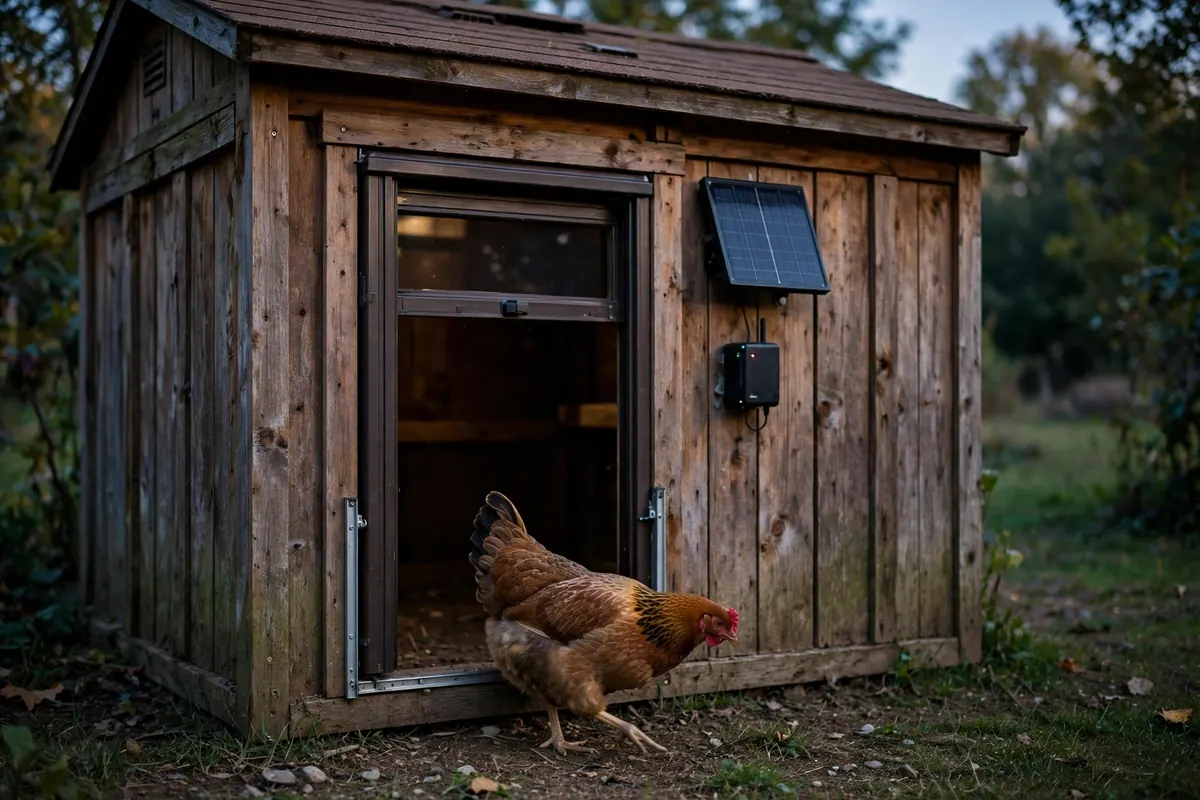
What does an automatic chicken coop door do?
An automatic chicken coop door opens the pop door in the morning and closes it at night, without anyone having to be there. The door is usually a vertical sliding panel that runs in a track, raised and lowered by a small motor, and it is controlled by a light sensor, a timer, or both. Some models run on mains power, some on batteries, and some on a small solar panel that charges a battery during the day. The point is simple: the birds get out at first light and are shut in at dusk, every day, whether the keeper is home or not.
The door does not feed the birds, water them, or check on them, and it does not replace the keeper. A flock with an automatic door still needs daily checking for food, water, health and eggs. What the door replaces is one specific job: being at the coop at dawn and at dusk. For a keeper who works early, travels, or keeps chickens at a property they do not live on, that one job is the difference between birds that are shut in safely every night and birds that are left out because the keeper was late.
Most doors also include a safety feature that stops the motor if the panel meets resistance, so a bird standing in the doorway is not trapped or crushed. The quality of that feature varies by model, and it is one of the things to check in the specifications before buying, rather than assuming every door has it. A door without a working obstruction sensor is a door that can injure a slow bird, and a door that closes on a bird that is still outside leaves that bird to the predators.
This guide does not test or rank products. No product has been tested for this guide, and no best product is named. What follows is a comparison of the types, the published specifications to check, and the failure modes that keepers report, so you can judge a door on its design rather than on a sales page.
How do automatic coop doors work?
Most automatic doors use one of three control methods. A light-sensor door opens when the sensor detects dawn light and closes when it detects dusk, so the timing follows the seasons automatically. A timer door opens and closes at times you set, which is predictable but needs adjusting as the days lengthen and shorten. A combined door uses both, for example a timer that sets the earliest opening time and a light sensor that decides the actual closing, which avoids opening the door in the middle of a dark winter morning.
The motor drives the panel in one of two ways. A worm-drive or screw-drive door turns a threaded rod that raises and lowers the panel, and it holds the panel firmly in place when the motor stops, which makes it hard for a predator to push open. A cable or pulley door winds a cord to lift the panel and lets it drop by gravity, which is simpler and cheaper, but the panel can sometimes be lifted from outside if the design does not include a locking catch. The drive type is usually stated in the specifications, and it is worth checking, because it affects both security and reliability.
Power comes from mains electricity, from replaceable or rechargeable batteries, or from a solar panel charging a battery. Mains power is the most reliable if the coop is near the house and the cable can be run safely, but it is not an option for a coop in a far corner of a garden. Batteries are simple and work anywhere, but they need checking and replacing, and a flat battery means a door that does not open or close. Solar charging solves the battery problem in a sunny spot, but it needs a panel that faces the sun and is not shaded by the coop roof or a tree.
The panel itself is usually aluminium, steel or a strong plastic, running in a track on either side of the doorway. Aluminium is light and does not rust, steel is heavier and stronger, and plastic is light and cheap but can warp in strong sun. The track needs to be kept clear of bedding, droppings and ice, because a blocked track is the commonest cause of a door that stops halfway.
What are the types of automatic chicken coop door?
The vertical sliding door is the commonest type. A flat panel slides up in a track to open and down to close, driven by a motor mounted above the doorway. It is simple, it fits most coops, and it seals reasonably well when closed. Its weakness is the track: bedding kicked into the track, droppings, or ice can jam it, and the panel can freeze to the frame in a hard frost if water has run into the track.
The horizontal sliding door is less common. The panel slides sideways, which avoids the problem of a panel dropping onto a bird, but it needs clear space to one side of the doorway and it is harder to seal against draughts and predators. It suits a coop where the doorway is wide and the wall beside it is free, and it is a poor choice where the coop is small or the doorway is close to a corner.
The hinged or swing door opens like an ordinary door, driven by a motorised arm. It is the least common type for chickens, because the arm and the hinge are exposed to the weather and to pecking, and the door can be pushed open by a strong predator if the motor does not lock it. It is mentioned here for completeness, but most keepers who buy an automatic door buy a vertical sliding one.
The simplest type is not a door at all but a timer-controlled opener that lifts an existing pop door by a cord. These are cheaper than a complete door, but they depend on the existing door being light, well balanced and free-running, and they rarely include an obstruction sensor or a locking catch. They are a budget option for a coop where the door is already in good condition, not a substitute for a door that is warped, heavy or badly fitted.
| Type | How it works | Strengths | Weaknesses |
|---|---|---|---|
| Vertical sliding | Panel slides up in a track | Fits most coops; seals well; worm-drive versions resist predators | Track can jam with bedding or ice |
| Horizontal sliding | Panel slides sideways | No dropping panel; no risk of closing on a bird from above | Needs side clearance; harder to seal |
| Hinged or swing | Door opens on a hinge by a motor arm | Familiar door action | Arm exposed; can be pushed open if not locked |
| Cord opener | Motor winds a cord to lift an existing door | Cheapest option; reuses your door | Depends on a good existing door; rarely has an obstruction sensor |
Vertical sliding doors are the commonest type and the usual choice for a first automatic door.
Are automatic chicken coop doors worth the money?
For a keeper who is away at dawn or dusk most days, yes. The door pays for itself in the birds it saves from a single night left open to predators, and in the mornings it saves when the keeper would otherwise have to be at the coop at first light. A single fox or raccoon visit can kill a whole flock, and a door that closes reliably every night is the cheapest insurance against that loss. The value is not in the convenience of not walking to the coop; it is in the nights when nobody would have been there to close it.
For a keeper who is always home, who enjoys the morning and evening routine, and whose coop is a few steps from the back door, the value is smaller. The door saves a few minutes a day and removes the risk of forgetting, but it adds a device that needs batteries, cleaning and occasional repair. If the routine is already reliable and the keeper is present every night, a well-fitted manual door and a good latch are enough, and the money is better spent on predator-proofing the run or on a better feeder.
For a keeper who is away for weekends or who keeps chickens at a second property, the door is close to essential, but only as part of a system. A door that opens and closes does not feed or water the birds, and a flock left for a weekend still needs a large feeder, a large waterer, and someone to check on them. Do not buy a door as a substitute for a daily check; buy it as a way of making the daily check less time-critical.
Think about the cost over the life of the door, not just the purchase price. A door needs batteries or a solar panel, occasional replacement of a worn cord or a damaged panel, and time spent cleaning the track and checking the sensor. A cheap door that jams every winter and needs replacing after two years costs more than a better-built door that runs for five or more, and it leaves the birds unprotected while it is broken. Read the specifications and the warranty before buying, and budget for the running costs as well as the purchase.
Do automatic coop doors work in winter?
Automatic doors work in winter, but winter is when they fail most often, and the failures are predictable. The commonest winter failure is ice: water runs into the track or onto the panel, freezes overnight, and the motor cannot lift a panel that is frozen to the frame. The second is snow: a drift against the door stops it opening, or snow blown into the track jams it. The third is the light sensor: a dull, overcast winter day may never get bright enough to trigger a sensor set for a clear summer morning, so the door opens late or not at all.
Prevent the ice problem by fitting the door under a small overhang or a rain guard, so water does not run down the coop wall and into the track, and by keeping the track clear of bedding and droppings before the first frost. Some keepers rub a little petroleum jelly or silicone spray on the track in autumn to stop ice sticking, but check the manufacturer's instructions first, because some lubricants damage the track or attract dirt. Do not pour hot water on a frozen door: it can crack the panel or the track, and it refreezes quickly.
Prevent the light-sensor problem by choosing a door with an adjustable sensor or a combined timer and sensor control, so you can set an earliest opening time and let the sensor decide within a range. If your door is sensor-only and it opens late on dull days, the birds lose foraging time and the morning routine slips, but the more serious failure is a door that does not close at dusk because the sensor never registered the light falling. Check the door at dusk for the first few weeks after fitting it, and do not trust it until you have seen it close correctly on a dull day as well as a bright one.
Batteries also perform worse in cold weather, and a solar panel produces less charge on short, dull winter days. If your door runs on batteries, check them more often in winter, keep a spare set, and consider a solar panel or a mains supply if the coop is in a cold, dull climate. A door that worked all summer and stops in January has usually run out of power, not broken.
Can raccoons open an automatic coop door?
A well-designed automatic door is harder for a raccoon to open than a simple manual pop door, but no door is raccoon-proof on its own. Raccoons are strong, dextrous and persistent, and they can lift a light panel, work a loose catch, or pull at a cord. The doors that resist them best are worm-drive vertical sliding doors, because the screw drive holds the panel firmly in place when the motor stops and the panel cannot be lifted from outside. Cable and pulley doors are more vulnerable, because the panel can sometimes be lifted if the design does not include a locking catch.
Check three things in the specifications before you buy. First, does the drive lock the panel when closed, or can the panel be lifted by hand from outside? Second, is there a locking catch or a lip that the panel sits behind when closed, so it cannot be pulled outward? Third, how thick and how strong is the panel itself, and does it fill the doorway without gaps a paw can get into? If the specifications do not answer those questions, treat the door as unproven and look for one that does.
The door is only one part of the coop's predator protection. A strong door in a weak coop is no protection at all: a raccoon that cannot open the door will try the run, the roof, or a gap in the wire. Use hardware cloth rather than chicken wire on the run, bury or skirt the wire at ground level, fit a solid roof, and check for gaps every month. The door should be the strongest point of the coop, not the only strong point.
Do not rely on the door's closing alone to keep the birds safe if the door can be opened from outside. Test the door yourself after fitting it: try to lift the panel from outside with your hands, try to pull it outward, and try to slide a finger into the gap at the sides. If you can move it, a raccoon probably can too, and the door needs a better fitting, a locking catch, or a different model.
What size automatic coop door do I need?
The doorway should be at least 10 inches wide and 12 inches high for standard large breeds, and larger for very large breeds such as Brahmas and Jersey Giants, which need a doorway of at least 12 inches wide and 14 inches high. Bantams can manage a smaller doorway, about 8 inches wide and 10 inches high, but a doorway that is too small for the birds you keep is a daily problem: large birds hesitate, get stuck, or injure themselves squeezing through, and a bird that is reluctant to use the door may be left outside at dusk.
Measure the birds you have, not the breed standard. A heavy, broad bird needs more width than a light bird of the same breed, and a bird that is moulting or carrying a full crop needs more room than the same bird in summer. The door should be wide enough for two birds to pass if the flock is large, because a single narrow doorway causes a jam at dusk when every bird wants to go in at once, and the last bird in the queue is the one that gets left outside when the door closes.
Fit the door at ground level or with a low ramp, so the birds can walk in rather than jump up. A door set high in the wall with no ramp is a barrier for heavy breeds and for older birds, and it becomes a worse barrier as the birds age. The ramp should be wide, non-slip, and at a gentle slope, with cleats across it so the birds can grip. Check that the door opens fully and that the panel, when raised, does not block the top of the doorway or leave a gap the birds have to duck under.
Check the door's own dimensions against the opening in your coop before you buy. Most automatic doors are sold as a complete unit with a frame, and the frame needs a flat, solid surface to mount on. If your coop wall is thin, uneven, or made of a material the screws will not hold in, you may need to add a mounting board first. Measure the opening, measure the frame, and make sure the two match before you order.
How do you install an automatic chicken coop door?
Start by choosing the position: on the coop wall, facing the run, at ground level or with a low ramp, and under an overhang if possible so rain does not run into the track. Mark the opening, cut it carefully, and fit a frame or a mounting board so the door unit sits flat and square. A door that is fitted crooked will jam, because the panel binds in the track when the frame is not square, and a door that is fitted to a flexible wall will work loose as the wall moves with the weather.
Mount the motor unit above the doorway, following the manufacturer's instructions, and keep the wiring out of reach of the birds. Chickens peck at anything, including cables, so run the cable inside a conduit or behind a cover, and keep the battery or the solar controller in a box the birds cannot peck. If the door runs on mains power, use an outdoor-rated cable and a residual current device, and do not run an extension lead across the garden to the coop.
Set the light sensor or the timer after the door is fitted, and test it for a week before you trust it. Watch the door open in the morning and close in the evening, check that every bird is inside before it closes, and check that the obstruction sensor stops the panel if a bird is in the doorway. Adjust the sensor sensitivity or the timer until the door opens after first light and closes after the last bird has gone in, not before. A door that closes while a bird is still outside is worse than no door at all, because it locks that bird out with the predators.
Clean the track every week, and check the door every day for the first month. Remove bedding, droppings and feathers from the track, check that the panel slides freely, and listen for a change in the motor sound, which can mean the track is binding or the battery is low. After the first month, a weekly check is enough, but never go more than a week without looking at the door, because a door that fails silently is a door that leaves the birds out all night.
Common automatic door problems and how to fix them
The commonest problem is a door that stops halfway. The cause is usually a blocked track, a warped panel, or a low battery. Clean the track, check the panel for warping or damage, and check the battery. If the door still stops halfway, check that the frame is square and that the coop wall has not moved, because a frame that has twisted with the weather will bind the panel at the same point every time.
The second problem is a door that does not open or does not close. Check the power first: a flat battery, a shaded solar panel, or a tripped mains supply is the commonest cause. Then check the sensor: a sensor covered in dust, droppings or cobwebs cannot see the light, and a sensor facing a bright light at night, such as a security light, may never register dusk. Clean the sensor, check what it faces, and adjust the sensitivity or the timer.
The third problem is a door that closes too early, leaving birds outside. This is usually a light sensor set too sensitively, so it registers dusk while there is still enough light for the birds to be out, or a timer set too early for the season. Adjust the sensor or the timer, and watch the flock for a few evenings to see when the last bird actually goes in. The door should close after the last bird, not at a fixed time that suits the keeper.
The fourth problem is a door that the birds will not use. Birds are cautious about a new doorway, especially one that moves, and some birds will avoid it for days. Prop the door open for the first few days so the birds learn to use the opening, scatter feed just inside and outside the doorway, and let the birds get used to the panel moving before you let it close on a timer. Do not force a bird through the door, and do not shut a reluctant bird inside: let the flock learn the doorway at its own pace.
Who should not buy an automatic coop door?
Do not buy an automatic door if your coop is not predator-proof in other respects. A door on a coop with chicken wire, gaps in the roof, or a run that a fox can dig under is money spent on the wrong problem. Fix the coop first, then add the door. The same applies if the coop door opening is the wrong size or the wall is too weak to mount a door: fix the coop, then buy the door to fit it.
Do not buy a door if you cannot commit to checking it. An automatic door that is never checked is a risk, not a convenience, because it can fail silently and leave the birds out all night. If you travel for weeks at a time with nobody checking the coop, a door alone does not solve that problem; you need a person to check the flock, the feed and the water, and the door is only part of that arrangement.
Do not buy the cheapest door you can find and expect it to last. The cheapest doors usually have the weakest motors, the thinnest panels, no obstruction sensor, and no locking catch, which are the very features that make a door safe and reliable. A door is a safety device, not a gadget, and it is worth buying the best-built door you can afford, with a warranty you can use, from a seller who answers questions. If the budget does not stretch to a well-built door, a well-fitted manual door with a good latch, used reliably every night, is a better choice than a cheap automatic door that fails in the first winter.
Finally, do not buy a door that needs WiFi or a phone app if your coop has no reliable signal. Some doors offer remote control and notifications, which are useful if they work, but a door that depends on a connection to open and close is a door that fails when the connection fails. Choose a door whose basic open and close functions work without any connection, and treat remote features as a bonus, not as the mechanism the birds depend on.
Sources: this guide compares published door designs and commonly reported failure modes; no product was tested for this guide and no product is recommended. For coop security and predator protection, see the poultry pages at the poultry.extension.org and the University of Minnesota Extension.
Related tools and guides
For more on the same topic, see How to Build a Chicken Coop and How to Keep Chickens Warm in Winter.
Frequently asked questions
Are automatic chicken coop doors worth it?
Yes, for keepers who are regularly away at dawn or dusk, or who want consistent predator protection at night. They are not worth it for a keeper who is always home at dusk and whose coop door is already easy to reach, because a reliable manual door is enough.
Do automatic coop doors work in winter?
Yes, but winter is when they fail most often: ice in the track, snow against the door, a light sensor fooled by dull days, and batteries that perform worse in the cold. Fit the door under an overhang, keep the track clear, and check the batteries more often in winter.
What is the best automatic chicken coop door?
No single door is best for every coop, and no product was tested for this guide. Look for a worm-drive vertical sliding door with an obstruction sensor, a locking panel, an adjustable light sensor or timer, and a panel that fills the doorway without gaps.
Can raccoons open an automatic coop door?
A well-designed worm-drive door that locks the panel when closed is hard for a raccoon to open, but no door is raccoon-proof on its own. Test the fitted door yourself by trying to lift and pull the panel from outside, and predator-proof the run and roof as well.
Do automatic coop doors need WiFi?
No. The basic open and close functions of a good door work on a light sensor, a timer, or both, without any connection. WiFi and phone apps are an optional extra, and a door should not depend on a connection to open and close.
About the author
John Walker is the founder of PeckCalc and has kept backyard chickens in Dallas, Texas since 2017. He started PeckCalc to give backyard keepers free calculators and guides with every figure traced to a university extension source.