
Can a Chicken Lay Two Eggs in One Day
 By John Walker · Backyard chicken keeper in Dallas, Texas since 2017
Yes, a chicken can lay two eggs in one day, but it is rare, and it is not something a hen can do every day. A hen ovulation cycle takes about twenty-five to twenty-six hours, which is why most hens lay one egg a day at most, and often skip a day. Two eggs in one day happen when two yolks are released close together, a double ovulation, and both travel through the oviduct and are laid within the same day. It is most common in young pullets whose laying rhythm is still settling, and it is often followed by a day with no egg at all. A hen that regularly lays two eggs a day would be laying more than her body can sustain, and it does not happen in a healthy flock.
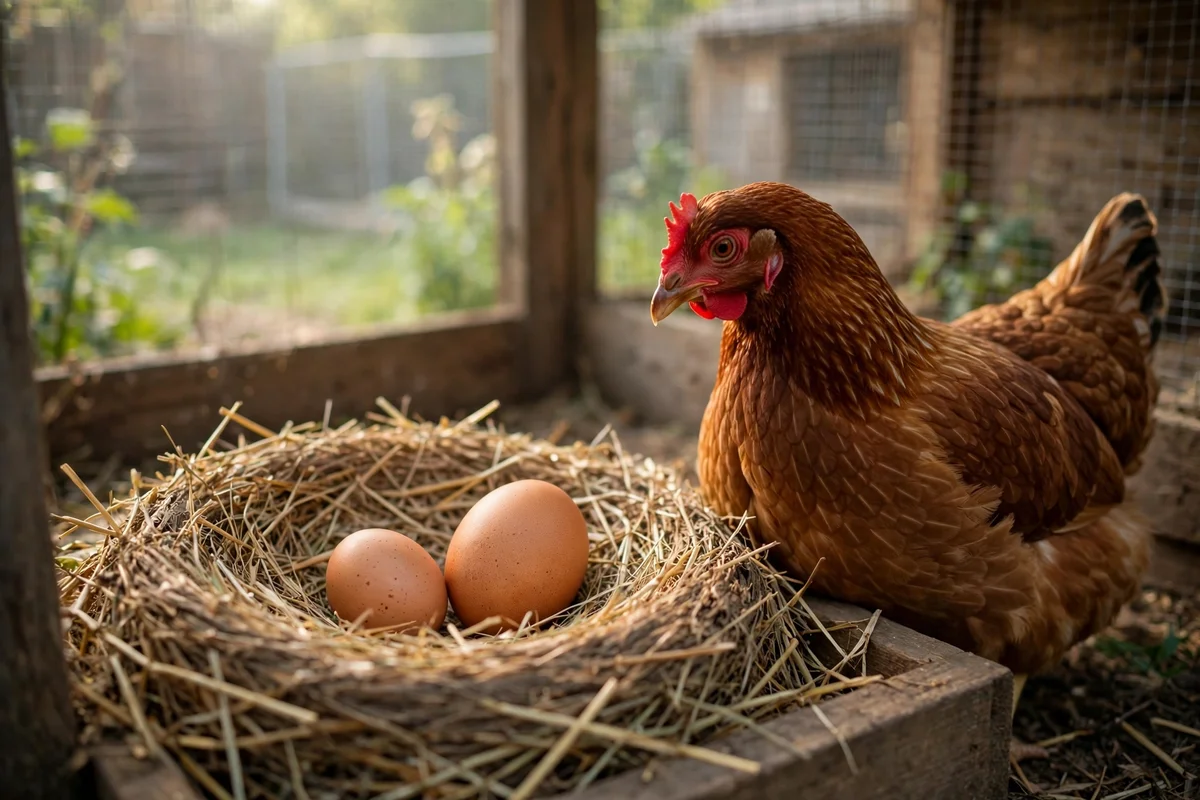
Can a chicken lay two eggs in one day?
Yes, a chicken can lay two eggs in one day, and it happens often enough that most keepers with a small flock will see it once or twice. The usual cause is a double ovulation: two yolks are released from the ovary within a few hours of each other, and both travel down the oviduct, one behind the other, and are laid on the same day. The second egg is often smaller or thinner shelled than the first, because the shell gland has had less time to work on it, and the hen will usually lay nothing the next day while her cycle resets.
The reason two eggs a day is rare is the length of the laying cycle. From ovulation to laying takes about twenty-five to twenty-six hours, and the shell alone takes around twenty hours to form. A hen laying on a twenty-six hour cycle will lay a little later each day until she skips a day and starts again in the morning. That is why even the best layers do not lay every single day of the year, and why a hen that lays two eggs in one day is borrowing from tomorrow rather than producing extra.
If you find two eggs in one nest box in a morning, check which hen laid them before assuming one bird did the work. In a flock with several hens and a favourite nest box, two eggs in one box usually means two hens used the same box. Two eggs from one hen in one day is rare; two hens sharing a box is everyday. Marking hens or watching the nest box for a morning is the only way to be sure.
Why does double ovulation happen?
Double ovulation happens when the ovary releases two yolks close together instead of one, and the most common reason is a young hen whose reproductive system is still finding its rhythm. Pullets in their first month of laying are prone to all kinds of irregularities: double yolks, tiny fairy eggs, soft shells, and two eggs in one day.
Their hormones are still settling, and the timing between ovulation and shelling is not yet steady. Most pullets settle into a regular cycle within a few weeks, and the double eggs stop.
Light is another trigger. A sudden increase in day length, or a coop light left on too long, can stimulate the ovary to release an extra yolk. This is one reason keepers are advised to increase light gradually in autumn and winter, rather than switching a light on for sixteen hours overnight. A hen that is overfed or overweight can also double ovulate more often, because excess body fat affects hormone levels, and some breeds are simply more prone than others. Heavy layers and hybrid layers bred for high production show double ovulations more often than light, slow-laying breeds.
Stress can play a part too, although it more often stops laying than doubles it. A fright or a disruption can delay an egg in the oviduct, and if the next yolk is released on schedule while the first is still inside, the two can end up travelling together. The result is often a double-yolked egg rather than two separate eggs, which is a related but different event. Our guide on double yolk eggs explains that one in full.
Is laying two eggs a day harmful?
A single day of two eggs is not harmful, and the hen will usually recover by taking a day off laying. The concern is only if it keeps happening, because a hen laying two eggs a day is using calcium and protein faster than she can replace them, and the second egg is often thin shelled or shell-less, which raises the risk of egg binding and oviduct damage. A hen that repeatedly double ovulates is also more likely to develop egg yolk peritonitis, where yolk material leaks into the abdomen and causes infection.
The practical signs to watch are the quality of the second egg and the hen condition. A second egg that is thin shelled, soft, or shell-less is a sign the shell gland is being rushed, and it should prompt a check of the calcium supply and the light schedule. A hen that looks lethargic, is off her feed, or is straining after laying two eggs needs attention, because she may be egg bound. Our guide on egg bound chicken explains the signs and what to do.
For most keepers the right response is to do nothing except watch. Note the date, check the hen is well, and see whether laying returns to normal the next day. If two-egg days happen once in a while in a young flock, they are a curiosity. If they happen every week from the same hen, look at her feed, her weight, and the light in the coop, and consider whether she is getting too much light or too much rich feed. A vet visit is worthwhile if the same hen keeps laying two eggs a day alongside thin shells or signs of illness.
How many eggs can a hen lay in a day at most?
The practical maximum for a hen is two eggs in one day, and even that is rare. Three eggs in one day is essentially unheard of in a backyard flock, because the oviduct can only hold one egg at a time in the shell gland, and the shell alone takes around twenty hours to form.
Reports of three eggs in a day are almost always a case of two hens sharing a nest box, or of eggs collected over two days being counted as one. If you think one hen has laid three eggs in a day, watch the nest box to be sure.
The number that matters for planning is not the daily maximum but the weekly and yearly average. A good hybrid layer will lay around five to six eggs a week in her first year, which works out to roughly three hundred eggs a year, and even that rate includes rest days. A heritage breed will lay three to four eggs a week. Our guide on how many eggs per week by breed gives realistic figures for common breeds, and the egg production calculator will work out what your flock should be producing.
It is also worth knowing that a hen is born with all the yolks she will ever lay already in her ovary, and she cannot make more. A hen that lays heavily in her first year will lay less in her second and third years, because the supply is finite. Pushing a hen to lay two eggs a day, if it were possible, would simply use up her supply faster and shorten her laying life. The hens that lay best over the long term are the ones that lay steadily, not the ones that lay in bursts.
Two eggs, double yolks and fairy eggs
Two eggs in one day, double-yolked eggs, and fairy eggs are three different results of the same underlying event: an irregular ovulation. A double ovulation where both yolks travel separately produces two eggs in one day. A double ovulation where both yolks travel together, wrapped in the same white and shell, produces a double-yolked egg.
And a hiccup in the oviduct where a tiny piece of tissue triggers egg formation without a yolk produces a fairy egg, a miniature egg with no yolk at all.
All three are most common in young pullets, and all three usually disappear as the hen matures. They are also all more common in heavy layers and hybrid breeds, which have been bred for high ovulation rates. A keeper who sees all three in the same young flock is not looking at three separate problems, but at one young flock settling into its rhythm. Patience is the right response, and the eggs themselves are safe to eat in every case, provided they are intact and fresh.
The one exception is a fairy egg that appears alongside other signs of illness, or a double-yolked egg from an old hen, because both can occasionally signal a problem in the oviduct. But in a healthy young flock, these odd eggs are normal, and they are part of the charm of keeping hens. Keep a note of them if you like, because the pattern over a season tells you more than any single odd egg. Our guide on what fairy eggs are covers the miniature eggs in detail.
What to do if your hen lays two eggs a day
First, confirm it is one hen. Watch the nest box for a morning, or mark the hens with a small dab of food colouring on the vent feathers, which transfers to the egg and identifies the layer. If two hens are sharing a box, there is nothing to do at all, and you may want to add another nest box, because hens queue for a favourite box and the queue itself can cause stress and broken eggs.
Second, check the basics: a complete layer feed, oyster shell free choice, fresh water, and a light schedule that does not exceed sixteen hours a day, increased gradually if you use light at all. Check the hen is not overweight, because excess weight affects hormones, and check she is not being overfed with treats and scratch, which should stay within the ten percent treat rule. If the light in the coop is on a timer, make sure it is not coming on too early or staying on too long.
Third, watch and wait. A single two-egg day in a young hen needs no action. A pattern of two-egg days from the same hen, especially with thin shells, is worth a vet visit, because it can signal a hormone problem or an oviduct issue. Do not try to stop double ovulation with supplements or by cutting light suddenly, because a sudden cut in light can stop laying altogether and stress the flock. Steady, calm management is the right approach, and most hens sort themselves out within a few weeks.
Sources: University of Minnesota Extension poultry pages and poultry.extension.org.
Related tools and guides
For more on the same topic, see Double Yolk Eggs.
Frequently asked questions
Can a chicken lay two eggs in one day?
Yes, rarely. Two eggs in one day happen when two yolks are released close together, a double ovulation, and both are laid the same day. It is most common in young pullets whose laying rhythm is still settling, and the hen usually lays nothing the next day.
Is it bad if my hen lays two eggs in one day?
A single two egg day is not harmful, and the hen will usually recover by taking a day off. It is only a concern if it keeps happening, because the second egg is often thin shelled and the hen is using calcium faster than she can replace it.
How many eggs can a chicken lay in a day?
Two is the practical maximum, and even that is rare. The shell alone takes around twenty hours to form, so three eggs in one day from a single hen is essentially unheard of. Reports of three eggs usually mean two hens shared a nest box.
Why did my hen lay two eggs and then stop laying?
She is resetting her cycle. Laying two eggs in one day uses up two ovulations at once, so the hen usually takes a day or two off before laying again. That pause is normal, and laying should return to its usual pattern within a few days.
Do double yolk eggs mean the hen laid two eggs?
No. A double yolk egg is two yolks wrapped in one white and one shell, while two eggs in one day is two separate eggs. Both come from a double ovulation, but they are different results, and both are most common in young pullets.
About the author
John Walker is the founder of PeckCalc and has kept backyard chickens in Dallas, Texas since 2017. He started PeckCalc to give backyard keepers free calculators and guides with every figure traced to a university extension source.