
Why Do Chickens Lay Double Yolk Eggs?
 By John Walker · Backyard chicken keeper in Dallas, Texas since 2017
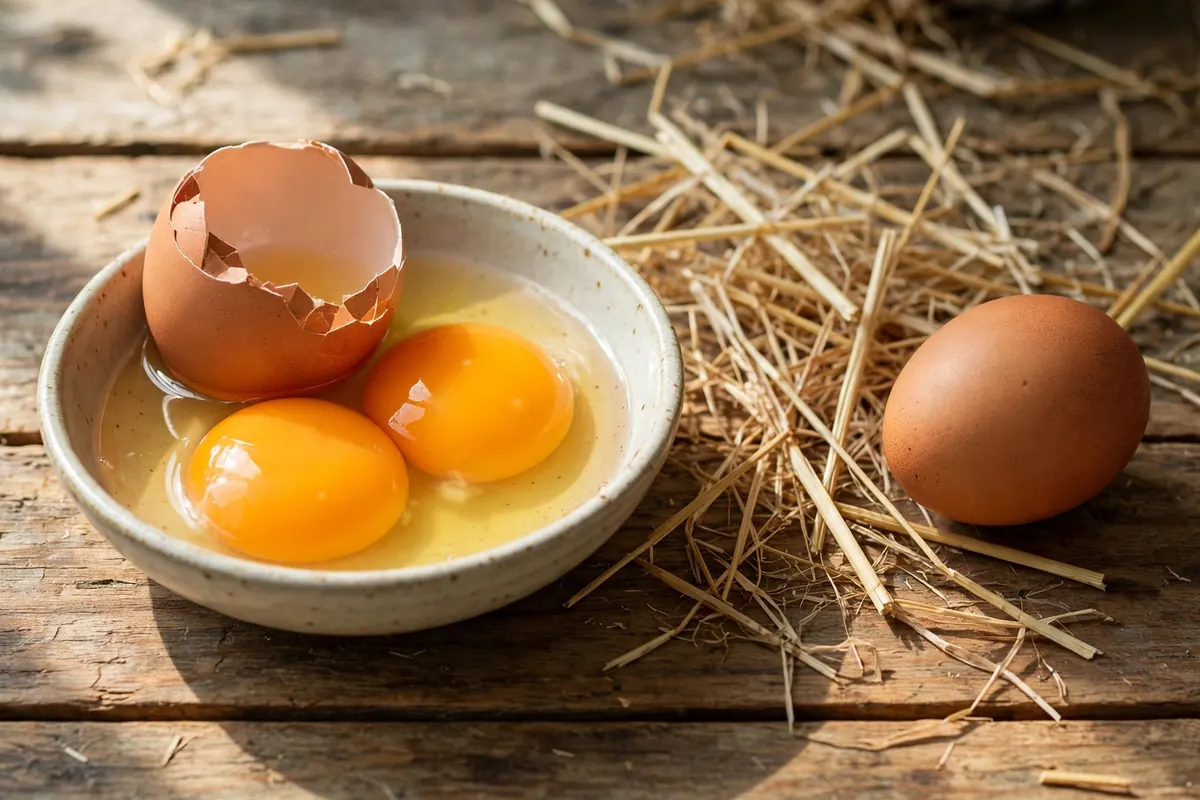
Chickens lay double yolk eggs when two yolks are released at the same time and travel down the oviduct together, so the shell forms around both. It happens most often in young pullets whose egg-laying hormones are still settling, and it is also common in heavy, high-production breeds. A double yolk egg is a normal variation, not a defect.
Why do young hens lay double yolks?
Young hens lay double yolks because their reproductive hormones are still settling, and the ovary sometimes releases two yolks in quick succession instead of one. The two yolks travel down the oviduct together and the shell forms around both. As the pullet matures, the timing settles and double yolks become rare.
Young hens lay double yolks because their reproductive hormones are still settling, and the ovary sometimes releases two yolks in quick succession instead of one. A pullet's first months of laying are a period of adjustment: the timing of ovulation is not yet regular, and two yolks can enter the oviduct close enough together that the shell gland wraps them in a single shell. As the pullet matures, the timing settles and double yolks become rare.
The same hormonal timing explains why double yolks are most common in the first few weeks of lay, and why they often come in runs: a pullet may lay several double yolk eggs in her first month, then none for a year. It is the same reason young hens lay the occasional tiny wind egg, or an egg with no yolk at all: the system is still learning its rhythm, and the variations are part of that learning.
Age is the strongest predictor, and breed is the second. Heavy breeds and high-production hybrids, which have been bred to lay large eggs frequently, release double yolks more often than light, slow-laying breeds, because their ovaries are more active. A young hybrid layer in her first month of lay is the most likely bird in any flock to produce a double yolk egg.
How common are double yolk eggs?
Double yolk eggs are uncommon but not rare: commonly cited figures put them at around one in a thousand eggs overall, but far more common in young pullets, where some keepers see one in every few dozen eggs in the first weeks of lay. Commercial producers remove them, so shop eggs rarely show them.
Double yolk eggs are uncommon but not rare: commonly cited figures put them at around one in a thousand eggs overall, but far more common in young pullets, where some keepers see one in every few dozen eggs in the first weeks of lay. The overall figure is low because it averages across all hens, including mature birds that almost never lay them; the figure for a young pullet in her first month is much higher.
Commercial egg producers remove double yolk eggs from the cartons you buy, because they are larger than standard eggs and do not fit the grading machines, which is why most people never see one in a shop egg. In a backyard flock, where eggs are not graded, double yolks are a regular surprise, and a keeper with several young pullets may find one every week or two during the first laying season.
Size is a useful clue: a double yolk egg is almost always noticeably larger and heavier than the hen's normal eggs, and often longer, because it contains two yolks and a larger white. If you find an unusually large egg from a young hen, there is a good chance it has two yolks inside, and weighing it against a normal egg from the same hen will usually confirm the difference.
Are double yolk eggs safe to eat?
Yes, double yolk eggs are safe to eat, and they are nutritionally the same as two normal yolks in one shell, with the same taste and cooking properties. There is nothing wrong with the egg. The only practical difference is size: count a double yolk egg as roughly one and a half eggs in a recipe.
Double yolk eggs are safe to eat, and they are nutritionally the same as two normal yolks in one shell, with the same taste and the same cooking properties. There is nothing wrong with the egg, and no health risk from eating it: the yolks are normal yolks that happened to share a shell, and the white is a normal white. Cook them as you would any egg, and use them the same way.
The only practical difference is size: a double yolk egg contains more yolk and more white than a single egg, so a recipe that calls for one egg will get more egg than it expects. If you are baking, count a double yolk egg as roughly one and a half eggs, and adjust the recipe, or save double yolk eggs for frying and scrambling, where the exact quantity matters less.
There is a persistent myth that double yolk eggs are a sign of a sick hen, or that they contain twins, and neither is true. A double yolk egg is a normal variation in a healthy young hen, and it is not a sign of disease, poor diet, or anything wrong with the flock. If a mature hen suddenly starts laying double yolks regularly, that is unusual, but a young pullet doing so is entirely normal.
Can double yolk eggs hatch twins?
Double yolk eggs can sometimes start to develop two chicks, but they almost never hatch, because two chicks in one shell run out of space, air and nutrients before they are ready. Do not set double yolk eggs for hatching; candle them out after a few days so they do not go bad in the incubator.
Double yolk eggs can sometimes start to develop two chicks, but they almost never hatch, because two chicks in one shell run out of space, air, and nutrients before they are ready. The shell is built for one chick, and two embryos competing for the same yolk sac, the same air cell, and the same space usually both die before hatching. Twin chicks that do hatch are rare, and they are usually weak.
For that reason, double yolk eggs should not be set for hatching. If you are incubating, candle the eggs after a few days and remove any that show two yolks, because they will not hatch and they can go bad in the incubator, risking the healthy eggs around them. Our guide on how to hatch chicken eggs covers candling and egg selection in detail.
The same logic applies to very large single-yolk eggs: an oversized egg is harder to hatch than a normal one, because the chick has further to turn and the air cell is in the wrong place. For hatching, choose clean, normally shaped, average-sized eggs from healthy hens, and leave the double yolks for breakfast.
Which chickens lay double yolk eggs?
Young pullets in their first weeks of lay are the most likely to lay double yolk eggs, and heavy, high-production breeds such as Rhode Island Reds, Plymouth Rocks and commercial hybrid layers lay them more often than light breeds or bantams, because their ovaries are more active.
The chickens most likely to lay double yolk eggs are young pullets in their first weeks of lay, and heavy, high-production breeds such as Rhode Island Reds, Plymouth Rocks, and commercial hybrid layers. Young birds of any breed can lay them, because the cause is hormonal timing rather than breed, but the heavy layers lay them more often, because their ovaries are more active and their eggs are larger.
Light breeds, such as Leghorns, lay double yolks less often, and bantams rarely lay them at all, because their eggs are small and their laying cycle is less intense. Heritage breeds, which lay fewer eggs over a longer life, also lay fewer double yolks than hybrids bred for maximum production, because their reproductive system is under less pressure. Our guide on heritage vs hybrid chickens compares the two types in detail, including their laying patterns.
Individual variation matters too: some hens lay double yolks regularly in their first season and then never again, while others never lay one at all. There is no way to make a hen lay double yolks, and no reason to try: the trait is not inherited in a useful way, and a hen selected for double yolks would be a hen with an irregular laying cycle.
Are double yolks lucky?
In many cultures, finding two yolks in one egg is considered lucky, a sign of good fortune or fertility, and the belief is old. There is no scientific basis for the luck, but a double yolk egg is a sign of a young, healthy, productive hen, and a flock that produces them is laying well.
Double yolks have been considered lucky in many cultures, and the idea appears in folklore from Europe to Asia, where finding two yolks in one egg is taken as a sign of good fortune, fertility, or a coming wedding. The belief is old, and it probably comes from the simple fact that a double yolk egg is a pleasant surprise: more egg than expected, from a hen that is laying well. There is no scientific basis for the luck, but there is no harm in enjoying the surprise.
The folklore also includes the opposite idea in some places, where a double yolk is taken as a warning, but the lucky reading is the more common one. What matters for the keeper is the practical side: a double yolk egg is a sign of a young, healthy, productive hen, and a flock that produces them is a flock that is laying well. Enjoy the egg, and do not read anything into it beyond that.
Shell colour, by contrast, tells you nothing about yolks: a double yolk egg can have a brown, white, blue, or green shell, depending on the breed, and the colour of the shell has no link to the number of yolks inside. If you are curious about shell colour genetics, the egg colour calculator shows which breeds lay which colours, but it predicts shell colour, not yolk count.
When should double yolks worry me?
Double yolks should worry you only if a mature hen that has been laying normally for months suddenly starts laying them regularly, or if they come with other signs of illness, such as a drop in laying or lethargy. In a young pullet, double yolks are normal; in a mature hen, a sudden change is worth watching.
Double yolks should worry you only if a mature hen that has been laying normally for months suddenly starts laying them regularly, or if double yolks come with other signs of illness, such as a drop in laying, lethargy, or abnormal droppings. In a young pullet, double yolks are normal; in a mature hen, a sudden change in egg pattern is worth watching, because it can signal a hormonal disturbance or a reproductive problem.
A mature hen laying the occasional double yolk is still nothing to worry about: the odd double yolk from an older bird is a normal variation, and it does not mean she is ill. The pattern that matters is a sudden, sustained change, especially if it comes with soft shells, shell-less eggs, or a hen that stops laying altogether. In that case, check the diet, the housing, and the bird's general health, and consult a veterinarian if the change persists.
Our guide on why are my chickens not laying eggs covers the reasons a hen stops laying, and the guide on why chickens lay soft shelled eggs covers shell problems, which are the more common signs of a laying problem than double yolks. In most flocks, double yolks are a delight, not a diagnosis.
Sources: for egg formation and laying physiology, see the poultry pages at the University of Minnesota Extension and poultry.extension.org.
Related tools and guides
Frequently asked questions
Are double yolk eggs safe to eat?
Yes. A double yolk egg is two normal yolks in one shell, with the same taste and the same cooking properties as a normal egg. There is no health risk. The only practical difference is size: count a double yolk egg as roughly one and a half eggs in a recipe.
Can double yolk eggs hatch twins?
They can sometimes start to develop two chicks, but they almost never hatch, because two chicks in one shell run out of space, air and nutrients. Do not set double yolk eggs for hatching; candle them out after a few days so they do not go bad in the incubator.
Which chickens lay double yolk eggs?
Young pullets in their first weeks of lay are the most likely, and heavy, high-production breeds such as Rhode Island Reds, Plymouth Rocks and commercial hybrid layers lay them more often than light breeds or bantams. The cause is hormonal timing, so young birds of any breed can lay them.
Are double yolks lucky?
In many cultures, finding two yolks in one egg is considered lucky, a sign of good fortune or fertility. There is no scientific basis for the luck, but a double yolk egg is a sign of a young, healthy, productive hen, and a flock that produces them is laying well.
Why do young hens lay double yolks?
Because their reproductive hormones are still settling, and the ovary sometimes releases two yolks in quick succession instead of one. The two yolks travel down the oviduct together and the shell forms around both. As the pullet matures, the timing settles and double yolks become rare.
About the author
John Walker is the founder of PeckCalc and has kept backyard chickens in Dallas, Texas since 2017. He started PeckCalc to give backyard keepers free calculators and guides with every figure traced to a university extension source.