
Can Chickens Eat Corn on the Cob?
 By John Walker · Backyard chicken keeper in Dallas, Texas since 2017
Yes, chickens can eat corn on the cob. Fresh corn, raw or cooked, is safe, and hens will peck the kernels off the cob and leave the bare cob behind. Serve it plain, keep the portion inside the treat allowance, and never offer canned corn, which is usually salted, or mouldy corn.
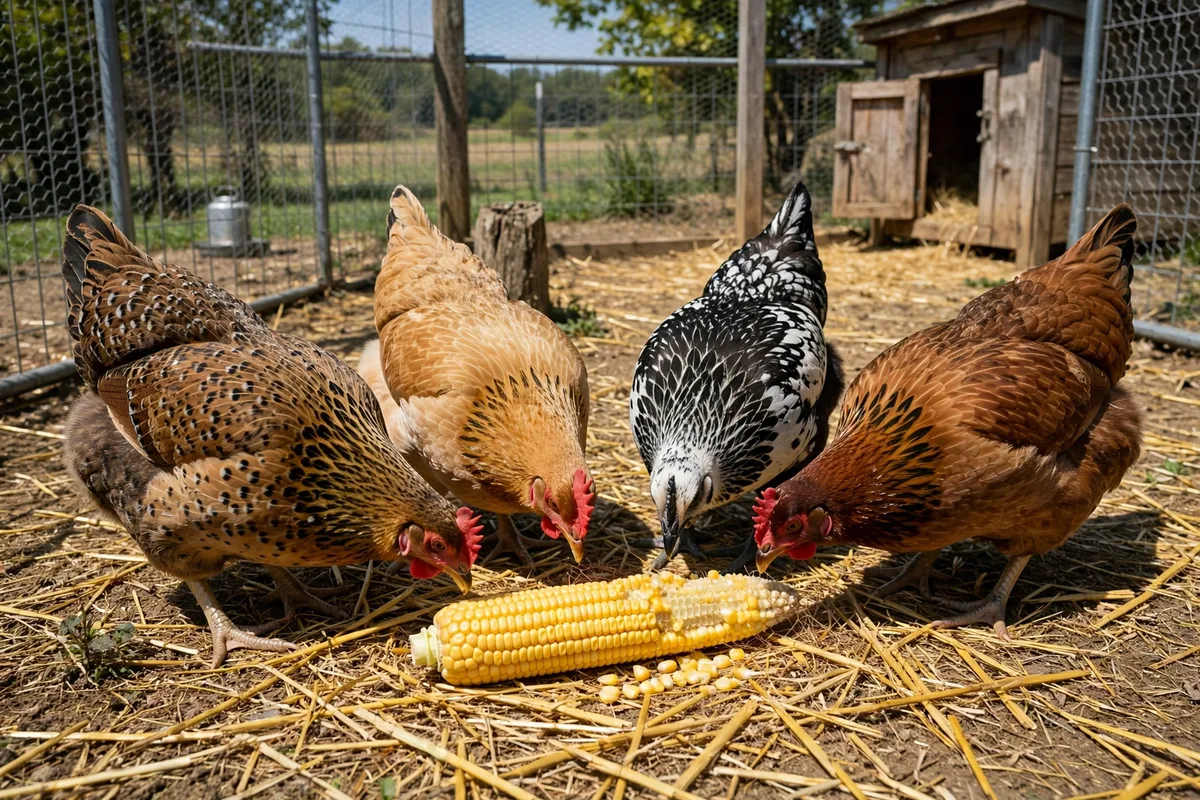
Can chickens eat corn on the cob?
Yes, chickens can eat corn on the cob, and it is one of the most entertaining treats you can offer a flock. A fresh cob placed in the run becomes a project: the hens peck the kernels off row by row, and the cob keeps them occupied far longer than scattered grain.
Raw corn and cooked corn are both safe, as long as the corn is plain, with no salt or butter. Corn is already a familiar food for most chickens, because cracked corn is a standard part of scratch feed and many mixed feeds. Sweetcorn on the cob is simply the fresh version of a grain the birds already know, and it is richer in water and easier to eat than dry cracked corn. The kernels are soft enough for young birds and old hens alike, and the cob gives the flock something to work on.
Do not offer canned corn. Canned corn is usually packed in salted water and may contain preservatives, and the salt alone is reason enough to skip it. Frozen corn, thawed, is fine, and so is fresh corn cut off the cob and scattered. If the corn has gone mouldy, compost it — mouldy grain can be toxic, and corn is one of the grains where mould is most often a problem.
What corn on the cob gives your chickens
Corn supplies starch for energy, along with fibre, small amounts of protein and vitamin A, which gives yellow corn its colour. It is an energy food, which is why it is so useful in winter, when hens need extra calories to stay warm and keep laying.
A cob on a cold afternoon gives quick energy and encourages birds that are reluctant to leave the coop to eat. Corn is not a complete food. It is low in protein and in some of the amino acids a laying flock needs, so a diet heavy in corn will show up as fewer eggs and slower growth in young birds. That is why corn should stay inside the treat allowance, even though the birds love it. Layer feed supplies the protein and calcium; corn supplies the energy on top.
A cob is also enrichment, which matters in a run where boredom leads to feather pecking. Pecking kernels off a cob is natural foraging behaviour, and it keeps the flock busy and calm. A cob hung from a string at head height lasts even longer, since the birds have to work for each kernel. Enrichment that is also food is the best kind, and corn on the cob is one of the simplest examples.
How to serve corn on the cob to chickens
Serve a fresh cob whole, raw or lightly cooked, placed on the ground or hung from a string at head height. For a small flock of four or five hens, one cob is plenty for one serving. For a larger flock, two or three cobs will keep the birds occupied without leaving a lot of waste.
There is no need to cut the kernels off, since pecking them off is the point. Cooked corn should be plain, with no salt or butter. If you have cooked corn left over from a meal, rinse off any butter or seasoning before offering it, or keep a plain cob aside before you season the rest. Corn on the cob from a barbecue is fine once it has cooled, as long as it has not been brushed with sauce or oil.
Do not serve corn that has been salted, buttered or coated in sauce, and do not leave a stripped cob in the run for days. The bare cob is harmless, but it will start to rot in wet weather, and it is better to compost it once the kernels are gone. If you grow your own sweetcorn, the cobs are safe straight from the garden, but wash off any soil first.
How much corn on the cob can chickens eat?
Keep corn to a small share of the diet — no more than about 10 percent of what a chicken eats in a day, counting all treats together. In practice, a cob or two shared between the flock, a few times a week, is a sensible portion.
A cob per bird every day is too much starch in one sitting, and a flock fed corn daily will start to eat less of its proper feed. Use the Chicken Treats Calculator to work out a daily treat allowance for your flock size, so corn, scraps and other treats together stay inside the 10 percent rule. If you are also offering other starchy treats such as cooked rice or bread in the same week, count them together — the limit applies to all treats, not to each food separately.
Cracked corn is often fed as scratch in winter, because it gives energy and encourages the birds to scratch and forage. That is a different use from a fresh cob, but the same limit applies: scratch grains are treats, not feed, and they should stay inside the 10 percent rule. If you want to check how much feed your flock needs overall, use the chicken feed calculator.
Which parts of corn on the cob are safe, and which are not?
Fresh raw corn, cooked corn, cracked corn, husks and silk are all safe for chickens. The cob itself is safe to peck at, though the birds will leave it behind once the kernels are gone. Canned corn is not safe, because it is usually salted and preserved, and mouldy corn is not safe, because mouldy grain can be toxic.
The risk with corn is not the corn itself but the condition it is in. Corn that has been stored damp can grow moulds that produce toxins, and those toxins are a real danger to poultry. Store corn and scratch feed somewhere dry, check it before you offer it, and compost any grain that smells musty or looks mouldy. The table below sums up the forms and the rules.
| Form | Verdict | Notes |
|---|---|---|
| Fresh raw cob | Safe | Hens peck the kernels off and leave the cob |
| Cooked cob | Safe | Plain, with no salt or butter |
| Cracked corn and scratch | Safe | A standard energy feed; keep it inside the treat allowance |
| Cob husks and silk | Safe | Hens may pick at them; the cob itself is left behind |
| Canned corn | Never | Usually salted and preserved; fresh or frozen corn instead |
| Mouldy corn | Never | Mouldy grain can be toxic; compost it |
Can chicks eat corn on the cob?
Chicks can eat corn from about six to eight weeks old, when treats are first introduced. Cut the kernels off the cob for young birds, since a whole cob is too big for a chick to manage, and offer a small scattering, with chick-sized grit available.
Corn is a good first treat for young birds because the kernels are soft and easy to swallow once cut off. Before six weeks, chicks should eat chick starter feed and nothing else, so they get the full benefit of a complete ration while they are growing fastest. Treats at that age dilute the starter and slow growth. If you want to check how much starter your chicks need at each age, use the chick feed calculator by age. Once treats begin, keep them to a small share of the daily diet, just as with adult birds.
A whole cob is too much for chicks, and it is also a choking risk if a young bird tries to swallow a large kernel whole. Cut the kernels off and scatter them, so every chick gets a share and no bird has to work at a cob it cannot manage. Adult hens can handle the whole cob without any trouble.
What to do if a chicken eats mouldy corn
If a chicken eats corn that has gone mouldy, remove the rest of it at once and watch the flock for a day. A small amount of mould is unlikely to cause serious harm, but moulds on grain can produce toxins, and chickens that eat a lot of mouldy grain can develop an upset crop or loose droppings.
Take the food away, give fresh water, and keep the flock on plain feed until droppings return to normal. Look for birds that stand apart, stop eating, or have a swollen, squishy crop — these are signs worth taking seriously, and a bird that does not improve within a day should be seen by a poultry vet. Our guide on sour crop in chickens explains what a sour crop looks like and how to tell it from a normal full crop. Prevention is simple: store grain somewhere dry, check it before you offer it, and compost anything that smells musty.
Sources: the feeding guidance on this page follows the treat rule used across PeckCalc — treats, including fruit and kitchen foods, should make up no more than about 10 percent of a chicken’s daily diet, with a complete feed supplying the rest. For feeding guidance, see the poultry pages at the University of Minnesota Extension and poultry.extension.org.
Related tools and guides
For more on the same topic, see What to Feed Chickens and What Not to Feed Chickens.
Frequently asked questions
Can chickens eat corn on the cob?
Yes. Fresh corn on the cob is safe, raw or cooked, and hens will peck the kernels off and leave the bare cob behind. Serve it plain, keep the portion small, and never offer canned corn, which is usually salted.
Can chickens eat raw corn?
Yes, raw sweetcorn is safe and easy for chickens to eat. Cooked corn is fine too, as long as it is plain with no salt or butter. Cracked corn is a standard scratch feed and is safe within the treat allowance.
Can chickens eat canned corn?
No. Canned corn is usually packed in salted water and may contain preservatives. Offer fresh corn on the cob, or frozen corn that has been thawed, instead.
Can baby chicks eat corn on the cob?
Chicks can have corn kernels from about six to eight weeks old, cut off the cob and scattered, with chick-sized grit available. Before six weeks, chicks should eat chick starter feed only. A whole cob is too big for a chick.
How much corn can chickens eat?
Keep corn and all other treats together to no more than about 10 percent of the daily diet. A cob or two shared between the flock, a few times a week, is a sensible portion.
About the author
John Walker is the founder of PeckCalc and has kept backyard chickens in Dallas, Texas since 2017. He started PeckCalc to give backyard keepers free calculators and guides with every figure traced to a university extension source.