
Cream Legbar Chickens: Breed Profile and Care Guide
 By John Walker · Backyard chicken keeper in Dallas, Texas since 2017
Cream Legbar chickens are a crested British breed with two rare talents: they lay sky-blue eggs, and their chicks can be sexed at hatch by down colour, so you know which are pullets on day one. They are medium-sized, active foragers developed at Cambridge University in the 1930s, and they suit keepers who want blue eggs, a distinctive bird and no surprises about roosters.
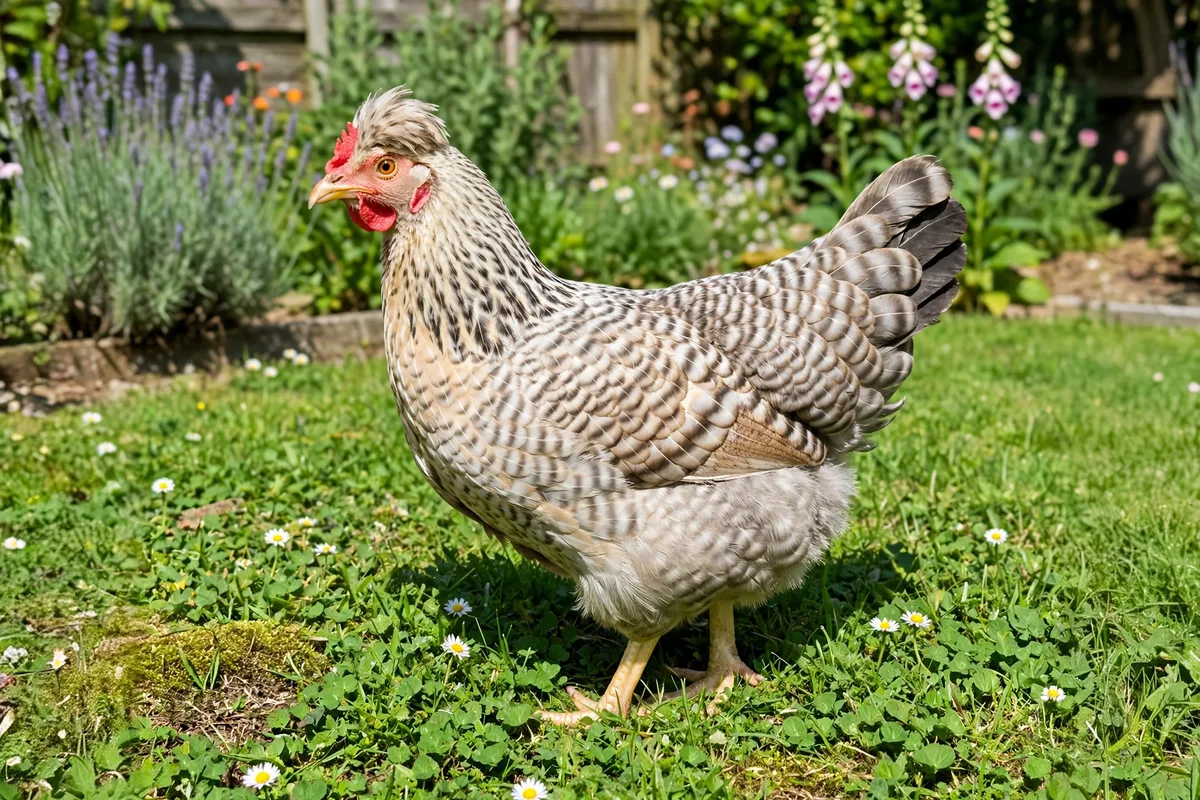
What is a Cream Legbar chicken?
A Cream Legbar chicken is a medium-sized British autosexing breed developed in the 1930s at Cambridge University by the geneticist Reginald Crundall Punnett, the same scientist who developed the Punnett square, working with Michael Pease. They crossed Brown Leghorns with Araucanas and other breeds to create a bird that laid blue eggs and could be sexed at hatch.
The breed was created for three traits: autosexing chicks, blue eggs and cream-coloured plumage with a crest. Hens weigh about 5.5 lb and roosters about 7 lb, and they have a small crest on the head, a single comb that may stand up or flop, and cream plumage with faint black barring.
Cream Legbars were recognised by the British Poultry Standard, but they are not currently listed as an accepted breed by the American Poultry Association, which matters if you want to show birds in the United States. They made their public debut at the London Dairy Show in 1947.
Cream Legbar temperament
Cream Legbars inherit a lot from their Leghorn ancestry: they are active foragers that love free-range time and will cover serious ground hunting bugs, and they are alert and aware, good at spotting predators and sounding the alarm, which protects the flock.
They are independent birds that tolerate handling but do not seek it out, and they are less inclined to be lap chickens than Buff Orpingtons or Easter Eggers. Temperament varies more than many short breed summaries admit: some birds are friendly, curious and easy to work around, while others are more nervous or flighty.
The breed club itself recommends asking breeders whether their line tends to be extremely flighty or more docile, friendly and curious, because strain matters. Handle chicks gently from a young age, and most birds settle into a confident, curious flock member.
Eggs and laying: how many eggs do Cream Legbars lay?
Cream Legbar hens lay 180–200 sky-blue eggs a year in productive strains, or about four a week, with some guides giving a wider range of 180–260 and one hatchery claiming around 280. A reasonable general backyard estimate is 180–200, and the higher figures should be treated with caution.
Eggs are medium-sized and sky blue, sometimes pale aqua or turquoise, and the colour is genuinely blue through the shell, so the inside is blue too and the colour does not fade. Hens start laying early, at 16–20 weeks old, which is earlier than most blue-egg breeds.
They rarely go broody, so they keep laying steadily instead of stopping to sit, which is good for egg supply but means they will not hatch their own chicks. Use the Egg Production Calculator to compare their output with other blue-egg breeds.
Housing and space for Cream Legbars
Cream Legbars need about 3–4 square feet of coop floor per bird and 8–10 square feet of run, with roosts at a comfortable height for a medium, active bird. They are lightweight, active foragers that thrive on free range and do not like being confined for too long, so give them room to roam.
They handle both cold and heat well, which makes them flexible for nearly any region, and their small single comb is less prone to frostbite than a Leghorn's. They are fairly quiet birds, which makes them a good fit for urban and suburban backyards where noise can be a concern.
Because they are alert and flighty, a covered run or a fence of at least 6 feet is sensible if you free-range near roads. Check the Chicken Breed Size Chart to compare their medium size with heavier breeds before planning nest boxes.
Feeding Cream Legbars
Cream Legbars do well on a standard layer feed of about 16 percent protein once laying, with grower feed before that and chick starter for the first six to eight weeks. A laying hen eats roughly a quarter of a pound of feed a day, and active foragers will find insects and greens on range.
They are frugal eaters with exceptional foraging skills, so they make good use of free range and will find a good share of their own food. Offer oyster shell in a separate dish so hens can take extra calcium for strong shells, and keep fresh water available at all times.
Feed is the same as for any laying flock, and no supplement will change egg colour: blue shells are set by genetics, not by feed. A balanced ration, clean water and enough daylight are what keep a moderate layer producing steadily through the season.
Health and common problems
Cream Legbars are hardy birds that commonly live five to eight years with good care. They have no major breed-specific weakness, and their main risks are the ordinary ones of a backyard flock: mites, lice, worms and respiratory illness in damp housing.
Their crest needs a little attention: it can get wet and dirty around drinkers, so use nipple drinkers or raise waterers off the ground, and check the crest feathers for mites. A wet crest in freezing weather can chill a bird, so keep the coop dry in winter.
Because they are flighty, they can injure themselves by crashing into fencing when startled, so avoid sudden movements and keep the run free of sharp edges. Vaccinate chicks against Marek's disease and quarantine new birds for at least two weeks.
Are Cream Legbars right for you?
Cream Legbars suit keepers who want sky-blue eggs, chicks that can be sexed at hatch, and an active, attractive bird that forages well. They are a good choice for free-range flocks, for urban and suburban backyards, and for anyone who wants a distinctive breed with a fascinating history.
They are a poorer fit if you want a calm lap chicken, since they are independent and can be flighty, or if you want to show birds in the United States, since they are not recognised by the American Poultry Association. If you want a calmer blue-egg layer, compare them with the Ameraucana chickens; if you want a friendlier blue-egg hybrid, look at the Easter Egger chickens.
Buy from a breeder who can show you the parent birds and their eggs, and ask whether their line tends to be flighty or docile. Buy sexed pullets or day-old chicks, since autosexing means you can tell males from females at hatch, and a flock of four to six hens will keep a family in blue eggs.
Buying Cream Legbar chickens: chicks, pullets and what to check
Buy Cream Legbars from a breeder who can show you the parent birds and their eggs, and ask whether their line tends to be flighty or docile, since strain matters. Because chicks are autosexing, you can buy day-old chicks and know which are pullets from the start.
Chicks are the cheapest option, but they need six weeks in a brooder and you will wait four to five months for the first egg, since Cream Legbars mature early. Started pullets cost more but lay within weeks, which suits a keeper who wants blue eggs quickly. Because the chicks are autosexing, you can buy day-old chicks with confidence about which are pullets, which removes the usual straight-run gamble. Whichever you buy, check that the birds are bright-eyed, active and clean around the vent, with a small crest and no discharge from the eyes or nostrils.
Ask the seller whether their line tends to be flighty or docile, and what the parent hens lay, since that tells you more than any breed description. A good breeder will tell you the age of the birds and whether they were vaccinated against Marek's disease, and will show you the parent birds and their blue eggs. Be wary of sellers who cannot show you a blue egg from the parent hens, or who promise a fixed number of eggs a year, since no honest seller can guarantee that. Buy from someone with a reputation to protect, and quarantine new birds for at least two weeks before mixing them with your flock.
Cream Legbar breed facts at a glance
| Trait | Cream Legbar |
|---|---|
| Origin | Cambridge, England; developed 1930s by R. C. Punnett and Michael Pease |
| Purpose | Eggs (blue) |
| Hen weight | About 5.5 lb (2.5 kg) |
| Rooster weight | About 7 lb (3.2 kg) |
| Eggs per year | 180–200 (some guides give 180–260) |
| Egg colour and size | Sky blue to blue-green, medium |
| Temperament | Active, alert, independent; sometimes flighty |
| Climate tolerance | Cold-hardy and heat-hardy |
| Broodiness | Rare to occasional |
| Good for beginners | Yes |
Egg figures vary widely by source: most guides give 180–200 a year, some give 180–220 or 180–260, and one hatchery claims around 280. The higher figures should be treated with caution, and 180–200 is the most commonly quoted range for backyard birds.
Sources: breed facts on this page are drawn from the breed profiles published by the Livestock Conservancy and from university extension poultry guidance, including the University of Minnesota Extension and poultry.extension.org. Where sources give different figures for eggs per year, this page shows the range and says so, rather than presenting one number as settled.
Related tools and guides
For more on the same topic, see Chicken Breed Size Chart and Egg Production Calculator.
Frequently asked questions
How many eggs do Cream Legbar chickens lay?
Cream Legbar hens lay 180–200 sky-blue eggs a year in productive strains, about four a week. Some guides give a wider range of 180–260, but 180–200 is the most commonly quoted figure for backyard birds.
Can you tell male from female Cream Legbar chicks at hatch?
Yes. Cream Legbars are autosexing: at hatch, female chicks have dark brown striping on the back and a distinct head pattern, while male chicks are paler yellow or cream all over with a faint head spot.
What colour eggs do Cream Legbars lay?
Cream Legbars lay sky-blue eggs, sometimes pale aqua or turquoise. The colour goes through the whole shell, so the inside is blue too, and it does not fade like the brown coating on a brown egg.
Are Cream Legbar chickens recognised by the American Poultry Association?
No. Cream Legbars were recognised by the British Poultry Standard but are not currently listed as an accepted breed by the American Poultry Association, which matters if you want to show birds in the United States.
Are Cream Legbar chickens friendly?
Cream Legbars are friendly and curious but independent: they tolerate handling without seeking it out. Temperament varies by strain, and some birds are more flighty than others, so ask the breeder about their line before buying.
About the author
John Walker is the founder of PeckCalc and has kept backyard chickens in Dallas, Texas since 2017. He started PeckCalc to give backyard keepers free calculators and guides with every figure traced to a university extension source.