
Egg Inside an Egg: What Is a Double-Shell Egg?
 By John Walker · Backyard chicken keeper in Dallas, Texas since 2017
An egg inside an egg is a rare double-shell egg, formed when a finished egg travels back up the oviduct and gets wrapped in a second shell. It is caused by a hiccup in the muscle movements that move eggs along, called counter-peristalsis. Most hens lay one in a lifetime, if ever, and it is safe to eat.
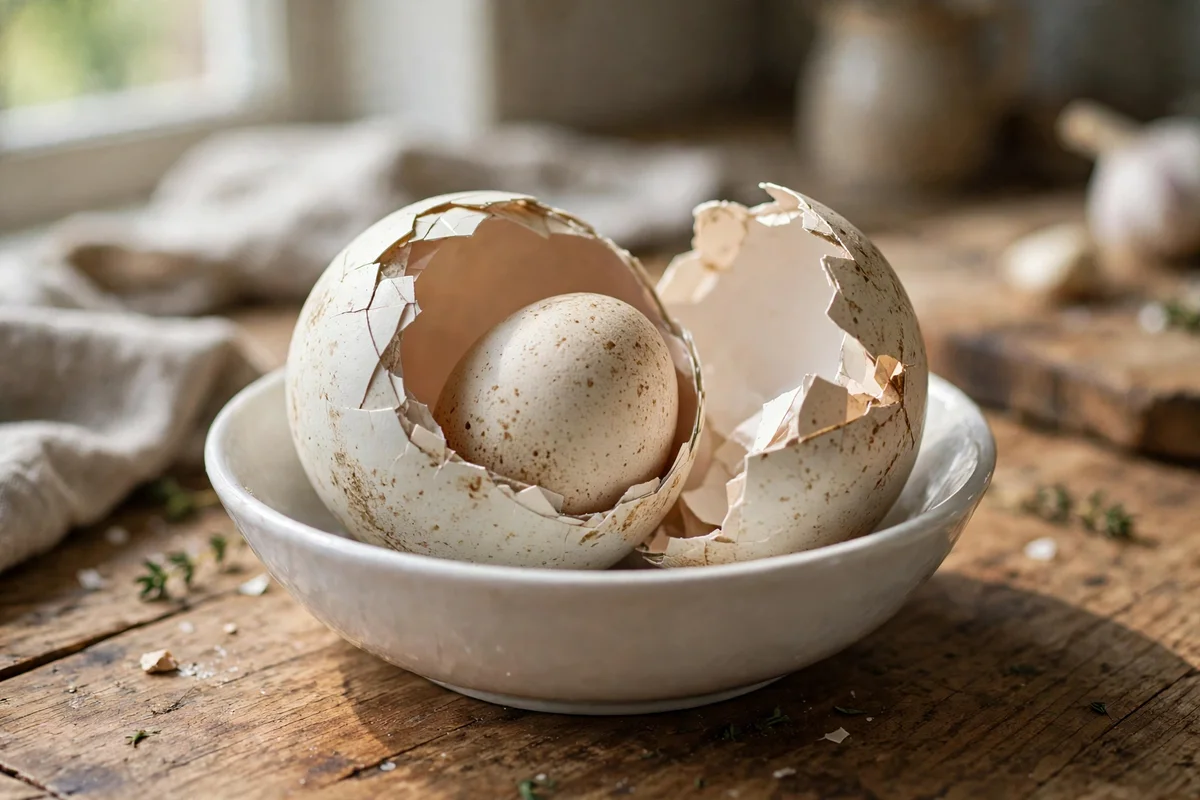
What is an egg inside an egg?
An egg inside an egg is a double-shell egg: a complete egg, with its own shell, sitting inside a larger egg that has a second shell around it. When you crack the outer egg open, you find a whole inner egg, sometimes with its own yolk and white, instead of the single yolk and white you expect.
It is one of the rarest odd eggs a keeper will ever see.
The inner egg is a real egg that was finished and ready to lay, and the outer egg is a second shell built around it after the finished egg was pushed back up the oviduct. The two eggs are not twins and they are not a double yolk, because a double-yolk egg has two yolks in one shell, while a double-shell egg has two complete shells, one inside the other.
Double-shell eggs are much larger and heavier than normal, and they are usually laid by a young pullet or a hen that has had a fright or a disturbance while laying. They are a curiosity rather than a problem, and a hen that lays one will almost always go back to laying normal eggs straight away.
How does an egg inside an egg form?
An egg inside an egg forms through counter-peristalsis, which is a reversal of the normal muscle waves that move an egg down the oviduct. Normally, the oviduct squeezes in one direction, pushing the egg from the ovary towards the vent, but a sudden shock or spasm can reverse the wave and push a finished egg back up the oviduct.
Once the finished egg has been pushed back up, the hen's reproductive system treats it as a new egg and starts building a second shell around it, adding white and then a second shell in the shell gland. The result is a complete egg inside a complete egg, and the hen lays the double egg as a single, oversized egg.
The trigger is usually a fright, a loud noise, a predator scare or a disturbance in the coop while the hen is laying, though it can also happen for no obvious reason, especially in young pullets whose laying system is still settling. Stress is the most likely cause, and it is one reason a calm, quiet laying area matters, as our guide on how to get chickens to lay in nest boxes explains.
Egg inside an egg vs double-yolk egg
An egg inside an egg and a double-yolk egg look similar from the outside, because both are much larger than a normal egg, but they are different inside. A double-yolk egg has two yolks in a single shell, and it forms when the ovary releases two yolks at once.
A double-shell egg has two complete shells, and it forms when a finished egg is pushed back up the oviduct.
You can tell them apart by cracking the egg open. A double-yolk egg gives you two yolks in one white, while a double-shell egg gives you a whole inner egg, with its own shell, sitting in the white of the outer egg. The inner egg may have its own yolk, or it may be mostly white, depending on how far along it was when it was pushed back.
Double-yolk eggs are common, especially in young pullets, while double-shell eggs are rare, and most keepers will never see one. Our guide on double-yolk eggs covers the common version, and this guide covers the rare one. Neither is a sign of illness on its own, and both are safe to eat if the shell is intact.
Is an egg inside an egg safe to eat?
Yes, an egg inside an egg is safe to eat, as long as the outer shell is intact and the egg is fresh. Crack it into a bowl first, as you would with any egg, and check that it looks and smells normal.
The inner egg is a complete egg, and the outer egg is a complete egg, so there is nothing wrong with either of them.
The main risk is the same as with any oversized egg, which is that the shell may be thin in places or cracked, and a cracked shell lets bacteria in. If the outer shell is cracked, throw the egg away rather than eating it, and if the inner egg looks odd, discoloured or smells off, throw that away too. A normal-looking, normal-smelling double-shell egg is fine to cook and eat.
Do not try to hatch a double-shell egg, because the inner egg takes up the space the chick needs, and the double shell is too thick for a chick to pip through. Hatching eggs should be normal-sized, smooth-shelled and clean, and our guide on how to hatch chicken eggs explains how to choose them.
Why did my hen lay an egg inside an egg?
A hen lays an egg inside an egg because something disturbed her while she was laying, and the muscle wave that moves the egg reversed. The most common triggers are a fright, a loud noise, a predator scare, or another hen disturbing her in the nest box.
Though it can also happen when a young pullet's laying system misfires for no clear reason.
Young pullets are the most likely to lay a double-shell egg, because their reproductive system is still learning its timing, and a small disturbance can throw it off. Older hens can lay one too, especially after a moult, after a broody spell, or after a fright, when the laying cycle is restarting and the timing is not yet settled.
If your hen lays one double-shell egg and then goes back to normal, there is nothing to fix, and the most useful response is to check that the nest boxes are quiet, dark and undisturbed. If she lays several odd eggs in a row, or if she shows signs of straining or distress, she may have a reproductive problem, and our guide on why is my hen laying huge eggs can help you work through the causes.
What to do when you find an egg inside an egg
When you find an egg inside an egg, note the date and the hen if you can, then crack it into a bowl and check it. Take a photo if you like, because it is a rare sight and most keepers will never see one.
And Then cook and eat it if it looks and smells normal, or throw it away if the shell is cracked or the contents look odd.
Check the nest boxes and the coop for the cause. Make sure the nest boxes are dark, quiet and private, that there are enough of them for the flock, and that nothing is frightening the hens while they lay. A dog barking outside the coop, a loud noise, or a hen being chased from a nest box can all trigger the spasm that causes a double-shell egg.
Watch the hen for a few days after she lays a double-shell egg, and look for straining, lethargy, a drop in laying or a swollen abdomen, because a very large egg can strain the oviduct. If she lays normally again and shows no signs of distress, she is fine, and the double-shell egg was a one-off curiosity rather than the start of a problem.
Sources: reproductive and shell-formation guidance on this page follows the laying-hen guidance published by university extension poultry services. For poultry guidance, see the poultry pages at the University of Minnesota Extension and poultry.extension.org.
Related tools and guides
For more on odd eggs and laying, see the guides below.
Frequently asked questions
What is an egg inside an egg?
An egg inside an egg is a double-shell egg: a complete egg, with its own shell, sitting inside a larger egg with a second shell around it. It forms when a finished egg is pushed back up the oviduct and gets wrapped in a second shell.
What causes an egg inside an egg?
Counter-peristalsis, a reversal of the muscle waves that move an egg down the oviduct. A fright, a loud noise or a disturbance while the hen is laying can trigger it, though it can also happen in young pullets for no clear reason.
Is an egg inside an egg the same as a double-yolk egg?
No. A double-yolk egg has two yolks in one shell, while a double-shell egg has two complete shells, one inside the other. Double-yolk eggs are common, while double-shell eggs are rare.
Is an egg inside an egg safe to eat?
Yes, as long as the outer shell is intact and the egg is fresh. Crack it into a bowl first and check that it looks and smells normal. Throw it away if the shell is cracked or the contents look or smell odd.
Will my hen lay another egg inside an egg?
Almost certainly not. A double-shell egg is usually a one-off, and the hen will go back to laying normal eggs straight away. If she lays several odd eggs in a row, or shows signs of straining, she should be checked by a vet.
About the author
John Walker is the founder of PeckCalc and has kept backyard chickens in Dallas, Texas since 2017. He started PeckCalc to give backyard keepers free calculators and guides with every figure traced to a university extension source.