
Easter Egger vs Olive Egger: Key Differences
 By John Walker · Backyard chicken keeper in Dallas, Texas since 2017
Easter Egger vs Olive Egger is a comparison many keepers make, because both birds lay colourful eggs and both are popular in backyard flocks. But they are not the same bird, and the difference matters if you want a particular egg colour. An Easter Egger is a mixed-breed chicken that lays blue or green eggs, and its egg colour varies from bird to bird. An Olive Egger is a cross bred specifically to lay olive-green eggs, and it is made by crossing a blue-egg layer with a dark brown-egg layer. The result is a bird whose eggs are a deep olive green, a colour no Easter Egger reliably produces. This guide compares the two side by side, so you can choose the bird that gives you the eggs you want.
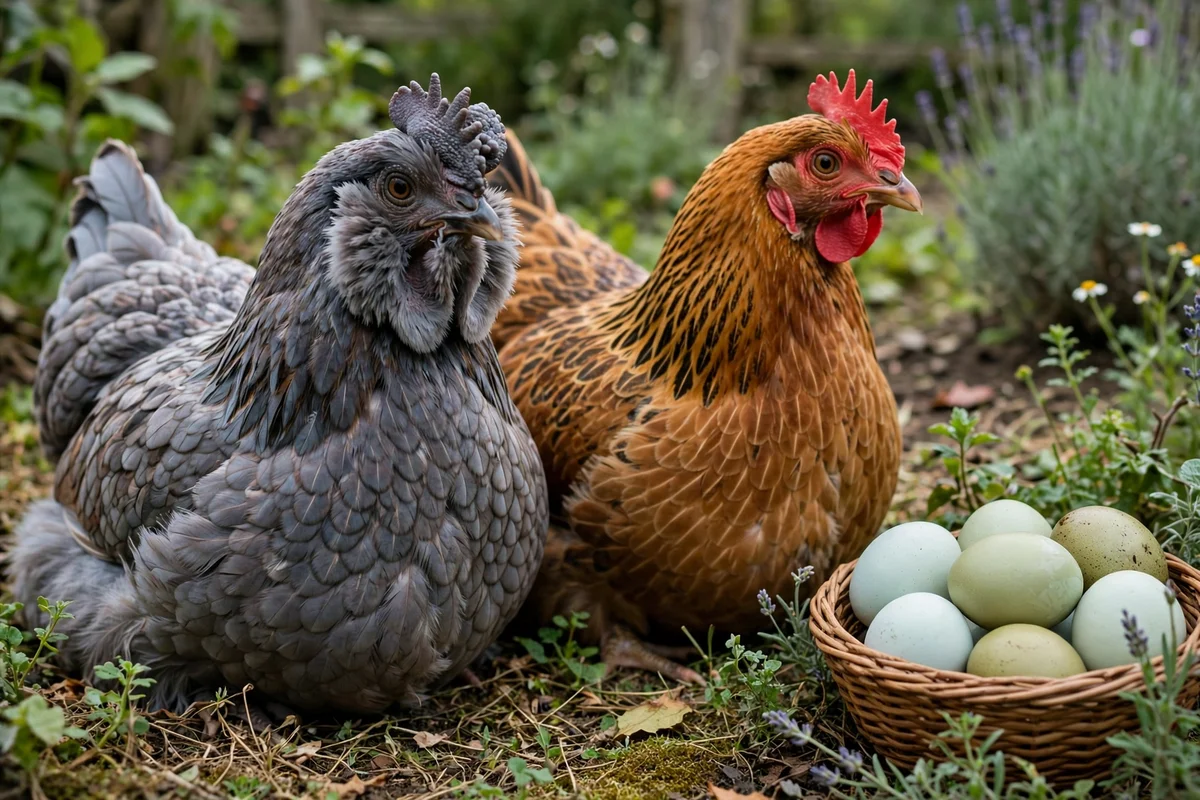
Easter Egger vs Olive Egger: the short answer
Easter Egger vs Olive Egger comes down to one thing: egg colour. An Easter Egger lays blue or green eggs, and the exact shade varies from bird to bird, because Easter Eggers are a mixed group rather than a single breed.
An Olive Egger lays olive-green eggs, a deep, mossy green that comes from a specific cross: a blue-egg layer crossed with a dark brown-egg layer, such as a Marans or a Welsummer.
An Easter Egger is not a recognised breed. It is a term for any chicken that carries the blue-egg gene and lays a coloured egg, usually the result of crossing an Ameraucana or Araucana with another breed. An Olive Egger is also not a recognised breed, but it is a more deliberate cross, made with a specific goal: olive eggs. The Olive Egger is a type of Easter Egger in the broad sense, but it is bred for one colour, while the Easter Egger is bred for variety.
If you want a basket of mixed pastel colours, choose Easter Eggers. If you want deep olive-green eggs specifically, choose Olive Eggers. That is the practical difference, and it is the reason many keepers have both: Easter Eggers for the blue and green, Olive Eggers for the olive. The two birds are similar in temperament and care, so the choice is mostly about the egg basket.
What is an Easter Egger?
An Easter Egger is a mixed-breed chicken that lays blue or green eggs. The name comes from the coloured eggs, which look like Easter eggs, and it is a marketing term rather than a breed name. Easter Eggers are usually made by crossing a blue-egg breed,
such as an Ameraucana or an Araucana, with a brown-egg breed, such as a Rhode Island Red or a Plymouth Rock. The chicks inherit the blue-egg gene, and they lay blue or green eggs.
Easter Eggers vary widely in appearance, because they are a mix. They often have a pea comb, which is a small, low comb with three ridges, and they often have muffs and a beard, which are tufts of feathers around the face. Their plumage can be almost any colour or pattern, from black to white to red to speckled, and no two birds look quite the same. That variety is part of their charm.
Easter Eggers are popular because they are hardy, friendly, and good layers, and because their eggs are beautiful. A hen lays around two hundred to two hundred and fifty eggs a year, and the eggs are medium to large. The birds are calm and easy to handle, and they do well in a backyard flock. Our guide on Easter Egger chickens covers the bird in full.
What is an Olive Egger?
An Olive Egger is a cross bred to lay olive-green eggs. It is made by crossing a blue-egg layer, such as an Ameraucana, a Cream Legbar, or an Easter Egger, with a dark brown-egg layer, such as a Marans, a Welsummer, or a Barnevelder.
The blue shell and the dark brown coating combine in the shell gland, and the result is an egg that looks olive green.
The olive colour varies. A first-generation Olive Egger, from a blue-egg parent and a dark brown-egg parent, usually lays a deep olive egg. A second-generation Olive Egger, from two Olive Eggers, may lay a lighter or darker olive, or even a brown egg, because the genetics are less predictable. The darkest olive eggs come from a cross with a Marans, because the Marans lays the darkest brown eggs of any breed, and that dark coating makes the deepest olive.
Olive Eggers vary in appearance, like Easter Eggers, because they are a cross. They often have a pea comb and muffs, and their plumage can be black, blue, or speckled. They are hardy, friendly, and good layers, laying around two hundred eggs a year. The main reason to choose an Olive Egger is the egg colour: a deep olive green that no other backyard bird reliably produces. Our guide on Olive Egger chickens covers the bird in detail.
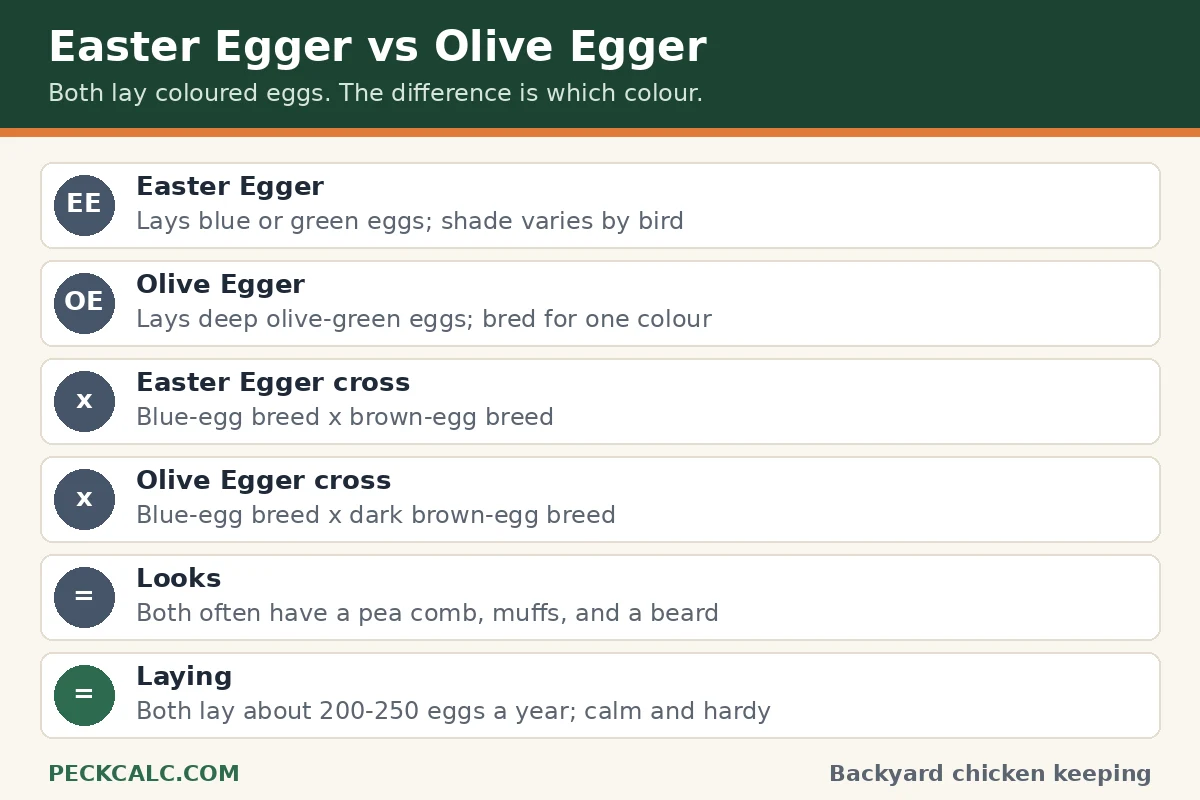
Egg colour: blue and green vs olive
The egg colour is the heart of the comparison, and it is worth understanding how it works. A blue egg gets its colour from a pigment called oocyanin, which is laid down through the whole shell, so the inside of a blue egg is blue too.
A brown egg gets its colour from a pigment called protoporphyrin, which is coated on the outside of the shell only, so the inside of a brown egg is white.
A green egg is a blue egg with a brown coating. The blue shell plus a light brown coating makes a green egg, and the shade depends on how dark the brown coating is. An Easter Egger that lays a green egg is a blue-egg bird with a light brown coating. An Olive Egger is a blue-egg bird with a dark brown coating, and the dark coating turns the green into a deep olive.
The practical result is that Easter Eggers give you a range of pastel blues and greens, and the shade varies from bird to bird, so a flock of Easter Eggers gives a mixed basket. Olive Eggers give you a narrower range of deep olive greens, and the shade is more consistent, because the cross is more deliberate. If you want a rainbow, choose Easter Eggers. If you want olive, choose Olive Eggers. Our guide on chicken breeds that lay coloured eggs explains the genetics behind every coloured egg.
Looks, temperament, and laying compared
Easter Eggers and Olive Eggers are similar in looks, because both are crosses that often share the same parent breeds. Both often have a pea comb, muffs, and a beard, and both come in a wide range of plumage colours.
The main visual difference is that Olive Eggers are more likely to be dark, because their dark brown-egg parent, often a Marans, passes on dark plumage, while Easter Eggers can be any colour.
Temperament is similar too. Both are calm, friendly, and easy to handle, and both do well in a backyard flock with children. Both are hardy and adaptable, and both tolerate cold weather well, because the pea comb is small and less prone to frostbite. Neither bird is aggressive, and both get along with other breeds.
Laying is similar as well. Both lay around two hundred to two hundred and fifty eggs a year, and both start laying at around twenty to twenty-four weeks old. The eggs are medium to large, and the shells are strong. The main difference is the egg colour, not the laying rate, and a keeper who chooses between them is choosing a colour, not a performance difference.
Which bird is right for your flock?
Choose an Easter Egger if you want variety. A flock of Easter Eggers will give you a basket of blue, green, and sometimes pink eggs, and no two birds will lay quite the same shade. Easter Eggers are also easier to find and usually cheaper,
because they are widely sold by hatcheries and breeders, and they are a popular choice for beginners.
Choose an Olive Egger if you want olive eggs specifically. An Olive Egger is the only reliable way to get deep olive-green eggs, and a flock of Olive Eggers will give you a consistent olive basket. Olive Eggers may cost a little more, and they may be harder to find, because the cross is more specific, but the egg colour is worth it if olive is what you want.
Choose both if you want the full rainbow. Many keepers have a mix: a few Easter Eggers for blue and green, a few Olive Eggers for olive, and a Marans or a Welsummer for dark brown. That mix gives a basket with every colour, and the birds all get along well. The two birds are so similar in care that keeping both is no harder than keeping one, and the egg basket is the reward.
Breeding Easter Eggers and Olive Eggers
Breeding Easter Eggers is unpredictable, because they are a mix, and their chicks may lay blue, green, brown, or even white eggs, depending on which genes they inherit. A keeper who breeds Easter Eggers should expect variety, and should not be surprised if a chick grows up to lay a brown egg.
The blue-egg gene is dominant, but it is not guaranteed, and the brown coating varies too.
Breeding Olive Eggers is more predictable in the first generation, but less so after that. A first-generation Olive Egger, from a blue-egg parent and a dark brown-egg parent, will usually lay an olive egg. But if two Olive Eggers are crossed, their chicks may lay olive, brown, green, or blue eggs, because the genes shuffle. The darkest olive eggs come from the first cross, not from breeding Olive Eggers together.
A keeper who wants olive eggs should buy first-generation Olive Eggers from a breeder who can explain the cross, rather than breeding them at home and hoping for the best. A breeder who crosses an Ameraucana with a Marans will produce reliable olive layers, while a keeper who crosses two Olive Eggers will get a mixed result. The genetics are fascinating, but they are also a reminder that egg colour is not guaranteed, and the only sure way to get olive eggs is to buy a bird bred for them.
Care and housing for both birds
Easter Eggers and Olive Eggers need the same care as any medium-sized laying breed. They need a coop with four square feet per bird, a run with ten square feet per bird, a balanced layer feed, clean water, and oyster shell for strong shells.
They are hardy and adaptable, and they do well in cold weather, because their small pea combs are less prone to frostbite.
Both birds are good foragers, and they enjoy ranging over grass and scratching for insects. They are not strong fliers, and they are content with a moderate fence, although a determined bird can clear a low fence if it wants to. They are quiet birds, and they do not make much noise, which makes them suitable for a suburban flock where neighbours are close.
The main care point for both birds is the same as for any layer: a balanced diet, clean water, and a dry coop. Egg colour does not change the care, and a bird that lays a blue egg needs the same calcium and protein as a bird that lays a brown egg. Our egg colour calculator can help predict the egg colour of a cross, and our guide on best chicken breeds for beginners covers the basics of choosing a first flock.
| Feature | Easter Egger | Olive Egger |
|---|---|---|
| Egg colour | Blue or green, varies | Deep olive green |
| Breed status | Mixed breed, not recognised | Deliberate cross, not recognised |
| Parent cross | Blue-egg breed x brown-egg breed | Blue-egg breed x dark brown-egg breed |
| Eggs per year | 200 to 250 | Around 200 |
| Comb | Usually pea comb | Usually pea comb |
| Temperament | Calm, friendly, hardy | Calm, friendly, hardy |
| Best for | A mixed pastel basket | Deep olive eggs specifically |
Sources: poultry.extension.org.
Related tools and guides
For more on the same topic, see Easter Egger Chickens.
Frequently asked questions
What is the difference between Easter Egger and Olive Egger?
An Easter Egger lays blue or green eggs and varies in shade. An Olive Egger is a specific cross of a blue-egg layer with a dark brown-egg layer, bred to lay deep olive-green eggs.
Is an Olive Egger the same as an Easter Egger?
An Olive Egger is a type of Easter Egger in the broad sense, but it is bred for one colour, olive green, while an Easter Egger is bred for a range of blue and green shades.
Do Olive Eggers lay olive eggs every time?
First-generation Olive Eggers usually lay olive eggs. Second-generation birds from two Olive Eggers may lay olive, brown, green, or blue eggs, because the genetics are less predictable.
Which lays more eggs, Easter Egger or Olive Egger?
They are similar. Both lay around 200 to 250 eggs a year. The difference is egg colour, not laying rate.
Are Easter Eggers and Olive Eggers good for beginners?
Yes, both are calm, friendly, hardy, and easy to handle, which makes them good choices for beginners and families.
About the author
John Walker is the founder of PeckCalc and has kept backyard chickens in Dallas, Texas since 2017. He started PeckCalc to give backyard keepers free calculators and guides with every figure traced to a university extension source.