
How Long Can Fresh Eggs Sit on the Counter
 By John Walker · Backyard chicken keeper in Dallas, Texas since 2017
Fresh unwashed eggs can sit on the counter for two to three weeks, as long as the bloom is intact and the room is cool. Fresh washed eggs, on the other hand, should not sit on the counter for more than two hours. The difference is the bloom, the thin coating on the shell that seals its pores and keeps bacteria out. Washing removes it, and once it is gone the egg has no protection and must be refrigerated. The two rules are often confused, which is why advice about counter storage seems to contradict itself: both answers are right, but they apply to different eggs. This guide untangles them and gives you a clear rule for every situation.
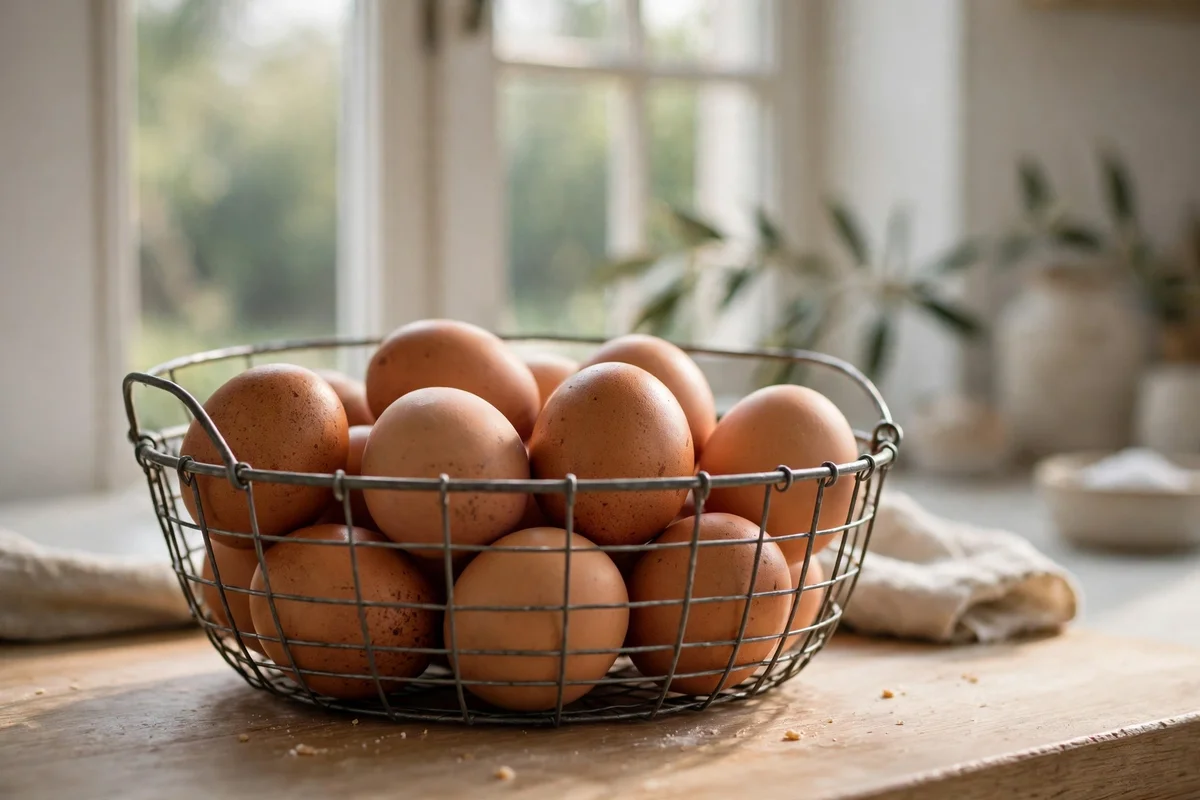
How long can fresh eggs sit on the counter?
Fresh unwashed eggs can sit on the counter for two to three weeks at cool room temperature, and in a cool house they can last up to a month. The bloom is doing the work here: it seals the pores in the shell and keeps bacteria out, and as long as it is intact and the egg is clean, the egg stays safe. The white will thin gradually over that time, and the yolk will flatten, but the egg remains safe to eat, and it will still be fine for scrambling and baking.
Fresh washed eggs are a different story. Once an egg has been washed, the bloom is gone, the pores are open, and the egg must be refrigerated. A washed egg left on the counter should be used within two hours, which is the food safety limit for perishable food at room temperature. The same two-hour limit applies to any egg that has been refrigerated and then taken out, because condensation forms on the cold shell and helps bacteria move through the pores.
The confusion comes from the fact that most advice does not say which kind of egg it is talking about. Commercial eggs in the United States are washed, so the advice for them is always to refrigerate. Backyard eggs are usually unwashed, so the advice for them is different. Before you follow any storage advice, check whether it is talking about washed eggs or unwashed eggs, because the answer changes completely.
Washed vs unwashed: the rule that decides everything
The bloom is the thin, invisible coating applied to the shell just before the egg is laid, and it dries within seconds. It seals the thousands of tiny pores in the shell, and it is the reason an unwashed egg can sit on the counter for weeks.
Dry cleaning, wiping an egg with a dry cloth or a fine sanding sponge, removes dirt without removing the bloom, so a dry-cleaned egg is still an unwashed egg for storage purposes, and it can sit on the counter.
Washing with water removes the bloom. It does not matter whether the water is warm or cold, or whether soap is used: water strips the coating, and once it is gone the egg must be refrigerated. That is why a washed egg has a shorter storage life than an unwashed egg, and why washed eggs should be used first. If an egg is heavily soiled with droppings or mud, wash it, because the dirt carries bacteria and a dirty egg is worse than a washed egg, but wash it knowing that it must then go in the fridge.
There is one more case to know: an egg that has been in the fridge and is then left out. The cold shell sweats as it warms, and the moisture on the shell helps bacteria enter through the pores. That is why a refrigerated egg should not sit on the counter for more than two hours, and why eggs should not be taken out of the fridge and put back repeatedly. Once an egg is refrigerated, keep it refrigerated. Our guide on whether fresh eggs need to be refrigerated covers the fridge side of the same question.
What shortens counter life?
Heat is the biggest factor. An egg kept at twenty degrees will last two to three weeks on the counter, but an egg kept at thirty degrees may only last a week, and an egg in a hot kitchen in summer can spoil faster still.
The bloom protects against bacteria, but it does not stop the egg ageing, and heat speeds ageing. A nest box in full sun can reach temperatures that damage eggs within hours, so collecting eggs promptly in summer matters, and getting them into a cool place quickly matters more than whether they go in the fridge or on the counter.
Dirty eggs spoil faster on the counter than clean eggs, because the dirt on the shell carries bacteria that can work through the pores over time. An egg with droppings on it should be cleaned or washed, and if it is washed it must go in the fridge. A cracked egg should never sit on the counter at all: a crack is an open door for bacteria, and a cracked egg should be used immediately or discarded. Check every egg as you collect it, and set aside any that are cracked or heavily soiled.
Age at collection also matters. An egg that has sat in the nest box for a week in summer is already a week old when you collect it, and its counter life is a week shorter than an egg collected the same day. Collect eggs at least once a day, more often in hot weather, and date them in pencil so you know which are oldest. Using the oldest eggs first is the simplest way to make sure none sit on the counter too long.
How to tell if a counter egg is still good
The float test is the quickest check. Put the egg in a bowl of water: a fresh egg lies flat on the bottom, an egg a week or two old stands on its end, and an old egg floats. A floating egg is not automatically unsafe, but it is old, and it should be cracked into a bowl and checked by smell before use. Our guide on whether the egg float test works explains what the test can and cannot tell you, and why it measures age rather than safety.
The crack test is the second check, and it is the more useful one. Crack the egg onto a flat plate and look at the white. A fresh egg has a thick white that stands tall around a high, round yolk. An older egg has a thin white that spreads flat, and a yolk that sits low and flattens. The smell test is the final check: a bad egg smells of sulphur or rot the moment it is cracked, and the smell is unmistakable. If an egg smells bad, discard it, no matter how good it looked in the water.
Dating your eggs makes all of this easier. Write the laying date on the shell in pencil when you collect, keep the eggs in a carton or basket with the oldest at the front, and use them in order. A dated egg is an egg you can trust, and a basket of undated eggs is a guessing game. If you sell or give away eggs, dating is not optional: it is the information your customers need to store the eggs safely.
Counter storage vs fridge storage
Counter storage is convenient and it works, but fridge storage is better in every measurable way. Eggs kept in the fridge last three to five weeks, while eggs kept on the counter last two to three weeks. The white stays firmer in the fridge, the yolk stays higher, and the egg is safer, because cold slows bacterial growth and ageing.
If you have fridge space, use it, and keep the counter for eggs you plan to use within a week or two.
The one advantage of counter storage is that eggs kept at room temperature are better for baking, because cold eggs do not whip as well and cold whites do not reach the same volume. A baker can take eggs out of the fridge half an hour before baking, which gives the same benefit without the storage risk. There is no cooking advantage to storing eggs on the counter for weeks, and the risk, while small, is real.
For a keeper with more eggs than fridge space, the practical answer is to keep a week supply on the counter and the rest in the fridge, rotating as the counter supply is used. That gives the convenience of counter eggs for daily cooking and the safety of fridge storage for the bulk of the flock output. Our guide on how to store fresh eggs covers the full method, and our guide on how to freeze fresh eggs explains what to do when the flock is producing more eggs than you can use.
The counter storage checklist
Keep only clean, unwashed eggs on the counter, and wash any dirty eggs and put them in the fridge instead. Keep the eggs in a cool spot, away from the stove, the oven, and direct sun, because heat shortens their life.
Keep them in a carton or a basket, pointed end down, and date them in pencil so you use the oldest first. Collect eggs daily, more often in hot weather, and never put a cracked egg on the counter.
Use counter eggs within two to three weeks, and sooner in summer. If you are unsure how old an egg is, use the float test and the crack test, and trust the smell test above all. If an egg smells bad, discard it. If you are unsure whether an egg was washed, treat it as washed and refrigerate it, because that is the safe assumption.
When in doubt, refrigerate. Refrigeration is the safer choice in every case, it costs nothing, and it gives the longest storage life. The counter is a convenience for eggs you will use soon, not a long-term storage method, and the two to three weeks it offers are enough for most keepers. The egg production calculator can help you work out how many eggs your flock produces each week, so you can plan storage around the real numbers rather than guessing.
Sources: USDA Food Safety and Inspection Service, shell eggs from farm to table and poultry.extension.org.
Related tools and guides
For more on the same topic, see How to Store Fresh Eggs.
Frequently asked questions
How long can fresh eggs sit on the counter?
Unwashed eggs with the bloom intact last two to three weeks on the counter at cool room temperature, and up to a month in a cool house. Washed eggs should not sit out for more than two hours, because washing removes the bloom that protects the shell.
Can I leave washed eggs on the counter overnight?
No. Once an egg has been washed the bloom is gone and the egg must be refrigerated. A washed egg left on the counter overnight should be used promptly or discarded, and it should not go back in the fridge as if nothing happened.
Do unwashed eggs really last weeks on the counter?
Yes, as long as the bloom is intact, the egg is clean, and the room is cool. The bloom seals the shell pores and keeps bacteria out, which is how eggs were stored for centuries before refrigeration. Heat shortens that window, so summer eggs last less long.
How do I know if a counter egg has gone bad?
Use the float test, the crack test and the smell test together. A bad egg floats in water, has a flat runny white when cracked, and smells of sulphur or rot. Trust the smell test above all: a bad egg announces itself clearly.
Is it better to store eggs on the counter or in the fridge?
The fridge is better. Fridge eggs last three to five weeks, counter eggs last two to three weeks, and the white stays firmer in the fridge. Keep a week supply on the counter if you like, and the rest in the fridge.
About the author
John Walker is the founder of PeckCalc and has kept backyard chickens in Dallas, Texas since 2017. He started PeckCalc to give backyard keepers free calculators and guides with every figure traced to a university extension source.