
How to Make Homemade Pasta With Fresh Eggs
 By John Walker · Backyard chicken keeper in Dallas, Texas since 2017
Learning how to make homemade pasta with fresh eggs is one of the best uses for a backyard glut of eggs, because the whole recipe is just eggs and flour, and the result is far better than anything from a packet. Fresh eggs give the dough a rich colour, a silky texture and a flavour that dried pasta cannot match. This guide explains the dough, the kneading, the resting, the rolling and the cutting, and how to dry and store the pasta once it is made.
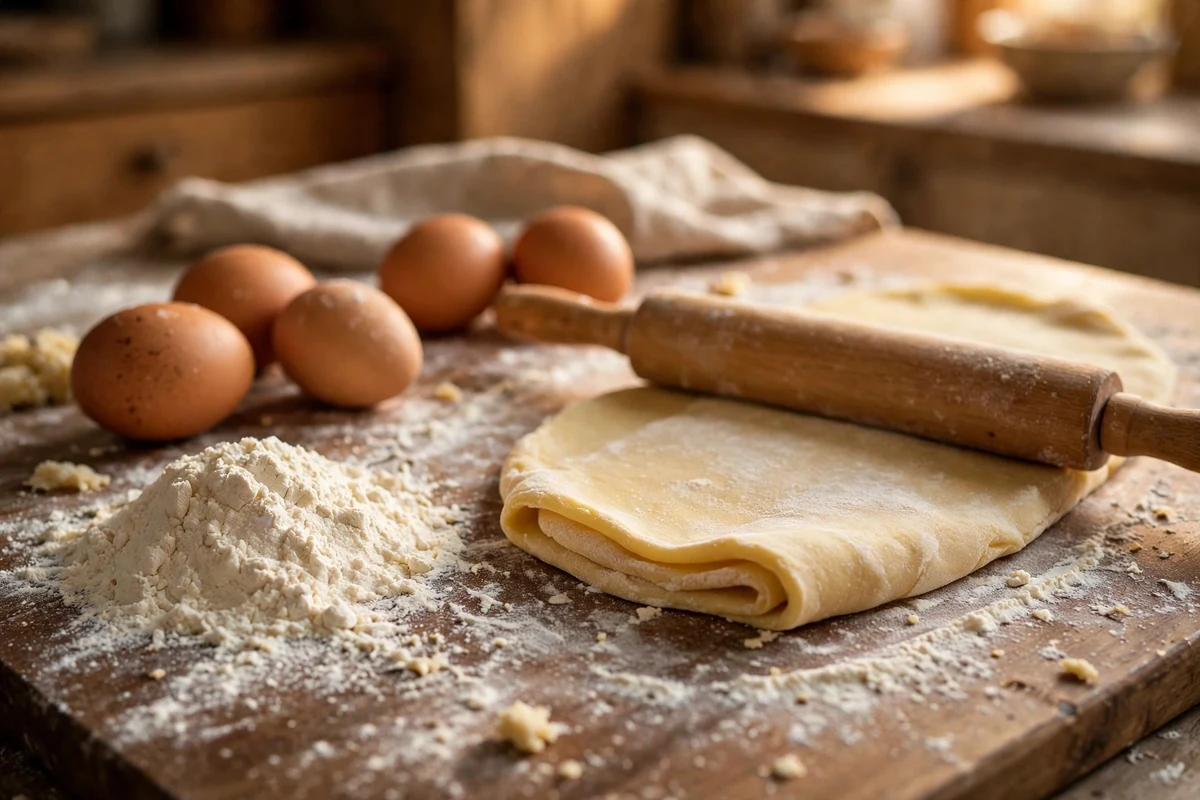
How to make homemade pasta with fresh eggs
To make homemade pasta with fresh eggs, mix eggs and flour into a firm dough, knead it until smooth, rest it for half an hour, roll it thin, cut it into the shape you want, and cook it in boiling salted water for two to four minutes.
That is the whole recipe, and the rest of this guide fills in the details.
The classic ratio is one large egg for every 100 grams of flour, which is about three quarters of a cup, and that ratio makes enough pasta for one generous serving. For a family meal, three eggs and 300 grams of flour is a good starting point, and the dough can be scaled up or down by the same ratio.
Fresh eggs are the reason this pasta is special. A backyard egg has a deep orange yolk, and that colour carries into the dough, giving the pasta a golden colour and a rich flavour that shop eggs, with their paler yolks, cannot match. The yolk also adds fat, which makes the dough silky and easy to roll.
You do not need a pasta machine to start. A rolling pin, a clean work surface, a knife and a little patience will make good tagliatelle, which are flat ribbons, and fettuccine, which are slightly wider ribbons. A machine makes the rolling faster and thinner, but it is not required.
The dough: eggs, flour and the ratio
The dough for homemade pasta with fresh eggs is just eggs and flour, with a pinch of salt, and the ratio is one large egg to every 100 grams of flour. Plain flour works well for a first batch, and strong bread flour or Italian 00 flour gives a firmer, silkier dough.
Flour is the structure of the pasta, and eggs are the moisture and the richness. The egg white adds protein, which gives the dough its strength, and the yolk adds fat and colour. A dough made with whole eggs is firm and easy to handle, while a dough made with yolks only is richer, softer and more delicate.
Use the freshest eggs you have, and bring them to room temperature before you start, because cold eggs make a stiff dough that is hard to knead. Crack the eggs into a bowl first, so you can fish out any shell, and check each egg as you crack it, because one bad egg will spoil the whole batch.
Put the flour in a mound on a clean work surface, make a well in the centre, and pour the beaten eggs into the well with a pinch of salt. Mix with a fork, drawing the flour in from the edges a little at a time, until the dough comes together in a shaggy ball. If it is too dry, add water a teaspoon at a time; if it is too sticky, add flour a spoonful at a time. Our guide on how to store fresh eggs explains how to keep eggs fresh for cooking.
Kneading and resting the dough
Knead the pasta dough for eight to ten minutes, until it is smooth, firm and springy, then wrap it and rest it for at least half an hour. Kneading builds the gluten, the protein network that gives pasta its bite, and resting lets that network relax so the dough rolls out thin.
To knead, push the dough away from you with the heel of your hand, fold it back over itself, turn it a quarter turn, and repeat. The dough will feel rough and lumpy at first, then smoother and firmer, and finally smooth and springy, like a firm earlobe. If it tears when you stretch it, knead a little longer.
Resting is not optional. A dough that has not rested will spring back when you try to roll it, and it will be hard to get thin. Wrap the dough tightly in cling film or a damp cloth, and leave it on the counter for half an hour, or in the fridge for up to a day. A rested dough rolls out easily and holds its shape when it is cut.
While the dough rests, clean up, fill a large pot with water, and set out the tools you will need: a rolling pin or a pasta machine, a sharp knife or a pastry wheel, and a clean tea towel or a drying rack for the finished pasta. A little flour for dusting is essential, because the dough will stick to everything if the surface is dry.
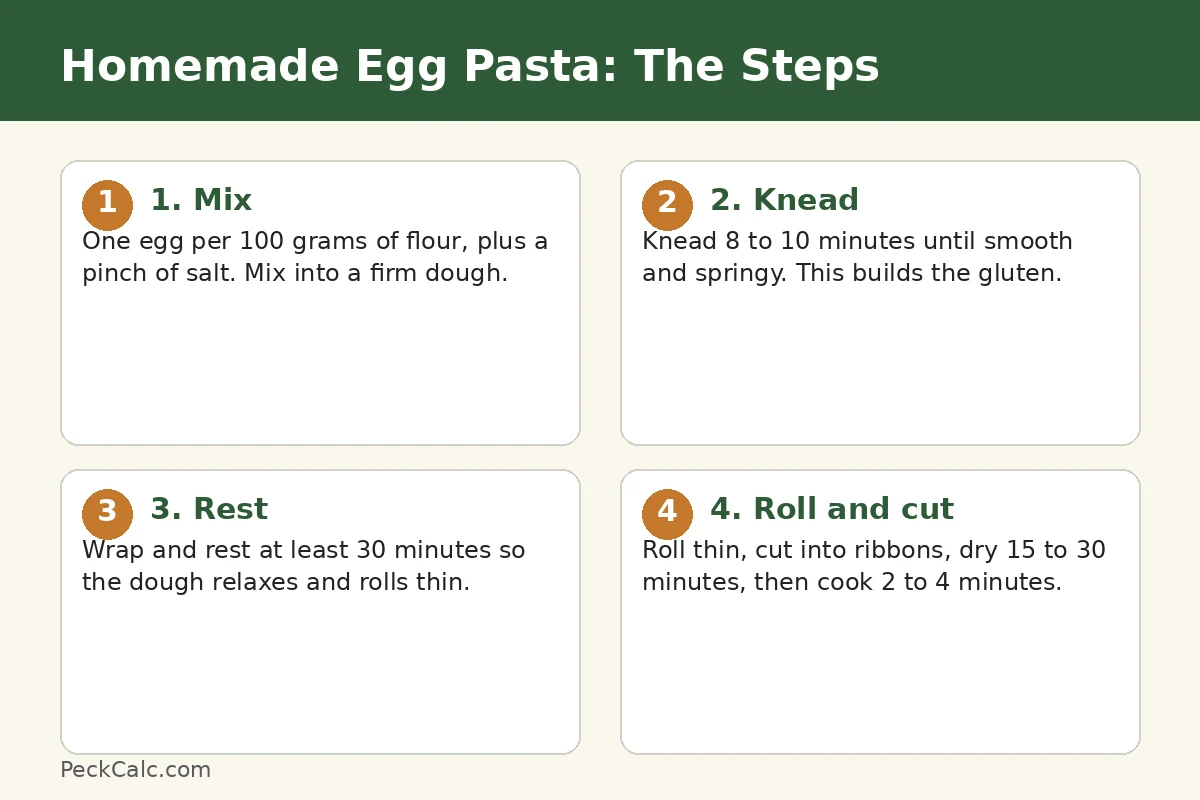
Rolling and cutting the pasta
Roll the rested dough out thin, until you can almost see your hand through it, then cut it into the shape you want. Thinness matters more than width, because pasta that is too thick cooks unevenly and feels doughy in the middle.
Divide the dough into four pieces, and work with one piece at a time, keeping the others wrapped so they do not dry out. Roll the piece out on a lightly floured surface, turning it often and dusting it with flour, until it is a long, thin sheet. With a pasta machine, pass the sheet through the widest setting several times, folding it in half each time, then work down through the settings until the sheet is thin.
For tagliatelle, roll the sheet up loosely, like a Swiss roll, and slice it into ribbons about half a centimetre wide, then unroll the ribbons and toss them with a little flour so they do not stick. For fettuccine, cut the ribbons a little wider. For lasagne, cut the sheet into rectangles. For filled pasta, such as ravioli, the sheet must be very thin, because it will be doubled over.
Let the cut pasta rest on a clean tea towel or a drying rack for fifteen to thirty minutes before cooking. This short drying time firms the surface, so the pasta holds its shape in the water, and it stops the ribbons from sticking together in the pot. Our guide on how to freeze fresh eggs explains how to preserve a glut of eggs for later cooking.
Cooking fresh egg pasta
Cook fresh egg pasta in a large pot of boiling salted water for two to four minutes, until it is tender but still firm to the bite. Fresh pasta cooks much faster than dried pasta, so watch it closely and taste it early.
Use plenty of water, at least a litre per serving, and add a generous pinch of salt, but no oil: oil makes the pasta slippery and stops the sauce from sticking to it. Drop the pasta in a little at a time, stirring gently so the ribbons do not clump, and keep the water at a rolling boil.
Fresh pasta is done when it floats and tastes tender with a slight bite, which Italians call al dente. Thin ribbons may be done in two minutes, while thicker shapes can take four. Taste a piece at two minutes, and then every thirty seconds, because the window between perfect and overcooked is short.
Drain the pasta, but save a cup of the cooking water, because its starch helps the sauce cling to the pasta. Toss the pasta with the sauce at once, over a low heat, for a minute, so the sauce coats every ribbon. Fresh egg pasta suits simple sauces best: butter and sage, olive oil and garlic, or a light tomato sauce, because a heavy sauce overwhelms the flavour of the egg.
Drying, storing and using up eggs
Dry homemade pasta by laying the ribbons on a clean tea towel or hanging them on a drying rack for an hour or two, then store them in an airtight container. Dried pasta keeps for weeks, and it is a good way to use up a glut of eggs.
For short drying, lay the ribbons in loose nests on a tea towel, dusted with flour, and leave them for an hour or two until the surface is dry. For longer storage, hang the ribbons on a rack or over a clean broom handle until they are brittle, then store them in a jar or a tin. Dried pasta takes a little longer to cook than fresh, around four to six minutes.
Fresh pasta can also be frozen. Lay the ribbons in loose nests on a tray, freeze them until firm, then pack them into a freezer bag. Frozen pasta cooks straight from frozen in boiling water, and it takes only a minute or two longer than fresh. It keeps for a few months, and it is the best way to preserve a large batch.
| Step | What to do | Time |
|---|---|---|
| Mix | One egg per 100 grams of flour, plus salt | 5 minutes |
| Knead | Push, fold, turn until smooth and springy | 8 to 10 minutes |
| Rest | Wrap and leave on the counter | At least 30 minutes |
| Roll | Roll thin, until almost see-through | 10 minutes |
| Cut | Ribbons, sheets or shapes, dusted with flour | 5 minutes |
| Cook | Boiling salted water until al dente | 2 to 4 minutes |
A flock in full lay can produce more eggs than a household can eat, and pasta is one of the best ways to use them, because each batch takes several eggs and the result stores well. Our guide on how to tell if eggs are fresh explains how to check eggs before cooking, and our guide on double yolk eggs covers the extra-large eggs that make the richest pasta.
Sources: general egg handling and food safety guidance from foodsafety.gov and the poultry pages at the University of Minnesota Extension. Cook eggs and pasta dishes thoroughly, and refrigerate leftovers promptly.
Related tools and guides
For more on the same topic, see How to Freeze Fresh Eggs and How to Store Fresh Eggs.
Frequently asked questions
How many eggs do I need for homemade pasta?
One large egg for every 100 grams of flour, which is about three quarters of a cup. That makes one generous serving. For a family meal, three eggs and 300 grams of flour is a good starting point, and the dough scales up or down by the same ratio.
What flour is best for homemade egg pasta?
Plain flour works well for a first batch. Strong bread flour or Italian 00 flour gives a firmer, silkier dough that rolls thinner and holds its shape better. Avoid self-raising flour, because the raising agents change the texture.
How long does fresh egg pasta take to cook?
Two to four minutes in a large pot of boiling salted water. Thin ribbons may be done in two minutes, while thicker shapes take four. Taste a piece at two minutes and then every thirty seconds, because fresh pasta goes from perfect to overcooked quickly.
Can I make pasta without a pasta machine?
Yes. A rolling pin, a clean work surface and a sharp knife will make good tagliatelle and fettuccine. A machine makes the rolling faster and thinner, but it is not required. Divide the dough into small pieces and roll each one as thin as you can.
How do I store homemade pasta?
Dry the ribbons on a tea towel or a drying rack for an hour or two, then store them in an airtight container, where they keep for weeks. Fresh pasta can also be frozen in loose nests on a tray, then packed into a freezer bag, and cooked straight from frozen.
About the author
John Walker is the founder of PeckCalc and has kept backyard chickens in Dallas, Texas since 2017. He started PeckCalc to give backyard keepers free calculators and guides with every figure traced to a university extension source.