
Sultan Chickens
 By John Walker · Backyard chicken keeper in Dallas, Texas since 2017
Sultan chickens are one of the most ornamental breeds in the world: pure white birds with a large crest, a full beard and muffs, feathered feet, five toes, and a V-shaped comb, kept for centuries as palace fowl in the Ottoman Empire. Hens lay only around 50 to 100 small white eggs a year, so Sultans are kept for show and companionship — and for the privilege of keeping one of the rarest breeds there is.
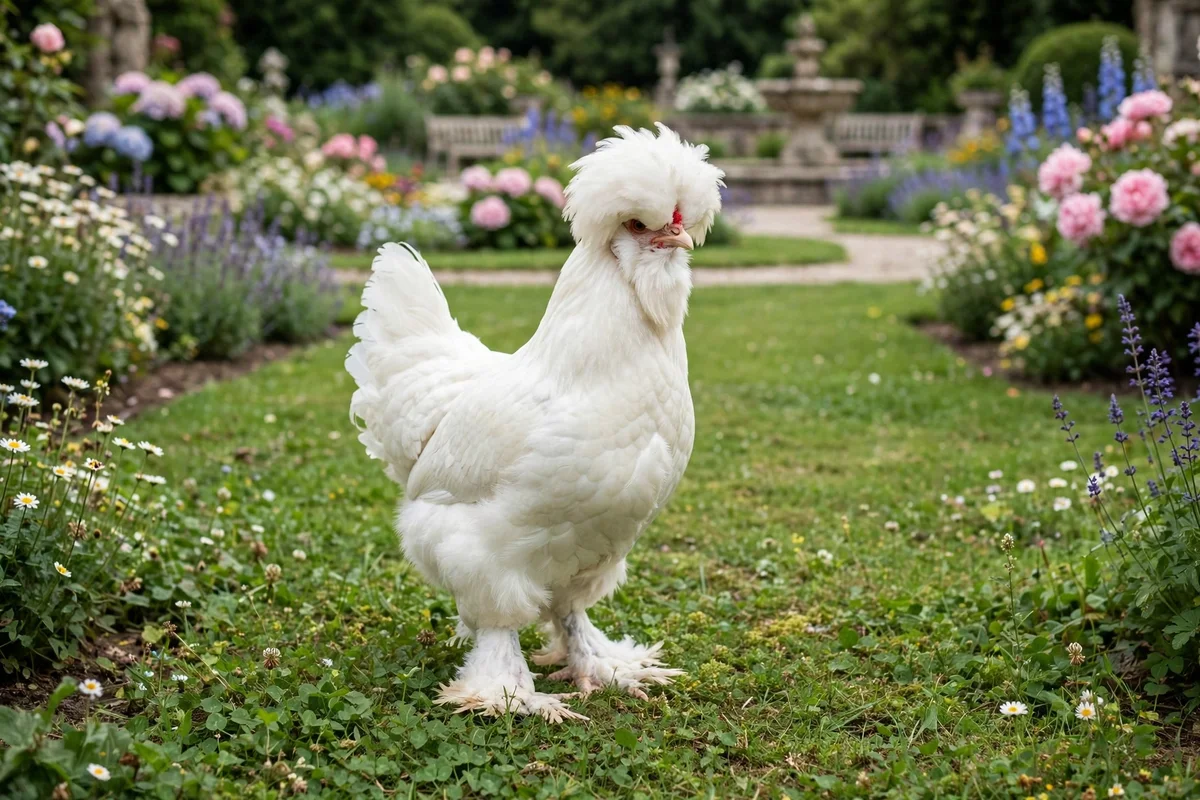
What is a Sultan chicken?
Sultan chickens are a crested Turkish breed with more unusual features than almost any other chicken: a full crest, a heavy beard and muffs, a V-shaped comb, heavily feathered legs and feet, vulture hocks on the thighs, and five toes on each foot.
The breed is believed to have originated in Turkey, where birds of this type were kept for ornament in the gardens of the Ottoman sultans — the Turkish name Sarai-Tavuk means fowls of the sultan. They were first imported to England in 1854 and included in the first American Poultry Association Standard of Perfection in 1874. The Livestock Conservancy lists the breed as Threatened, and the world population is very small.
Sultan chicken breed facts
| Fact | Detail |
|---|---|
| Origin | Turkey, Ottoman Empire |
| Other names | Sarai-Tavuk, Serai Täook, Fowl of the Sultan |
| APA recognition | 1874, in the first Standard of Perfection |
| Purpose | Ornamental and exhibition only |
| Rooster weight | About 6 lb (2.7 kg) |
| Hen weight | About 4 lb (2.0 kg) |
| Eggs per year | About 50 to 100; some sources give about 50, others 50 to 70 |
| Egg colour | White |
| Egg size | Small, about 53 g |
| Temperament | Docile, friendly, social, easily tamed |
| Climate tolerance | Low in cold and wet; crest and feathered feet need dry conditions |
| Broodiness | Low |
| Good for beginners | No — rare, delicate, and needs careful housing |
| Conservation status | Threatened (Livestock Conservancy) |
Figures are the breed standard or the range reported by the Livestock Conservancy and university extension sources. Where sources disagree, the table shows the range rather than a single figure.
History and origin of the Sultan
The Sultan is believed to have originated in the part of the former Ottoman Empire now known as Turkey. According to legend, birds of this type were kept for ornament in the gardens of the palace of one of the sultans, and the breed's Turkish name, Sarai-Tavuk, means fowls of the sultan. The known history begins in 1854, when Elizabeth Watts of Hampstead received a small shipment of the birds from a friend in Constantinople.
Every Sultan in the Western world today is said to descend from that original stock. The White Sultan was included in the very first APA Standard of Perfection in 1874, and the breed became popular among poultry fanciers looking for a decorative show bird. It almost went extinct in the 1930s and remains critically rare: the world population was estimated at 86 birds in 2026 by one source, and the Livestock Conservancy lists it as Threatened, with fewer than 1,000 breeding birds in the United States.
What do Sultan chickens look like?
The Sultan is pure white from crest to feet, and it is the only colour recognised by the APA, though Black, Blue, Splash and Buff exist in other countries and Black and Blue bantams are recognised by the ABA. The bird carries a full crest that covers the eyes, a heavy beard and muffs, a V-shaped comb usually visible only in cocks, heavily feathered shanks and toes, vulture hocks, and five toes. The shanks and toes are slate-blue to pale blue, and the beak is pale.
Bantam Sultans are recognised at about 26 oz for a cock and 22 oz for a hen. The breed's slow, deliberate manner and low-carried wings, which cover the thighs and upper hocks, give it a regal, almost stately look. Compared with the Houdan chickens, the other great five-toed crested breed, the Sultan is smaller, whiter, more heavily feathered on the legs, and more ornamental.
How many eggs do Sultan chickens lay?
Sultan hens lay small white eggs, about 53 g each, and very few of them: about 50 a year by most accounts, with some sources giving 50 to 100. That is about one egg a week. Pullets are slow to mature and often do not lay their first egg until six to ten months, frequently waiting until eight to ten months.
If you want eggs, do not buy Sultans. If you want a rare ornamental bird, they are a good choice. Use the egg production calculator with 50 to 100 eggs per hen so you are not disappointed. Compared with the Sebright chickens, the Sultan lays a similar number of eggs but is the larger and more heavily feathered bird.
Sultan temperament and behaviour
Sultans are docile, friendly and social, and they are well known as one of the friendliest breeds you can find. They are easily tamed, contented birds that enjoy human company, and they are gentle with other breeds. They are not flighty or aggressive, and they make good pets for a keeper who has time for them.
Their gentleness is also a weakness: Sultans do not defend themselves well, and their crest limits their vision, so they need protection from predators and from pushy flock mates. They do best kept with other calm, gentle breeds, or on their own, in a secure run where they can be watched.
Are Sultan chickens good for beginners?
No, Sultans are not a good beginner breed. They are rare, delicate, slow to mature, and need careful, dry, predator-proof housing. Our guide to the best chicken breeds for beginners recommends sturdier birds for a first flock instead.
An experienced keeper who wants a rare ornamental breed and is willing to give it a dry, secure home will find Sultans rewarding. A beginner who wants eggs and an easy first flock will be disappointed. If you do start with them, buy from a breeder who is working to preserve the breed, and be prepared to wait months for your first egg.
Housing and space for Sultan chickens
Allow about 3 to 4 square feet of coop space and 8 to 10 square feet of run per standard bird. The chicken breed size chart puts the Sultan in the light to medium class, so the coop can be smaller than for a heavy breed, but the run must be secure.
A covered run is essential: Sultans cannot see predators well because of their crest, and they are poor at evading them. One nest box per four hens is enough, and roosts should be low, since a heavily feathered bird does not want to jump far. Keep the coop dry, since a wet crest and wet foot feathers can chill the bird and lead to health problems.
What to feed Sultan chickens
Feed starter, then grower, then layer feed from about 18 weeks, with free-choice calcium on the side. Sultans are moderate eaters and do not need a high-energy ration. Their beard and muffs can get wet in a deep waterer, so use a nipple drinker or a waterer with a narrow drinking area.
Because they are not strong foragers, do not rely on ranging to feed them — give them a full ration and let foraging be a bonus. Keep scratch to a small handful, and make sure they have grit available when they eat anything other than pellets or crumble. In winter, make sure they always have feed available.
Sultan chickens in cold and hot weather
Sultans are not cold hardy. Their crest can get wet and chill them, their feathered feet need dry ground, and their small size means they lose heat fast. In a cold climate, they need an insulated, dry coop with deep litter and a covered run.
In heat they do reasonably well, provided they have shade and cool water. Their main climate weakness is cold and wet: a dry Sultan in a cold coop will do better than a wet Sultan in a mild one. If your site is wet and exposed, either house them well or choose a hardier breed.
Health and common problems
Sultans are a generally healthy breed with a lifespan of five to eight years, though some live to ten with good care. The main things to watch are crest-related problems — wet crests, mites in the crest feathers, and vision problems — foot problems from their feathered legs, and the usual backyard issues of mites, lice and worms.
Check the crest and feet weekly, keep the run dry, and trim the crest feathers around the eyes if they block vision. Buy from a breeder who selects for vigour, ask about Marek's vaccination, and quarantine new birds for two weeks. Because the breed is so rare, buy from a breeder who is working to preserve it.
Sultan vs Houdan
The Sultan and the Houdan are the two great five-toed crested breeds, and they share a lot: both are crested, bearded and muffed, both have five toes, and both are rare heritage breeds. The Sultan is smaller, at 6 lb for a cock against 8 lb for a Houdan, pure white where the Houdan is mottled, and more heavily feathered on the legs, with vulture hocks that the Houdan lacks.
The Houdan is the hardier and more productive of the two, laying 150 to 200 eggs a year against the Sultan's 50 to 100, and it was once a valued meat bird. The Sultan is the more ornamental and the rarer bird, kept purely for show and companionship. If you want a crested bird that also lays, pick the Houdan; if you want the most ornamental bird you can own, pick the Sultan. The Faverolles chickens share the Sultan's five toes in a gentler, more productive package.
Keeping Sultan chickens with other breeds
In a mixed flock, Sultan chickens generally do best with birds of a similar size and temperament. A Sultan hen weighs about 4 lb (2.0 kg), and a rooster about 6 lb (2.7 kg), so they are medium birds, and they fit well with most standard breeds, provided the flock has enough space and more than one feeder. The breed's temperament is described as docile, friendly, social, easily tamed, and that is the best guide to how they will settle in: a calm bird usually joins a flock quietly, while a more assertive one needs space and at least two feeding and watering stations so weaker birds can eat in peace. Watch the first week closely for feather picking or one bird being kept from the food.
Add new birds slowly, through a wire divider for a few days before mixing them fully, as described in our guide on how to introduce new chickens to a flock, and quarantine any new bird for two weeks first. Keep only one rooster per flock unless you have a large property and separate pens. Broodiness in this breed is low, so a hen that does go broody will need a quiet corner away from the main flock while she sits. With those basics covered, Sultan chickens usually settle into a mixed flock within a week or two and stay there happily for years.
Should you keep Sultan chickens?
Sultans suit an experienced keeper who wants a rare, beautiful, friendly ornamental bird and can give it a dry, secure home. They are at their best in a covered run with a keeper who enjoys an unusual bird and is in no hurry for eggs.
They are less suited to a beginner, a keeper who wants eggs, a free-range setup with predators, or a wet site. For the right keeper, though, a Sultan is one of the most rewarding birds you can own — a living piece of Ottoman history, and one of the rarest chickens in the world.
Sources: breed weights and egg figures on this page follow the Livestock Conservancy breed profiles and university extension poultry pages. For general poultry guidance, see the poultry pages at the University of Minnesota Extension and poultry.extension.org.
Related tools and guides
For more on the same topic, see Chicken Breed Size Chart and Egg Production Calculator.
Frequently asked questions
How many eggs do Sultan chickens lay per year?
Sultan hens lay about 50 to 100 small white eggs a year, or about one egg a week. Some sources give about 50, others 50 to 70, so they are among the poorest layers of any breed.
Are Sultan chickens rare?
Yes, very rare. The Livestock Conservancy lists the Sultan as Threatened, and the world population was estimated at 86 birds in 2026 by one source, with fewer than 1,000 breeding birds in the United States.
Are Sultan chickens good for beginners?
No. They are rare, delicate, slow to mature, and need careful, dry, predator-proof housing, so they suit an experienced keeper better.
What colour are Sultan chickens?
The APA recognises only the White variety, which is pure white from crest to feet. Black, Blue, Splash and Buff exist in other countries, and Black and Blue bantams are recognised by the ABA.
Why do Sultan chickens have five toes?
Sultans are one of the few breeds with five toes on each foot instead of the usual four. The trait is shared with Houdans, Faverolles, Silkies and Dorkings, and it is a normal breed characteristic, not a defect.
About the author
John Walker is the founder of PeckCalc and has kept backyard chickens in Dallas, Texas since 2017. He started PeckCalc to give backyard keepers free calculators and guides with every figure traced to a university extension source.