
Why Do Hens Squat?
 By John Walker · Backyard chicken keeper in Dallas, Texas since 2017
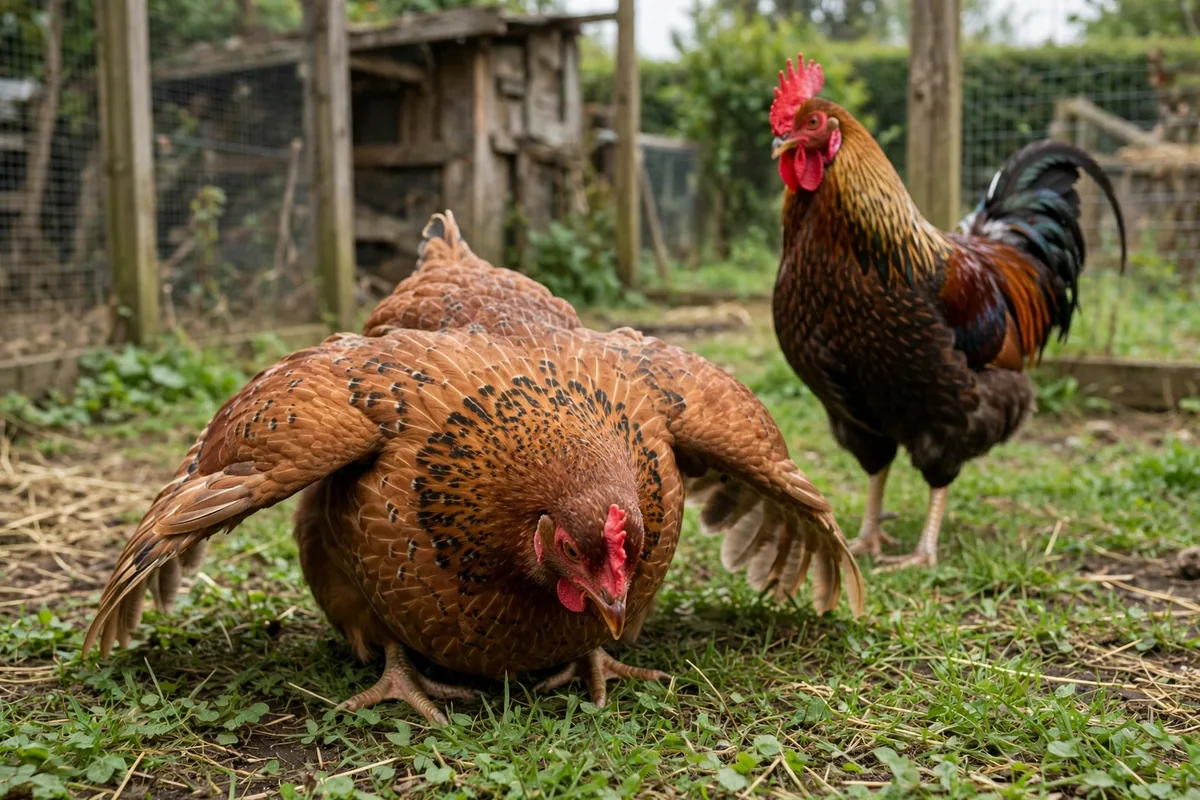
Hens squat because squatting is the mating posture, driven by the hormones of lay. When you reach towards a laying hen, she crouches low, spreads her wings slightly, and holds still — the same posture she takes when a rooster mounts her. Squatting is one of the best signs that a hen is laying or about to start laying, and a pullet that starts squatting will usually lay her first egg within a week or two. A hen that squats is a hen in lay, and a hen that stops squatting has usually stopped laying.
Why do hens squat?
A hen squats because the hormones of lay make her do it. When a hen is in lay, her body produces the hormones that drive mating, and the squat is the posture that goes with them: she crouches low, spreads her wings slightly away from her body, holds her head up, and stays still.
In a flock with a rooster, the squat invites the rooster to mount her. In a flock with no rooster, the hen squats for the keeper, because the keeper's hand reaching towards her triggers the same response as a rooster approaching.
Squatting is one of the most reliable signs of lay, because it appears when the hormones of lay are active and disappears when they are not. A pullet that starts squatting is about to lay her first egg, usually within a week or two. A hen that squats regularly is in lay. A hen that stops squatting has usually stopped laying — because she is moulting, because the days are short, or because she has gone broody. Our guide on how to tell if a hen is laying eggs explains the other signs that go with squatting.
| Squatting pattern | What it means |
|---|---|
| Pullet starts squatting | First egg within a week or two |
| Hen squats every time you reach for her | Hen is in lay |
| Hen stops squatting | Hen has stopped laying — moult, winter, broody |
| Hen squats for the rooster, not for you | Normal — she squats for the bird she knows |
| Hen never squats but lays eggs | Normal — some hens rarely squat |
What does the squat look like?
The squat is easy to recognise once you have seen it. The hen crouches low to the ground, her legs bend, her body drops, and her wings lift slightly away from her sides. She holds her head up, her tail may lift, and she stays still, waiting.
The posture lasts a few seconds, and then she stands up and walks away, often shaking her feathers. Some hens squat the moment your hand comes near; others squat when you are a few feet away, as soon as they see you reaching.
The squat is different from crouching in fear. A frightened hen crouches low and freezes, with her wings tight against her body and her head pulled in, and she runs as soon as she can. A squatting hen holds still, her wings are slightly out, and she does not run — she is waiting. The difference is the wings and the stillness: a squatting hen is calm and still, and a frightened hen is tense and ready to run. A hen that squats for you trusts you, and that is a good sign.
When do pullets start squatting?
Pullets start squatting one to two weeks before their first egg, as the hormones of lay rise. The first squat is often hesitant — the pullet crouches for a second, then stands up and runs away — and the squats become firmer and more regular as the first egg approaches. A pullet that is squatting, with a reddening comb and widening pelvic bones, is days away from laying, and the nest box should be ready. The first egg calculator estimates point of lay from breed and hatch date, and squatting is the sign that the estimate is about to come true.
Not every pullet squats before her first egg, and some pullets lay their first egg without ever squatting for the keeper. A pullet that does not squat may squat for a rooster, or she may simply be a bird that does not squat. The absence of squatting does not mean the pullet is not laying, and the presence of squatting does not guarantee an egg tomorrow — but in most flocks, squatting is the earliest and most visible sign that lay is about to start.
Squatting and the rooster
In a flock with a rooster, the squat is part of mating. The hen squats, the rooster mounts her, grips her neck feathers with his beak, and mates, and the hen stands up and shakes herself afterwards. The squat is the hen's consent to mating, and a hen that does not squat will run from the rooster instead. A rooster that chases a hen that will not squat is a rooster that is mating too roughly, and the hen will lose feathers and become stressed — see our guide on rooster overmating signs.
A hen that squats for the rooster but not for the keeper is normal: she squats for the bird she knows as a mate, and she may not squat for a person she does not trust as much. A hen that squats for the keeper but not for the rooster is also normal, especially in a flock with no rooster, where the keeper is the creature the hen associates with the mating posture. Either way, the squat means the hen is in lay, and that is the useful information.
Why has my hen stopped squatting?
A hen stops squatting when she stops laying. The hormones of lay fall when the hen moults, when the days shorten in winter, when she goes broody, or when she is stressed or ill, and the squat disappears with them. A hen that was squatting every day and suddenly stops has usually stopped laying, and the reason is in the flock: a moult, a change in the light, a fright, or an illness. Our guide on why chickens stop laying eggs runs through the causes in order.
A hen that stops squatting and also stops laying, goes pale in the comb, and sits puffed up is likely ill, and she needs checking. A hen that stops squatting because she is moulting will start again when the moult is over and the new feathers are in. A hen that stops squatting in winter will start again when the days lengthen in spring. The squat is a barometer of lay, and it returns when lay returns. If the squat does not return with the spring, check the hen's vent, pelvic bones and comb, as in our guide on how to tell if a hen is laying eggs.
Should I do anything when a hen squats?
Nothing. A squatting hen is behaving normally, and the kindest thing to do is to give her a gentle stroke on the back and let her stand up. Do not pick her up by force when she squats, and do not chase her — the squat is a moment of trust, and a hen that is grabbed when she squats will stop squatting for you. If you need to catch a hen, a squatting hen is easy to pick up gently, and our guide on how to catch a chicken explains the calm method.
Use the squat as information, not as a task. A pullet that starts squatting needs a nest box ready, with clean bedding and a quiet corner, because her first egg is days away. A hen that squats is in lay, and her eggs should be collected daily. A hen that stops squatting needs a check, because she has stopped laying and the reason matters. The squat is one of the simplest, most honest signals a hen gives you, and it costs nothing to read it.
What if a hen squats but never lays?
A hen that squats but never lays an egg is usually a hen whose hormones are active but whose laying is blocked or delayed.
The most common case is a pullet that starts squatting a week or two before her first egg: the squat appears first, and the egg follows, so a squatting pullet that has not laid yet is normal and needs no action. A hen that squats for weeks without laying is a different story, and it needs checking.
The first thing to check is whether the hen is laying somewhere hidden. A hen that squats and disappears for an hour each morning may be laying in a secret nest under a bush or in a shed, and the eggs are there, just not in the nest box. Search the garden in the morning, and watch where she goes. The second thing to check is whether she is egg bound: a hen that squats, strains, walks like a penguin and then stops is in trouble, and she needs a vet the same day. Our guide on egg bound chicken explains the signs.
A hen that squats, looks well, and lays nothing for a month or more may have a reproductive problem, such as an ovary that has stopped working, or she may be an older hen whose laying has ended but whose hormones still trigger the squat now and then. A vet can check her, but a hen that eats, drinks and behaves normally, and simply does not lay, can live well as a pet. The squat without an egg is not an illness on its own — it is a signal to check the nest, the garden, and the bird, in that order.
Sources: poultry.extension.org and University of Minnesota Extension poultry pages.
Related tools and guides
For the other signs of lay, see How to Tell If a Hen Is Laying Eggs and Why Are My Chickens Not Laying Eggs?.
Frequently asked questions
Why do hens squat?
Hens squat because squatting is the mating posture, driven by the hormones of lay. When you reach towards a laying hen, she crouches low, spreads her wings slightly, and holds still — the same posture she takes when a rooster mounts her.
When do pullets start squatting?
Pullets start squatting one to two weeks before their first egg, as the hormones of lay rise. A pullet that is squatting, with a reddening comb and widening pelvic bones, is days away from laying, and the nest box should be ready.
Does squatting mean a hen is about to lay an egg?
It means the hen is in lay, not that she is about to lay at that moment. A hen that squats regularly is laying, and a pullet that starts squatting will usually lay her first egg within a week or two.
Why has my hen stopped squatting?
A hen stops squatting when she stops laying — because she is moulting, because the days are short in winter, because she has gone broody, or because she is stressed or ill. The squat returns when lay returns.
Do all laying hens squat?
No. Most laying hens squat, but some rarely squat, especially shy or low-ranking birds, and some squat for the rooster but not for the keeper. A hen that never squats can still be laying, so use the vent and pelvic bone checks alongside it.
About the author
John Walker is the founder of PeckCalc and has kept backyard chickens in Dallas, Texas since 2017. He started PeckCalc to give backyard keepers free calculators and guides with every figure traced to a university extension source.