
Backyard Chicken Laws by State
 By John Walker · Backyard chicken keeper in Dallas, Texas since 2017
Backyard chicken laws by state are not what most keepers expect, because no US state issues a permit to keep chickens, and no state sets the rules for a backyard flock. The rules are set by cities and counties, and they vary from one town to the next, so a flock that is legal on one street can be illegal on the next. This guide explains how the rules work, where to find them, the limits that apply almost everywhere, and how to check before you buy birds.
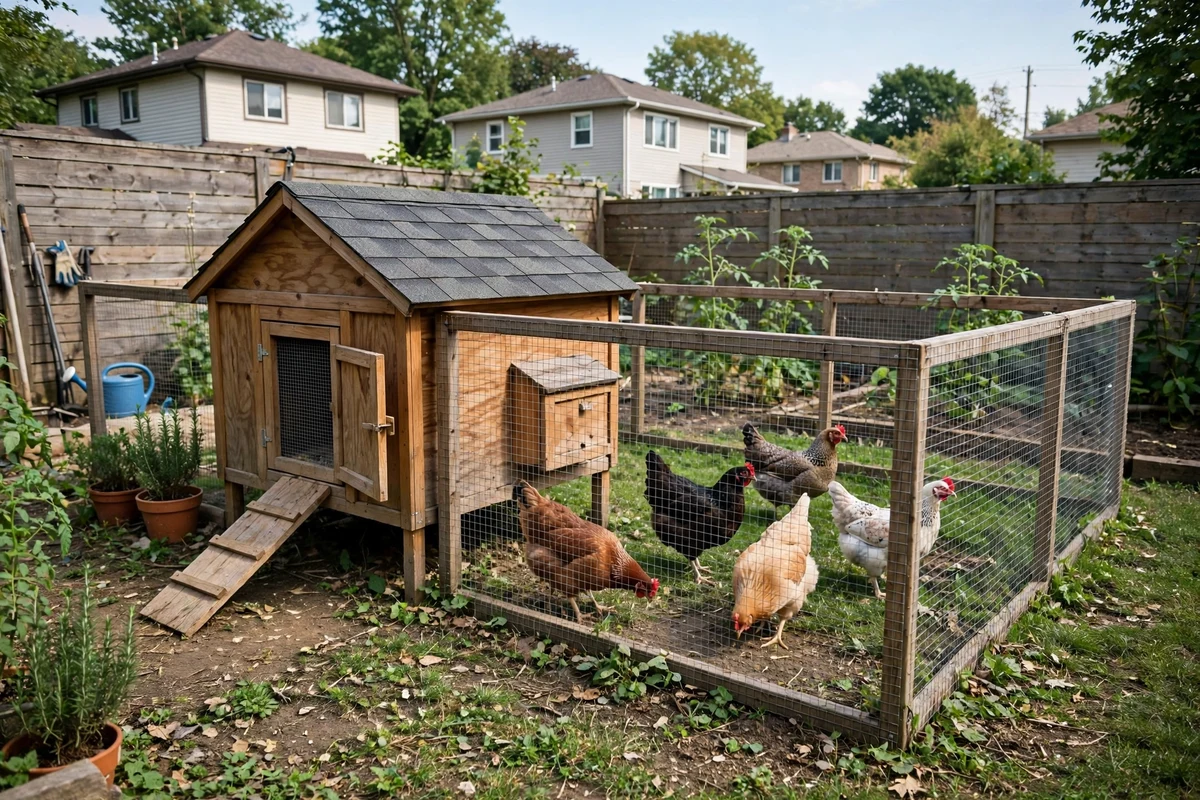
Backyard chicken laws by state: how the rules work
Backyard chicken laws by state are mostly set by cities and counties, not by states, and no US state issues a permit to keep chickens. The state sets animal health rules, but the rules that decide whether you can keep chickens, and how many, are local.
The legal picture has three layers. The state sets rules about animal health, disease control and moving birds, and it can ban poultry in a disease outbreak. The county sets rules about land use, zoning and nuisance, and it can limit where chickens can be kept. The city or town sets the detailed rules: how many birds, whether roosters are allowed, how far the coop must be from a neighbour, and whether a permit is needed.
That is why a state-by-state list is misleading. A state that looks chicken-friendly on paper can have cities that ban chickens entirely, and a state that looks strict can have towns that allow a small flock with no permit. The rules that matter are the ones for your address, not the ones for your state.
The honest answer to the question behind this guide is that there is no single set of state rules to look up, and any page that prints a neat table of state laws is either out of date or wrong. What follows is how to find the rules that apply to you, and the patterns that show up almost everywhere.
Where to find your local rules
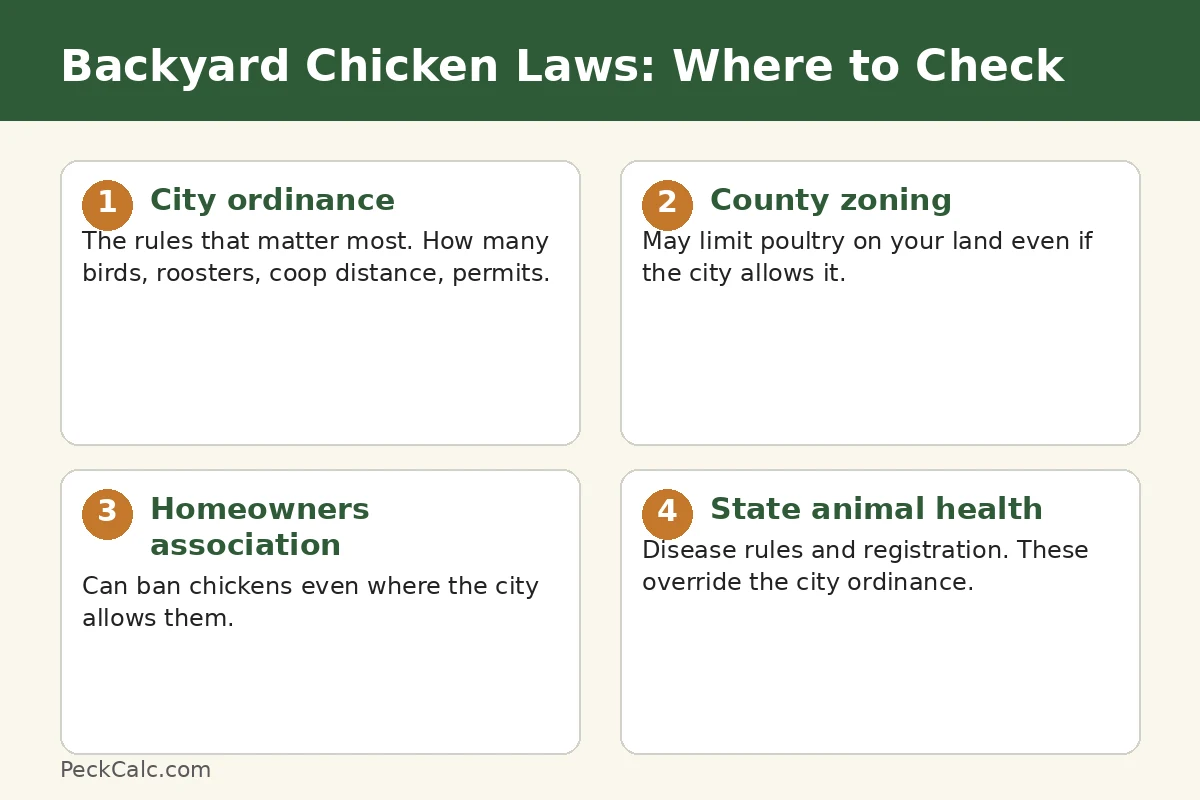
To find your local chicken rules, start with your city or town's website, search for the animal or poultry ordinance, and then check the county zoning rules and any homeowners association rules. The city ordinance is the document that matters most.
An ordinance is a local law passed by a city council, and the animal ordinance is the one that covers chickens. It is usually on the city's website, under a section called municipal code, animal control, or zoning. Search for the words chicken, poultry, fowl and livestock, because the rules may be under any of those headings.
Check the county rules next, because the county zoning may limit chickens on your land even if the city allows them. Check your homeowners association rules too, because an association can ban chickens even where the city allows them, and an association fine is a real penalty even though it is not a law.
State law can also limit what a homeowners association may ban, and those laws change, as two recent examples show. In Missouri, a 2024 law (HB 2062) barred HOAs from banning up to six hens on lots of at least two-tenths of an acre, but in October 2025 Cole County Circuit Judge Brian Stumpe struck the law down as unconstitutional, so HOA bans are enforceable again; the state has said it plans to appeal. In Michigan, House Bills 4049 and 4050 (January 2025) would allow up to five hens per quarter acre, maximum 25, but remain pending in committee. Always check your local ordinance and current status before keeping chickens.
If you cannot find the rules online, call your city clerk, your animal control office, or your county planning office, and ask in writing, so you have a record of what was said. Keep that record, because a neighbour's complaint is much easier to answer when you can show that you checked the rules first. Our guide on backyard chicken laws explains the first checks to make before you buy birds.
The limits that apply almost everywhere
The limits that apply to backyard chickens almost everywhere are a cap on the number of birds, a ban on roosters in many places, a minimum distance from neighbours, and a requirement to keep the coop clean and the birds contained. The details vary, but the pattern is the same.
A cap on numbers is the most common rule. Many cities allow a small flock, often between four and twelve hens, and some allow more on larger plots. The cap is usually tied to the size of the lot, so a larger garden allows more birds, and a small garden allows fewer.
Roosters are banned in many cities and towns, because they crow and neighbours complain. A city that allows hens may still ban roosters entirely, and a city that allows roosters may limit them to one, or require them to be kept a certain distance from a neighbour. If you want a rooster, check the rooster rule specifically, not just the chicken rule.
Distance rules are the third common limit. Many cities require the coop to be a certain distance from a neighbour's house, often between 10 and 50 feet, and some require it to be a certain distance from the property line. A coop that is too close to a neighbour is the most common reason for a complaint, and it is the easiest to avoid by measuring before you build.
Permits, registration and neighbours
Permits for backyard chickens are usually local, not state, and many cities require a permit or a registration, while others require nothing at all. A permit is a permission from the city, and a registration is a record that you keep chickens, and the two are often confused.
Some cities require a permit before you buy birds, and the permit may involve a fee, an inspection of the coop, and a check that the coop is far enough from neighbours. Other cities require only a registration, which is a form you fill in so the city knows you have birds. Still others require nothing, and you can keep chickens as long as you follow the other rules.
Registration is different from a permit, and it is worth knowing which one your city requires. In the United Kingdom, for example, keepers must register their birds with the government animal health agency, and that registration has been mandatory since October 2024, even for a single bird. In the United States, there is no national registration, but some states and cities have their own requirements, so check locally.
Neighbours matter as much as the law. A flock that is legal but noisy, smelly or badly kept will draw complaints, and complaints can lead to inspections and fines even when the flock is technically legal. Keep the coop clean, control flies and rats, keep the birds in, and talk to your neighbours before you buy birds, because a neighbour who feels consulted is far less likely to complain than one who feels surprised. Our guide on are backyard chickens noisy explains what neighbours actually hear.
What the rules do not cover
The rules for backyard chickens do not cover animal health, and that is a separate set of laws that apply everywhere, regardless of what your city allows. A flock that is legal under the city ordinance can still be illegal under state animal health rules, if it is diseased or unregistered.
State animal health rules cover disease control, and they can require testing, registration and reporting. If avian influenza is found in your area, the state can order birds to be kept indoors, can ban the movement of birds, and can require testing before birds are sold or moved. Those rules override the city ordinance, and they apply whether or not your city allows chickens.
Federal rules also apply, though they rarely affect a small backyard flock directly. The United States Department of Agriculture sets the rules for moving birds across state lines, and for the National Poultry Improvement Plan, which is the testing programme that many states use. Our guide on do you need a permit to transport chickens across state lines explains the movement rules in full.
Animal cruelty laws apply everywhere, and they are the floor that no local rule can go below. A flock that is legal under the city ordinance can still be seized if the birds are neglected, starved or kept in cruel conditions. The law sets a minimum, and good keeping goes well beyond it.
Before you buy birds: a checklist
Before you buy birds, check your city ordinance, your county zoning, your homeowners association rules, and the state animal health rules, and talk to your neighbours. A short checklist, done before you spend money, will save you from a flock you cannot legally keep.
Start with the city ordinance, and find out whether chickens are allowed at your address, how many you can keep, whether roosters are allowed, how far the coop must be from neighbours, and whether a permit or registration is needed. Then check the county zoning, because the county may limit chickens on your land even if the city allows them.
Check your homeowners association rules, because an association can ban chickens even where the city allows them, and check the state animal health rules, because they may require registration or testing. Then measure your garden, plan the coop, and talk to your neighbours, so they know what is coming and you know whether they will object.
| Check | Where to look | What to ask |
|---|---|---|
| City ordinance | City website, municipal code | Are chickens allowed? How many? Roosters? |
| County zoning | County planning office | Does zoning allow poultry on my lot? |
| Homeowners association | Association rules | Does the association ban chickens? |
| State animal health | State department of agriculture | Is registration or testing required? |
| Neighbours | Talk to them | Will a small, well-kept flock be a problem? |
Rules change, and a city that allows chickens today may change its ordinance tomorrow, so check again before you expand the flock, and keep a copy of the rules you relied on. Our guides on do I need a permit to keep chickens and are roosters allowed in residential areas explain the two questions keepers ask most, and both have the same answer: it depends on where you live.
Sources: general poultry law and animal health guidance from the United States Department of Agriculture and the poultry pages at poultry.extension.org. Rules vary by city and county and change often; always check your local ordinance before buying birds.
Related tools and guides
For more on the same topic, see Backyard Chicken Laws and Do I Need a Permit to Keep Chickens?.
Frequently asked questions
Are backyard chickens legal in every state?
No state bans backyard chickens outright, and no state issues a permit to keep them. The rules are set by cities and counties, so a flock that is legal in one town can be illegal in the next. Check your city ordinance, your county zoning and your homeowners association rules before buying birds.
Do I need a permit to keep chickens?
It depends on where you live. Some cities require a permit or a registration before you buy birds, and others require nothing at all. No US state issues a permit to keep chickens. Check your city clerk or animal control office, and ask in writing so you have a record.
Are roosters allowed in residential areas?
Usually not. Many cities that allow hens ban roosters entirely, because they crow and neighbours complain. A city that allows roosters may limit them to one, or require them to be kept a certain distance from a neighbour. Check the rooster rule specifically, not just the chicken rule.
How many chickens can I keep in my backyard?
It depends on your city and the size of your lot. Many cities allow a small flock, often between four and twelve hens, with more allowed on larger plots. The cap is usually tied to lot size, and the coop must be a certain distance from neighbours.
Do I need to register my chickens with the government?
In the United States there is no national registration, but some states and cities have their own requirements, so check locally. In the United Kingdom, keepers must register their birds with the government animal health agency, and that has been mandatory since October 2024, even for a single bird.
About the author
John Walker is the founder of PeckCalc and has kept backyard chickens in Dallas, Texas since 2017. He started PeckCalc to give backyard keepers free calculators and guides with every figure traced to a university extension source.