
Delaware Chickens
 By John Walker · Backyard chicken keeper in Dallas, Texas since 2017
Delaware chickens are a friendly American dual-purpose breed created by accident in the 1940s, when a cross of Barred Plymouth Rock and New Hampshire produced striking white birds with black barring. Hens lay around 150 to 200 large brown eggs a year, roosters grow fast enough for the table, and the breed's calm nature makes it one of the easiest heritage birds to keep.
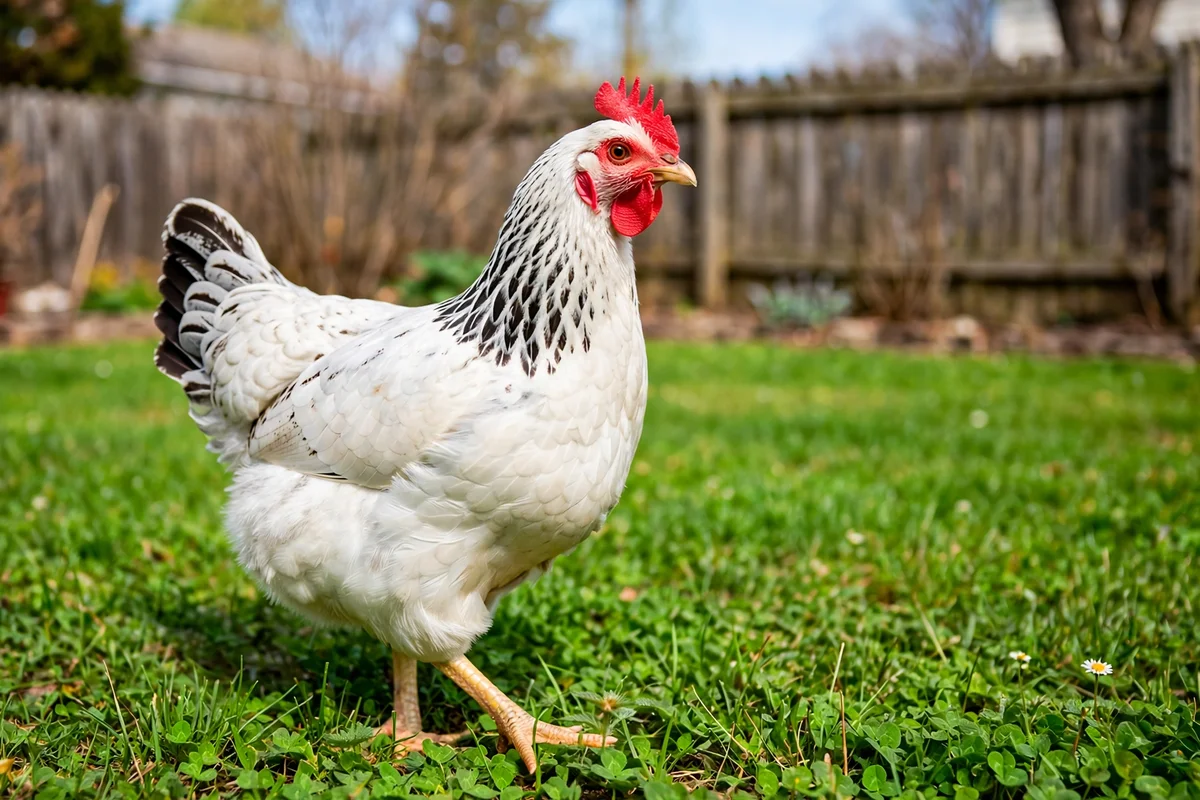
What is a Delaware chicken?
Delaware chickens are medium-large white birds with black barring on the neck, wings and tail, a single comb, and yellow skin and legs. A standard rooster weighs about 8. 5 lb and a hen about 6. 5 lb, though some sources give 7. 5 lb and 5. 5 lb, so expect birds in that range depending on strain.
The breed was the dominant broiler of the Delmarva Peninsula for about a decade before the Cornish Cross replaced it, and it nearly vanished in the 1960s. The Livestock Conservancy now lists it as Recovering, which means numbers are improving but the breed still benefits from keepers who choose it deliberately. For a backyard flock it offers a rare combination: a calm bird, a respectable layer, and a genuinely useful table bird.
Delaware chicken breed facts
| Fact | Detail |
|---|---|
| Origin | Delaware, USA, 1940s |
| Developed by | George Ellis, Indian River Hatchery, from Barred Plymouth Rock x New Hampshire |
| APA recognition | 1952 |
| Purpose | Dual-purpose: eggs and meat |
| Rooster weight | About 7.5 to 8.5 lb |
| Hen weight | About 5.5 to 6.5 lb |
| Eggs per year | About 150 to 200; some sources report up to 280, so the top figure is disputed |
| Egg colour | Light brown |
| Egg size | Large to jumbo |
| Temperament | Calm, friendly, curious |
| Climate tolerance | Good in cold and heat; handles both reasonably well |
| Broodiness | Low |
| Good for beginners | Yes |
| Conservation status | Recovering (Livestock Conservancy) |
Figures are the breed standard or the range reported by the Livestock Conservancy and university extension sources. Where sources disagree, the table shows the range rather than a single figure.
History and origin of the Delaware
The Delaware was not planned. In the 1940s George Ellis of the Indian River Hatchery in Delaware was crossing Barred Plymouth Rock roosters with New Hampshire hens when some chicks came out white with black barring instead of the expected barred pattern. Ellis and his colleague Edmund Hoffman recognised the value of the white birds: white feathers leave a cleaner-looking carcass, and the cross grew fast.
For about ten years the Delaware was the leading broiler breed on the Delmarva Peninsula, the region that still produces a large share of American chicken. Then the Cornish Cross arrived in the late 1950s, grew even faster, and within a decade the Delaware had almost disappeared from commercial production. It was listed as critically endangered by 2009 before backyard keepers brought it back; the Conservancy now lists it as Recovering. The American Poultry Association admitted the breed to the Standard of Perfection in 1952.
What do Delaware chickens look like?
Delawares are easy to recognise: a mostly white body with black barring on the hackles, wings and tail, a single red comb, red wattles and earlobes, and yellow skin and legs. The white plumage is not just decorative — it was the reason the breed was developed, because white feathers do not leave dark pinfeathers in a dressed carcass.
There is only one recognised variety, the white with black barring, which makes identification simple. The body is broad and deep with a long keel, and the birds carry themselves upright. Compared with the New Hampshire Red chickens they came from, Delawares are paler, slightly lighter in frame, and much easier to spot across a field.
How many eggs do Delaware chickens lay?
Delaware hens lay large to jumbo light brown eggs. The Livestock Conservancy gives about four eggs a week, up to around 200 a year, while other breed guides report 200 to 280. The honest planning figure is 150 to 200 a year, with the higher numbers coming from laying-selected strains. Pullets can start laying early, sometimes from around 16 to 20 weeks.
That early start and large egg size make the Delaware one of the more productive heritage dual-purpose birds, though it will not match a modern hybrid layer. To see what a small flock would actually produce, run your hen count through the egg production calculator using 150 to 200 eggs per hen per year rather than the best-case number. Production drops in winter, and hens that go broody — which is uncommon in this breed — will pause laying while they sit.
Delaware temperament and behaviour
Delawares are known for a calm, friendly and curious temperament, and they are often described as one of the most personable heritage breeds. They follow their keepers around the garden, tolerate handling well, and settle into a mixed flock without much fuss.
They are not a cuddly lap breed, but they are rarely aggressive and roosters are usually manageable. They can be mildly assertive with flock mates at the feeder, so give them enough feeder space and more than one feeding station if you keep them with smaller or shyer breeds such as the Sebright chickens.
Are Delaware chickens good for beginners?
Yes, Delawares are a good beginner breed. They are docile, low maintenance, and forgiving, and they do well in both confinement and free range. They appear in our guide to the best chicken breeds for beginners for exactly those reasons.
The one thing a beginner should plan for is size: these are solid birds that eat a fair amount and need a coop built for a heavy breed. They are also fairly popular with predators because their white plumage is easy to spot, so a secure run and a covered top matter more than they would for a camouflaged breed.
Housing and space for Delaware chickens
Allow about 4 square feet of coop space and 10 square feet of run per bird. The chicken breed size chart shows how the Delaware compares with lighter layers and heavier meat breeds, and it is worth checking before you buy timber, because a coop built for Leghorns will feel cramped for Delawares.
Give them one nest box per four hens and a sturdy roost bar — a 2 by 4 with the wide side up works well for a heavy bird. They are good foragers and enjoy ranging, so if you can let them out to scratch in the garden for part of the day they will be calmer and healthier. A 5 to 6 foot fence usually holds them, though they can fly better than their size suggests when young.
What to feed Delaware chickens
Feed a starter crumble, then grower, then layer feed from about 18 weeks, with free-choice oyster shell or crushed eggshell on the side. Delawares grow fast as youngsters, so do not skimp on the starter phase, but do not push them with broiler rations either — they are meant to live for years, not weeks.
They are enthusiastic foragers and will happily eat greens, garden scraps and insects when ranging, which takes some pressure off the feed bill. Keep scratch grains to a small afternoon handful: a heavy bird that fills up on grain instead of layer feed will lay fewer eggs and put on fat.
Delaware chickens in cold and hot weather
Delawares handle both cold and heat reasonably well. Their single comb can catch frostbite in a cold, damp coop, so ventilation and dry bedding matter in winter. In summer they need shade and cool water like any heavy bird, and their white plumage reflects sun better than a dark-feathered breed.
They are not as cold-specialised as a pea-combed breed such as the Buckeye chickens, and not as heat-specialised as a Mediterranean breed, but for most temperate climates they cope without special measures. In very hot regions, give them extra shade and check water twice a day.
Health and common problems
Delawares are a generally healthy heritage breed with a lifespan of around five to eight years. Watch for the usual backyard issues: mites and lice, worms, and coccidiosis in chicks. Their white feathers make external parasites easier to spot, which is a small practical advantage.
Because the breed went through a severe population bottleneck, buy from a breeder who selects for vigour and type rather than from the cheapest source. Ask about Marek's vaccination for chicks, quarantine new birds for two weeks, and keep the coop dry — wet bedding causes more health problems than cold weather ever does.
Delaware vs New Hampshire Red
The Delaware and the New Hampshire Red are parent and child: the Delaware was bred from New Hampshire hens crossed with Barred Plymouth Rocks. The New Hampshire is the slightly better layer on average and the more cold-hardy of the two, while the Delaware lays larger eggs, dresses out with a cleaner white carcass, and has the calmer temperament.
In the hand the difference is obvious — chestnut-red against white with black barring — but in the flock they are similar in size and appetite. If you want the friendliest dual-purpose bird and the biggest eggs, pick the Delaware; if you want the hardiest bird and the fastest growth, pick the New Hampshire Red. Many keepers run both, and the two breeds get along well.
Keeping Delaware chickens with other breeds
In a mixed flock, Delaware chickens generally do best with birds of a similar size and temperament. A Delaware hen weighs about 5.5 to 6.5 lb, and a rooster about 7.5 to 8.5 lb, so they are medium birds, and they fit well with most standard breeds, provided the flock has enough space and more than one feeder. The breed's temperament is described as calm, friendly, curious, and that is the best guide to how they will settle in: a calm bird usually joins a flock quietly, while a more assertive one needs space and at least two feeding and watering stations so weaker birds can eat in peace. Watch the first week closely for feather picking or one bird being kept from the food.
Add new birds slowly, through a wire divider for a few days before mixing them fully, as described in our guide on how to introduce new chickens to a flock, and quarantine any new bird for two weeks first. Keep only one rooster per flock unless you have a large property and separate pens. Broodiness in this breed is low, so a hen that does go broody will need a quiet corner away from the main flock while she sits. With those basics covered, Delaware chickens usually settle into a mixed flock within a week or two and stay there happily for years.
Should you keep Delaware chickens?
Delawares suit a keeper who wants a calm, attractive dual-purpose flock: large brown eggs, a bird that grows well enough for the table, and a hen that is pleasant to have around. They are a particularly good fit for a family flock or a first heritage breed.
They are less suited to a keeper who wants maximum eggs from minimum feed, or to a small urban garden where a white bird stands out to every hawk in the neighbourhood. For a rural or suburban backyard with a secure run, they are one of the most rewarding heritage breeds to keep.
Sources: breed weights and egg figures on this page follow the Livestock Conservancy breed profiles and university extension poultry pages. For general poultry guidance, see the poultry pages at the University of Minnesota Extension and poultry.extension.org.
Related tools and guides
For more on the same topic, see Chicken Breed Size Chart and Egg Production Calculator.
Frequently asked questions
How many eggs do Delaware chickens lay per year?
Delaware hens lay about 150 to 200 large light brown eggs a year, according to the Livestock Conservancy, which gives about four eggs a week. Some sources report up to 280, but that top figure is disputed and comes from laying-selected strains.
Are Delaware chickens good for beginners?
Yes. They are calm, friendly, docile and low maintenance, and they do well in confinement or free range, which makes them a good first heritage breed.
Are Delaware chickens rare?
They were critically endangered in 2009 after nearly disappearing from commercial production. The Livestock Conservancy now lists them as Recovering, so numbers are improving but the breed still benefits from keepers who choose it deliberately.
What do Delaware chickens look like?
Delawares are mostly white with black barring on the neck, wings and tail. They have a single red comb, red wattles and earlobes, and yellow skin and legs.
Do Delaware chickens go broody?
Rarely. Delaware hens have low broodiness, which suits keepers who want steady egg production, but it means you will usually need an incubator or a broody hen of another breed to hatch chicks.
About the author
John Walker is the founder of PeckCalc and has kept backyard chickens in Dallas, Texas since 2017. He started PeckCalc to give backyard keepers free calculators and guides with every figure traced to a university extension source.