
Buckeye Chickens
 By John Walker · Backyard chicken keeper in Dallas, Texas since 2017
Buckeye chickens are a deep mahogany-red dual-purpose breed from Ohio, famous for two things: they are the only American breed developed entirely by a woman, breeder Nettie Metcalf, and they are among the most cold-hardy chickens in the American class. Hens lay around 150 to 200 brown eggs a year, and the breed's pea comb all but eliminates frostbite.
What is a Buckeye chicken?
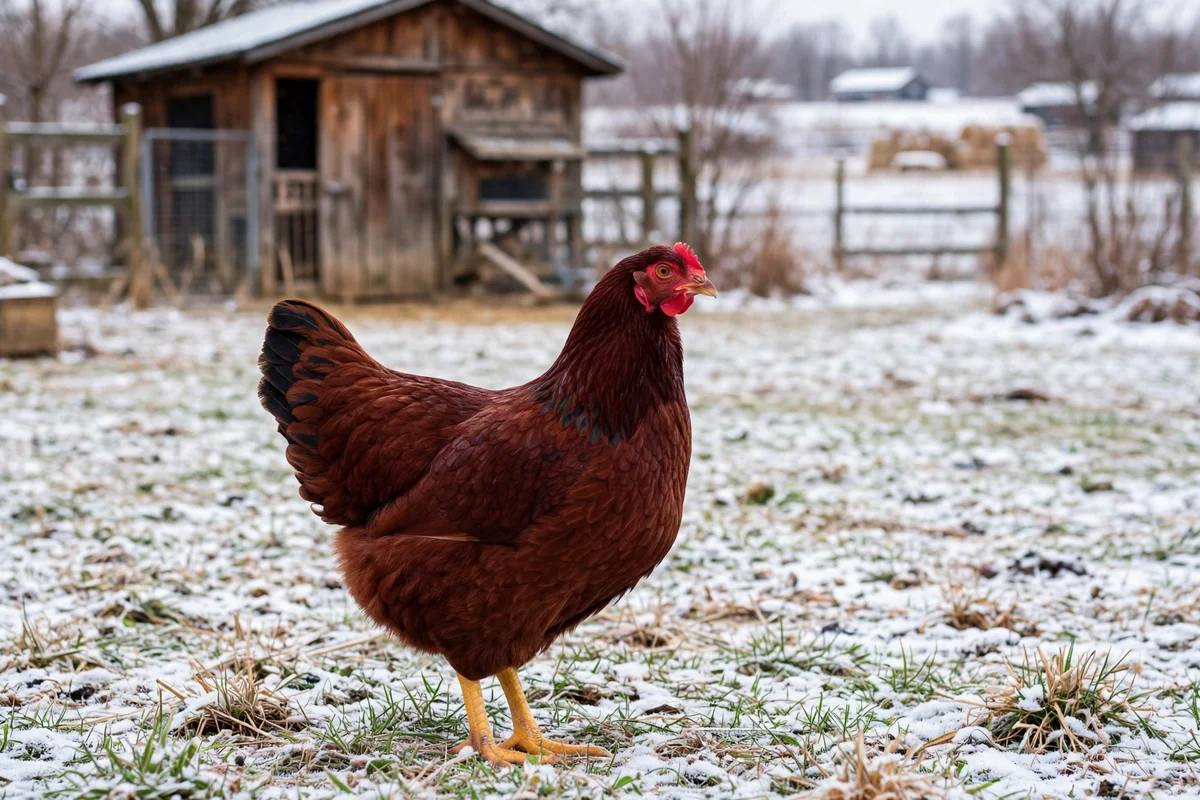
Buckeye chickens are muscular, broad-breasted birds with tight feathering, a rich mahogany-red colour with black in the tail, and a small pea comb that sits almost flush with the head. A standard rooster weighs about 9 lb and a hen about 6.5 lb, and hens lay brown eggs.
The breed was developed in Ohio in the late 1800s by Nettie Metcalf, who crossed Barred Plymouth Rocks, Buff Cochins and Black Breasted Red Game birds to build a practical farm bird for Midwest winters. It is the only breed in the American class with a pea comb, and the Livestock Conservancy lists it as Watch. For a keeper in a cold climate who wants a dual-purpose bird with real character, the Buckeye is hard to beat.
Buckeye chicken breed facts
| Fact | Detail |
|---|---|
| Origin | Ohio, USA, late 1800s |
| Developed by | Nettie Metcalf of Warren, Ohio |
| APA recognition | 1904 or 1905 — sources disagree on the year |
| Purpose | Dual-purpose: meat and eggs |
| Rooster weight | About 9 lb (4 kg) |
| Hen weight | About 6.5 lb (3 kg) |
| Eggs per year | About 150 to 200; some laying-selected lines are reported at 175 to 240 |
| Egg colour | Brown |
| Egg size | Large |
| Temperament | Confident, active, curious, good forager |
| Climate tolerance | Excellent in cold; good in moderate heat |
| Broodiness | Moderate |
| Good for beginners | Yes |
| Conservation status | Watch (Livestock Conservancy) |
Figures are the breed standard or the range reported by the Livestock Conservancy and university extension sources. Where sources disagree, the table shows the range rather than a single figure.
History and origin of the Buckeye
The Buckeye began in 1896, when Nettie Metcalf of Warren, Ohio, set out to create a practical chicken for Ohio winters. She crossed Buff Cochins and Barred Plymouth Rocks with Black Breasted Red Game birds, selecting for cold hardiness, meat quality and foraging ability. Neighbours reportedly called her early birds Metcalf's Mongrels before the breed earned its name from the deep mahogany colour of its plumage, which resembles the seed of the Ohio buckeye tree.
Metcalf exhibited her birds as Buckeyes in 1902, and the breed was admitted to the American Poultry Association Standard of Perfection in 1904 according to some sources and 1905 according to others — the two years are both cited, so treat the exact year as unsettled. Either way, she became the first woman to have a breed she developed accepted into the Standard. The breed declined as commercial hybrids took over, but it survives as a heritage breed with a loyal following among homesteaders.
What do Buckeye chickens look like?
Buckeyes are stocky, muscular birds with a rounded, almost Cornish-like body shape, short necks, and tight mahogany-red feathering with black in the tail. The pea comb is the defining feature: small, close-fitting and nearly flush with the head, which is why the breed handles frost so well. The skin and legs are yellow.
Only one colour is recognised: the deep mahogany red. Compared with a Rhode Island Red, the Buckeye is rounder bodied, darker in tone, and carries the pea comb instead of a single comb. Bantam Buckeyes exist at about 32 oz for a cock and 28 oz for a hen, but the large fowl is the standard bird.
How many eggs do Buckeye chickens lay?
Buckeye hens lay brown eggs, about 150 to 200 a year for most flocks, or three to four a week. Some laying-selected lines are reported at 175 to 240 a year, so the top figure depends on strain, but 150 to 200 is the safe planning number. Eggs are large, and pullets usually start laying at around 20 to 24 weeks.
That rate will not match a hybrid layer, but it is respectable for a heavy dual-purpose breed, and Buckeyes keep laying in cold weather when lighter breeds often stop. Use the egg production calculator with 150 to 200 eggs per hen to plan your flock. Compared with the Dominique chickens, the Buckeye lays a few less eggs but gives you a heavier table bird.
Buckeye temperament and behaviour
Buckeyes are confident, active and curious, with a reputation for personality. They are excellent foragers that like to range, and they are often described as friendly and even a little bold with their keepers. They are not a shy breed and they do not hide at the back of the run.
Roosters can be assertive, and some keepers report that Buckeye roosters are more protective than average, so handle young cockerels regularly and do not keep two in a small space. Hens are generally calm with people and make good mothers when they go broody.
Are Buckeye chickens good for beginners?
Yes, Buckeyes are a good beginner breed, especially for a keeper in a cold climate. They are hardy, active, and forgiving, and they feature in our guide to the best chicken breeds for beginners as a practical dual-purpose choice.
The main thing a beginner should know is that Buckeyes like space and activity. A small, bare run will bore them and can lead to feather picking, so give them room to forage and things to scratch in. They are also enthusiastic eaters, so measure the ration rather than free-feeding grain.
Housing and space for Buckeye chickens
Allow about 4 square feet of coop space and 10 square feet of run per standard bird, and more run space if you can, since this breed loves to range. The chicken breed size chart places the Buckeye among the heavy breeds, so build the roosts and nest boxes to take real weight.
One nest box per four hens is enough. Because Buckeyes are strong fliers when young and very active, a covered run or a 6 foot fence is sensible. In winter, the pea comb means you do not need to worry about frostbite the way you would with a single-combed breed, but the coop still needs to be dry and ventilated.
What to feed Buckeye chickens
Feed starter, then grower, then layer feed from about 18 weeks, with free-choice calcium on the side. Buckeyes are good foragers and will find much of their own food on range in summer, which helps with the feed bill for a heavy breed.
Because they grow fast and carry a lot of muscle, chicks need a good starter crumble and clean water from day one. Avoid pushing them with broiler rations: they are meant to live for years, and excess protein in a growing bird can cause leg problems. Keep scratch to a small afternoon handful.
Buckeye chickens in cold and hot weather
Buckeyes are among the most cold-hardy chickens in the American class. The pea comb, tight feathering and stocky build were all selected for Ohio winters, and the breed handles snow and frost with very little trouble. They are the bird to choose if your winters are the problem.
In heat they cope reasonably well for a heavy bird, though they need shade, cool water and dust baths in a heatwave. They are not as heat-tolerant as a light Mediterranean breed, so in a very hot climate a lighter bird would be a better choice.
Health and common problems
Buckeyes are a generally healthy, long-lived breed, often reaching six to ten years. They have no particular breed-specific disease, and the main risks are the usual ones: mites, lice, worms and coccidiosis in chicks.
Their fast growth as chicks is the main thing to manage: do not overfeed protein and do not keep them on a broiler ration. Buy from a breeder who selects for vigour, ask about Marek's vaccination, and quarantine new birds for two weeks before mixing them in.
Buckeye vs Rhode Island Red
Buckeyes are often compared with Rhode Island Reds because both are deep red American dual-purpose breeds, but the differences are clear once you know them. The Buckeye is rounder bodied, carries a pea comb where the Rhode Island Red carries a single comb, and is the more cold-hardy of the two. The Rhode Island Red usually lays a few more eggs a year.
In temperament the Buckeye is the more active and confident bird, and the better forager, while the Rhode Island Red is the steadier layer. If your winters are harsh, the Buckeye wins; if you want maximum eggs and a bird that tolerates confinement, the Rhode Island Red has the edge. The New Hampshire Red chickens sit between the two, with the Buckeye's cold hardiness and the Rhode Island Red's laying focus in a lighter red package.
Keeping Buckeye chickens with other breeds
In a mixed flock, Buckeye chickens generally do best with birds of a similar size and temperament. A Buckeye hen weighs about 6.5 lb (3 kg), and a rooster about 9 lb (4 kg), so they are medium birds, and they fit well with most standard breeds, provided the flock has enough space and more than one feeder. The breed's temperament is described as confident, active, curious, good forager, and that is the best guide to how they will settle in: a calm bird usually joins a flock quietly, while a more assertive one needs space and at least two feeding and watering stations so weaker birds can eat in peace. Watch the first week closely for feather picking or one bird being kept from the food.
Add new birds slowly, through a wire divider for a few days before mixing them fully, as described in our guide on how to introduce new chickens to a flock, and quarantine any new bird for two weeks first. Keep only one rooster per flock unless you have a large property and separate pens. Broodiness in this breed is moderate, so a hen that does go broody will need a quiet corner away from the main flock while she sits. With those basics covered, Buckeye chickens usually settle into a mixed flock within a week or two and stay there happily for years.
Should you keep Buckeye chickens?
Buckeyes suit a keeper in a cold climate who wants a dual-purpose bird with character: a good forager, a respectable layer, a useful table bird, and a comb that will not freeze. They are at their best with room to range and a keeper who enjoys an active flock.
They are less suited to a tiny garden or a keeper who wants a quiet lap bird. For a homestead in the Midwest, the north of England, or anywhere with a real winter, they remain one of the most practical heritage breeds you can choose.
Sources: breed weights and egg figures on this page follow the Livestock Conservancy breed profiles and university extension poultry pages. For general poultry guidance, see the poultry pages at the University of Minnesota Extension and poultry.extension.org.
Related tools and guides
For more on the same topic, see Chicken Breed Size Chart and Egg Production Calculator.
Frequently asked questions
How many eggs do Buckeye chickens lay per year?
Buckeye hens lay about 150 to 200 brown eggs a year, or three to four a week. Some laying-selected lines are reported at 175 to 240, but 150 to 200 is the safe planning figure.
Are Buckeye chickens cold hardy?
Yes, they are among the most cold-hardy chickens in the American class. Their pea comb sits almost flush with the head, so there is very little to freeze, and their tight feathering handles snow well.
Who developed the Buckeye chicken?
Nettie Metcalf of Warren, Ohio, developed the Buckeye in the late 1800s by crossing Barred Plymouth Rocks, Buff Cochins and Black Breasted Red Game birds. She is the only woman to have developed an American breed accepted into the APA Standard.
Are Buckeye chickens good for beginners?
Yes, especially in cold climates. They are hardy, active and forgiving, though they need space to forage and a keeper who is comfortable with a confident, sometimes assertive rooster.
When was the Buckeye recognised by the APA?
Sources disagree: some give 1904 and others 1905. Either way, the breed was admitted to the Standard of Perfection in the first decade of the 1900s.
About the author
John Walker is the founder of PeckCalc and has kept backyard chickens in Dallas, Texas since 2017. He started PeckCalc to give backyard keepers free calculators and guides with every figure traced to a university extension source.