
Why Are My Eggs Hatching Late?
 By John Walker · Backyard chicken keeper in Dallas, Texas since 2017
Why are my eggs hatching late? Usually because they were kept too cool: even one degree below the right temperature slows the embryo down and adds a day or two to the hatch. Chicken eggs normally hatch on day 21, counted from the day they go into the incubator, and a hatch on day 22 is common and usually fine. A hatch on day 23 or 24 is rare, and eggs that have not hatched by then are unlikely to do so. This guide explains why eggs hatch late, what to do while you wait, and when to give up on the remaining eggs.
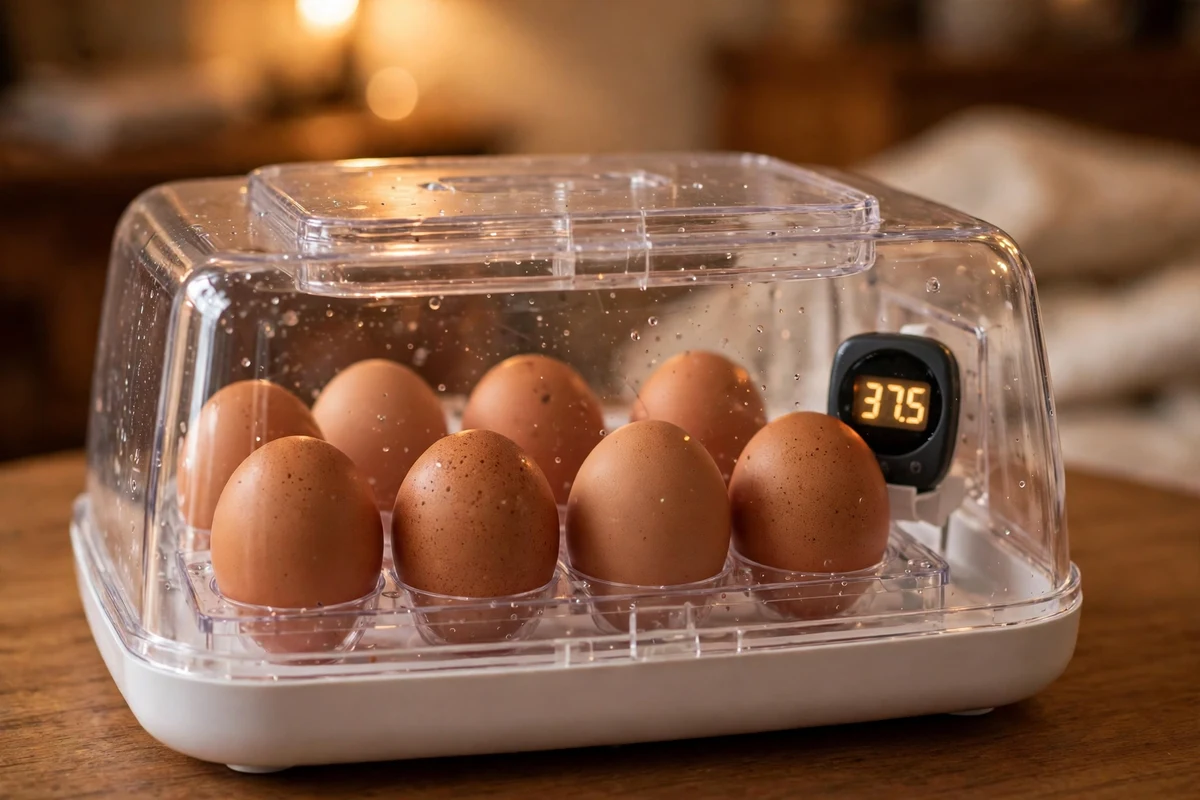
Why are my eggs hatching late?
The most common reason eggs hatch late is low temperature. An embryo develops at a rate set by the temperature, and if the incubator runs even one degree Fahrenheit below the right setting for the whole incubation, the hatch will be delayed by 24 to 48 hours.
The right setting is 99.5 degrees in a forced air incubator, and 101 to 102 degrees at the top of the eggs in a still air incubator, and a thermometer that reads wrong by a degree or two is enough to cause a late hatch. Many keepers discover after a late hatch that their thermometer was reading high, so the incubator was actually cooler than they thought.
The second reason is the age and storage of the eggs. Eggs that were stored for a long time before incubation, more than seven days, hatch later than fresh eggs, because the embryo has already started to age and needs longer to develop. Eggs from old hens also hatch later, and eggs that were stored in a cold place, or that were allowed to cool down during incubation, will be late too. Eggs that were set at different times, for example if you added eggs to the incubator over several days, will hatch on different days, and the later eggs will look late when they are simply younger.
The third reason is low humidity during the hatch. If the humidity is too low in the last three days, the membrane inside the egg dries out and becomes tough, and the chick cannot break through it easily, so it takes longer to hatch, or it gets stuck. This is called shrink wrapping, and it is a common cause of late and failed hatches. Keep the humidity at 65 to 70 percent during the last three days, and do not open the incubator, because opening it lets the humidity out and the membrane dries in minutes.
How late is normal? Day 22, 23, and 24
Day 21 is the expected hatch day, but day 22 is common and nothing to worry about. Many hatches spread over two days, with the first chicks hatching on day 21 and the last on day 22, and that is normal, especially in a still air incubator or with eggs from different hens.
If most of the chicks have hatched by the end of day 22 and a few eggs are left, give them another day, because they may simply be slow.
Day 23 is late but not hopeless. A few chicks can still hatch on day 23, especially if the temperature was a little low, and they may be healthy, although they are often weaker than the chicks that hatched on time. If an egg has pipped, which means the chick has made a small hole in the shell, on day 23, give it time, because a chick can take 24 hours from the first pip to the full hatch, and rushing it can kill it.
Day 24 is rare, and eggs that have not hatched by the end of day 24 are unlikely to do so. A chick that hatches on day 24 is often weak, deformed, or unable to stand, because the delay usually means something went wrong during incubation. If no eggs have pipped by day 24, and candling shows no movement, the remaining eggs are almost certainly dead, and they should be removed. Our guide on how to candle chicken eggs explains how to check whether an egg is still alive.
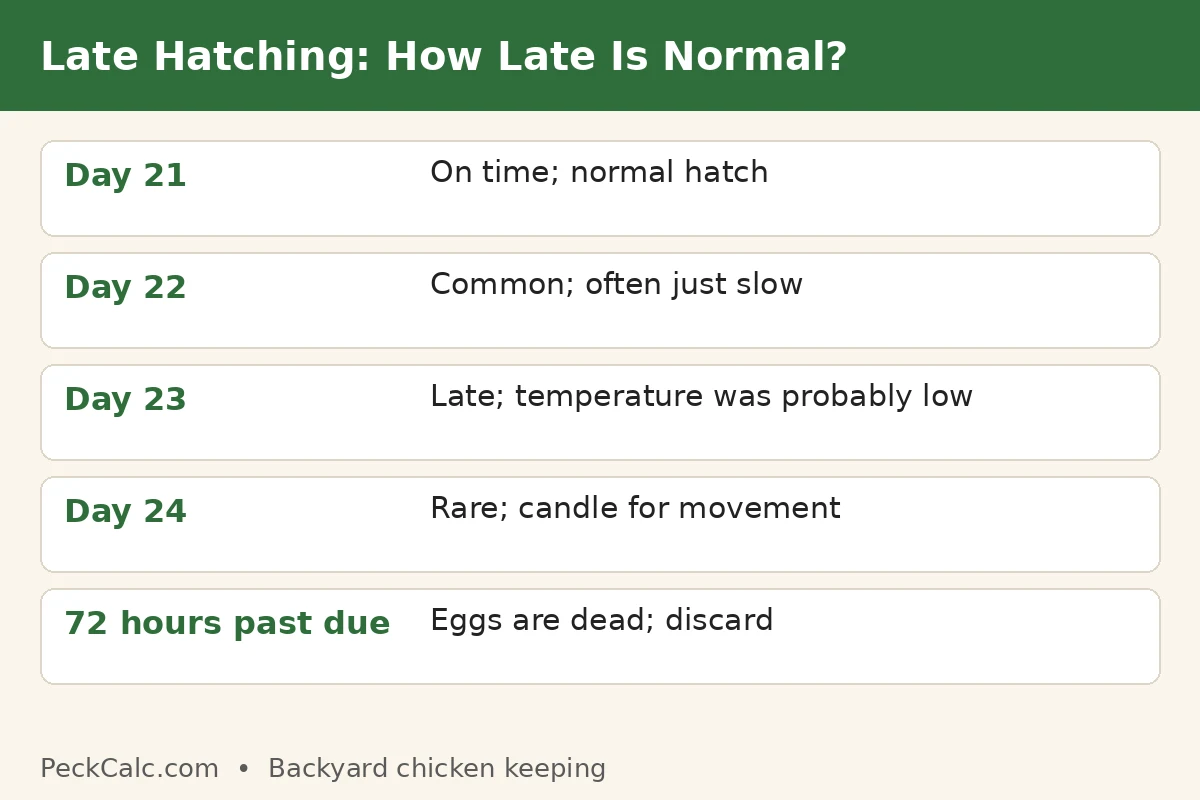
| Hatch day | What it means | What to do |
|---|---|---|
| Day 21 | On time; normal hatch | Let chicks hatch; do not open the incubator |
| Day 22 | Common; often just slow | Wait; most remaining eggs will hatch |
| Day 23 | Late; temperature was probably low | Wait; candle unpipped eggs for movement |
| Day 24 | Rare; usually a problem | Candle; remove eggs with no movement |
| After 72 hours past due | Eggs are dead | Discard the eggs; clean the incubator |
Wait, candle, or assist: what to do with late eggs
The first rule with late eggs is to wait. A chick that is hatching late is still developing, and opening the incubator to check on it can do more harm than good, because the humidity drops and the membrane dries out.
Wait until the end of day 22 before you do anything, and if most of the chicks have hatched, wait until the end of day 23 before you candle the remaining eggs. Patience is the hardest part of hatching, but it is also the most important.
Candling is the next step. Take each unhatched egg out of the incubator, hold it up to a bright light in a dark room, and look for movement. A live chick will move, and you may see the shadow of the beak in the air cell. A dead chick will be still, and the egg may look dark all the way through, or you may see a blood ring, which is a sign of early death. If the egg is alive, put it back in the incubator and wait. If it is dead, remove it, because a dead egg can burst and contaminate the incubator.
Assisting a hatch, which means helping a chick out of the shell, should be a last resort, and only for a chick that has pipped but has made no progress for more than 24 hours. A chick that is helped too early can bleed to death, because the blood vessels in the membrane have not yet closed, and a chick that is helped out of the shell before it has absorbed the yolk sac will die. If you do assist, work slowly, keep the membrane damp with warm water, and stop at once if you see blood. Most keepers are better off letting nature take its course, and accepting that some chicks will not make it.
Low temperature: the main cause of late hatching
Low temperature is the cause of most late hatches, and it is usually caused by a thermometer that reads wrong, a thermostat that is not accurate, or a room that is too cold. A incubator in a cold room, a garage, or a draughty corner will struggle to hold its
temperature, and the temperature inside will fall at night when the room cools down. The embryo does not stop developing when the temperature falls, but it slows down, and the delay adds up over 21 days.
The fix is to check the thermometer. Buy a digital thermometer with a probe, and check it against a known accurate thermometer, for example by putting it in a glass of iced water, which should read 32 degrees Fahrenheit, or in a glass of warm water with a medical thermometer. If your incubator thermometer reads two degrees high, the incubator has been running two degrees low, and that explains the late hatch. Replace the thermometer, and run the incubator empty for a day to check the temperature before the next hatch.
The room matters too. Put the incubator in a room with a steady temperature, away from windows, doors, and draughts, and away from direct sunlight, which can overheat it during the day. A room that stays between 65 and 75 degrees Fahrenheit is ideal. If the room is cold at night, wrap the incubator in a towel or a blanket, leaving the vents clear, to help it hold its temperature. Our guide on egg incubator temperature and humidity explains the settings in full.
Other causes of late hatching
Old eggs are a common cause of late hatching. Eggs that were stored for more than seven days before incubation hatch later than fresh eggs, and eggs stored for more than ten days may not hatch at all. Store hatching eggs pointy end down, in a cool place at about
55 to 65 degrees Fahrenheit, and set them within seven days of laying for the best results. Our guide on how to store hatching eggs before incubation explains the method in full.
Eggs from old hens also hatch later, because the eggs are larger and the shells are thinner, which affects the humidity inside the egg. Eggs from very young pullets can also hatch late, because the eggs are small and the embryos are less vigorous. The best hatching eggs come from hens in their first or second year of laying, and from a flock with a healthy rooster and a good diet.
Low humidity during the hatch can also delay hatching, because the membrane dries out and the chick cannot break through it. Keep the humidity at 65 to 70 percent during the last three days, fill the water channels, and do not open the incubator. If the humidity is low, add a damp sponge or a cloth to the incubator, but do not spray water directly onto the eggs, because that can chill them.
When to discard late eggs
Discard eggs that have not hatched 72 hours after the due date, which means the end of day 24 for chicken eggs. By then, any chick that was going to hatch has hatched, and the remaining eggs are dead. Leaving them in the incubator risks a burst egg, which can
contaminate the incubator and the chicks that have already hatched, and it can smell very bad.
Before you discard an egg, candle it to check for movement, and if you are unsure, do a float test: put the egg in warm water, and if it moves or wobbles, the chick may still be alive. If the egg is still, and it has been past due for 72 hours, discard it. Do not crack it open to check, because a dead egg can contain bacteria and gas, and it can burst in your hands. Put it in a sealed bag and throw it away, and wash your hands thoroughly.
After a late hatch, clean the incubator thoroughly before the next use, and check the thermometer and the thermostat. A late hatch is a sign that something was wrong, and it is worth finding out what it was before you set another batch of eggs. Our guide on how to clean an incubator explains the cleaning method, and the chicken hatch date calculator can help you plan the next hatch.
Sources: poultry.extension.org and University of Minnesota Extension, poultry resources.
Related tools and guides
For more on the same topic, see How to Hatch Chicken Eggs.
Frequently asked questions
Why are my eggs hatching late?
Low temperature is the usual cause. If the incubator runs even one degree Fahrenheit below the right setting, the hatch is delayed by 24 to 48 hours. Old eggs, eggs stored too long, and low humidity during the hatch can also cause a late hatch.
Is it normal for eggs to hatch on day 22?
Yes, day 22 is common and usually fine. Many hatches spread over two days, with the first chicks on day 21 and the last on day 22. Day 23 is late but not hopeless. Day 24 is rare, and eggs that have not hatched by then are unlikely to do so.
How long should I wait for late eggs to hatch?
Wait until the end of day 22 before doing anything, and until the end of day 23 before candling unhatched eggs. Discard eggs that have not hatched 72 hours after the due date, which is the end of day 24 for chicken eggs.
Should I help a chick that is hatching late?
Only as a last resort, for a chick that has pipped but made no progress for more than 24 hours. Work slowly, keep the membrane damp with warm water, and stop at once if you see blood. A chick helped too early can bleed to death or die because it has not absorbed the yolk sac.
Does 1 degree low really delay hatching by a day or two?
Yes. An embryo develops at a rate set by temperature, and one degree Fahrenheit below the right setting for the whole incubation adds 24 to 48 hours to the hatch. A thermometer that reads two degrees high is enough to cause a late hatch, so check your thermometer against a known accurate one.
About the author
John Walker is the founder of PeckCalc and has kept backyard chickens in Dallas, Texas since 2017. He started PeckCalc to give backyard keepers free calculators and guides with every figure traced to a university extension source.