
Grit for Chickens
 By John Walker · Backyard chicken keeper in Dallas, Texas since 2017
Grit for chickens is small, hard, insoluble stone that sits in the gizzard and grinds food, because chickens have no teeth. Any bird that eats more than complete feed — whole grains, scratch, scraps, grass or insects — needs access to grit.
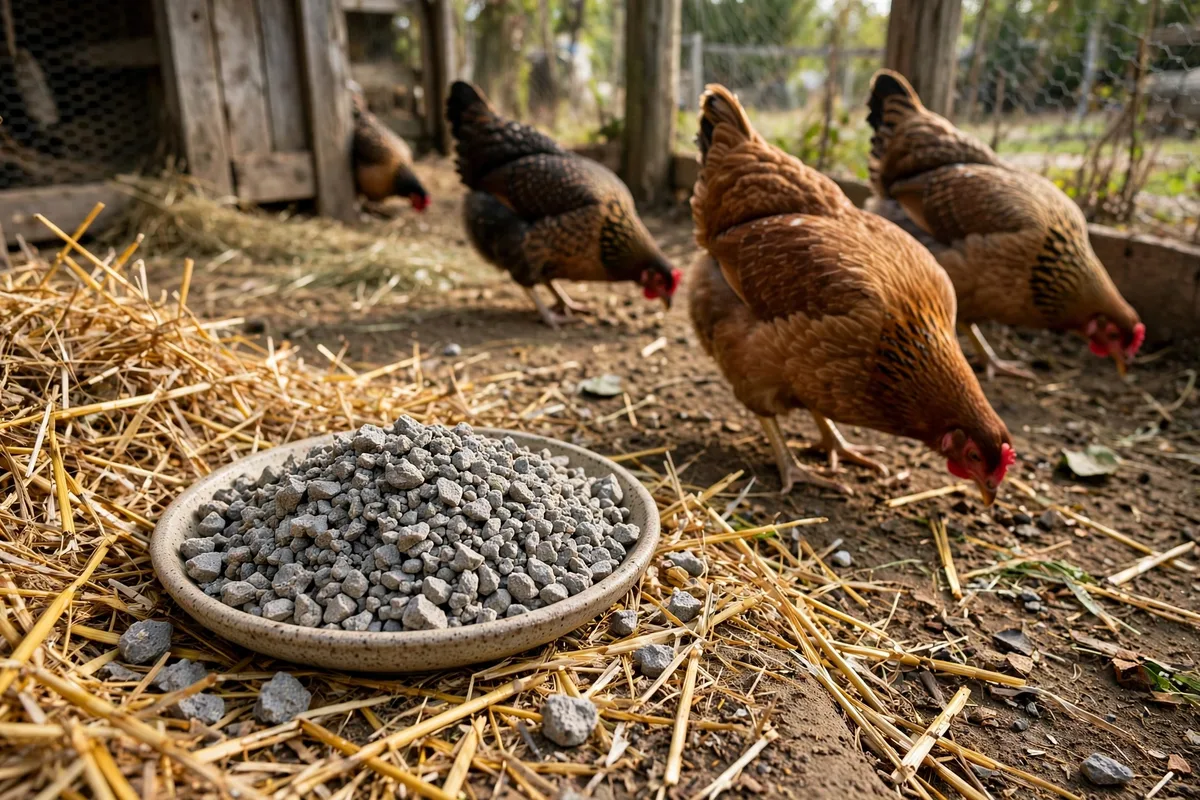
What is grit for chickens?
Grit for chickens is crushed granite, flint or quartzite, graded to a size a chicken can swallow, that lodges in the gizzard and acts as the bird's teeth. Food passes from the crop into the gizzard, a muscular pouch that squeezes and grinds, and the hard grit particles inside it crush whole grains.
Grit is insoluble, which means it does not dissolve in the bird's gut. A particle of granite grit can stay in the gizzard for weeks, slowly wearing down as it grinds food, before it is passed out and replaced by a new particle the bird picks up. That is why a dish of grit lasts so long: the birds only replace what they wear out.
This is different from oyster shell, which looks similar in the bag but is soluble calcium carbonate that dissolves to supply calcium for eggshells. Oyster shell is far too soft to grind anything, and granite grit carries no usable calcium, so the two are not interchangeable. See our guide to oyster shell for chickens for the calcium side of the story.
Do chickens need grit?
Chickens need grit whenever they eat anything besides a complete commercial crumble or pellet. Complete feed is already ground fine and softens in the crop, so a bird eating nothing else needs little grit for that feed alone. Almost no backyard flock eats nothing else, though, and the moment a bird eats scratch grains, whole seeds, leafy greens, kitchen scraps or forage, it needs grit to break that food down.
Free-ranging birds pick up some natural grit from the soil, especially small stones and coarse sand, and that can cover part of the need. It is not a reliable supply on its own, because the stones in your soil may be the wrong size or too soft, and in winter, when the ground is frozen or snow-covered, birds cannot find any at all. A free-choice dish removes the guesswork.
Without grit, hard foods pass through the gut only partly broken down, so the bird gets less nutrition from the same feed, and in the worst case undigested material can contribute to crop or gizzard problems. Grit is cheap insurance, and a bird that does not need it simply will not eat much of it.
What type of grit should you buy?
Buy insoluble grit made from crushed granite, flint or quartzite, sold as poultry grit or chicken grit in feed stores. The label should list a single ingredient and nothing else, and the particles should be hard, angular and clean. Avoid soft stone, limestone grit sold as a calcium source, and any grit with added colouring or fillers.
Granite is the most common choice because it is very hard and wears down slowly in the gizzard, so it keeps grinding for longer than softer stone. Flint grit is equally good where it is sold, and quartzite sits in the same class. The material matters less than the hardness and the particle size, so buy a reputable poultry grit rather than general-purpose gravel.
Do not use sand as a substitute for grit. Sand is too fine and too soft to do the grinding job, and while birds will pick at it, it passes through the gizzard quickly. Sand has its place as bedding, which our guide to sand bedding for chicken coop covers, but it is not grit.
Chick grit, grower grit and adult grit sizes
Grit is sold by size to match the bird, and the size matters. Chick grit is fine, with particles small enough for a chick's gizzard, and it is the only grit young birds should get. Grower or pullet grit is a middle size for birds between about eight weeks and point of lay. Adult or layer grit is the coarsest, for full-grown birds.
A chick given adult grit can choke on particles too large to swallow safely, and an adult given chick grit gets little grinding value from particles that pass through too fast. Use the size labelled for your birds' age, and move up a size as the birds grow, roughly in step with the feed changes from starter to grower to layer.
When in doubt, buy the size for the youngest bird in the flock and offer it alongside the adult size in a second dish, so each bird can take the size that suits it. Birds are good at choosing, and a mixed flock will sort itself out if both sizes are available.
When do chicks need grit?
Chicks eating only a complete chick starter crumble do not need grit, because starter is finely ground and digestible on its own. The day you offer anything else, even a few blades of grass or a small treat, the chicks need chick-sized grit to handle it, so introduce the grit at the same time as the first treat, not after.
That timing catches many keepers out, because chicks are often given their first greens or mealworms at two or three weeks old without any grit on offer. A tiny dish of chick grit in the brooder from the first week costs nothing and means the grit is already there when the treats start. Our guide to mealworms for chickens explains which treats suit chicks and at what age.
Do not give chicks oyster shell by mistake. Oyster shell is a calcium supplement for laying hens, and the extra calcium can damage a chick's kidneys. Keep oyster shell out of the brooder entirely, and keep the chick grit dish clearly separate from anything the adult birds use.
How to offer grit to your flock
The easiest and best method is free choice: put grit in a small separate container and leave it available at all times, so each bird takes what it needs. A heavy dish, a small hanging feeder or a wall-mounted dispenser all work, and the dish should sit somewhere dry, near the feed but not under the waterer where it can get wet and dirty.
Do not mix grit into the feed. Mixed in, the birds cannot choose how much to take, and you cannot tell whether they are using it. A separate dish also lets you see at a glance whether the grit is being eaten and when it needs topping up, which is useful information about how much hard food the flock is actually eating.
Keep the dish clean and dry, and top it up whenever it runs low. Grit does not go stale, so a bag lasts a long time, and the dish only needs emptying if it fills with bedding, droppings or rain. In a covered run the dish can sit out all year with almost no attention.
How much grit do chickens eat?
Chickens eat very little grit by weight, because each particle stays in the gizzard for weeks before it wears out and is replaced. A flock of six hens might go through a few pounds of grit in a year, and a bird eating mostly complete feed with occasional treats will use even less.
Use goes up when the flock eats more hard food: a lot of scratch grains, whole corn, forage or kitchen scraps means more grinding work and faster grit wear. That is a normal and healthy pattern, and it is one reason to keep the dish topped up rather than rationing it.
If the dish never seems to go down at all, check what the birds are actually eating. A flock on complete pellets alone will barely touch it, which is fine, while a flock that eats a lot of whole grain and never touches the grit may be finding natural stone in the soil instead. Either way, the dish being available is what matters.
Grit for free-range and confined flocks
Free-range birds find natural grit in the soil, and on ground with plenty of small hard stones they may meet most of their need that way. Even so, a free-choice dish is worth keeping, because soil grit varies in size and hardness, and in wet weather or winter the birds cannot always find it. The dish is a backup that costs almost nothing.
Confined birds with no access to soil have no natural source at all, so the dish is essential rather than optional. A flock in a run on a concrete or wood floor, or in a coop with deep litter, cannot pick up stones from the ground, and without a grit dish they will struggle with any hard food you offer.
The same applies to birds kept on sand runs. Sand is not grit, and a bird on sand still needs a dish of proper granite grit if it eats whole grains, scraps or forage. If your flock's diet is complete feed only, the need is small, but the dish should still be there for the day you offer a treat.
Grit mistakes to avoid
The most common mistake is confusing grit with oyster shell and buying one thinking it does the other's job. They sit side by side in the feed store and look alike, but grit grinds food and oyster shell builds eggshells, and neither can do the other's work. Buy both, in separate bags, and offer both in separate dishes.
The second mistake is giving chicks adult-sized grit, which is too large for a young bird to swallow safely. Always match the grit size to the youngest bird in the flock, and move up a size as the birds grow, in step with their feed.
The third mistake is forgetting grit altogether when the flock's diet changes. A flock that moves from pellets to a grain-heavy diet, or starts free-ranging and eating more forage, needs grit from the first day of the new diet, not weeks later when digestion problems appear. Put the dish out before you change the feed.
A fourth mistake is using grit that has been sitting wet and dirty for months. Grit does not go stale, but a dish full of bedding, droppings and rainwater is not a dish the birds will use, and it can harbour bacteria. Empty and refill the dish whenever it gets fouled, and keep it under cover so it stays dry and clean.
Grit and digestion: how it works
A chicken has no teeth, so the gizzard does the chewing. Food is stored in the crop, softened, then passed a little at a time into the gizzard, where strong muscles squeeze it against the grit. The grinding action breaks hard seeds and fibrous material into small pieces, exposing more surface to digestive juices and letting the bird extract more nutrition.
The gizzard is remarkably strong, and the grit inside it is the working surface. Without grit, the gizzard can still squeeze, but it has nothing hard to grind against, so whole grains and fibrous foods pass through partly intact. That is why birds without grit do poorly on whole-grain diets even when they eat plenty.
This is also why grit matters most for birds that forage. A free-range hen eating grass, seeds, insects and grit from the soil is using her gizzard hard all day, and the grit she picks up is part of that system. A confined bird on pellets uses its gizzard far less, which is why its grit use is so much lower.
Sources: the grit figures on this page — granite, flint or quartzite as insoluble grit, chick, grower and adult sizes, and free-choice offering in a separate dish — are the planning values used across PeckCalc. For feeding guidance, see the poultry pages at the University of Minnesota Extension and poultry.extension.org.
Related tools and guides
For more on the same topic, see Oyster Shell for Chickens and What to Feed Chickens.
Frequently asked questions
Do chickens need grit if they only eat pellets?
Usually not much, because complete pellets and crumbles are already ground fine and soften in the crop. As soon as a bird eats whole grains, scratch, scraps, grass or insects, it needs grit, so keep a dish available free choice even for a pellet-fed flock.
What is the difference between grit and oyster shell?
Grit is hard, insoluble granite or flint that sits in the gizzard and grinds food. Oyster shell is soluble calcium carbonate that dissolves and supplies calcium for eggshells. They do different jobs and one cannot replace the other.
What size grit do chicks need?
Chicks need fine chick grit, with particles small enough for a young bird's gizzard. Do not give chicks adult grit, which is too large to swallow safely, and do not give them oyster shell, because the extra calcium can damage developing kidneys.
How do I offer grit to chickens?
Put grit in a small separate container and leave it available free choice at all times, somewhere dry near the feed. Do not mix it into the feed, because the birds then cannot choose how much to take and you cannot tell whether they are using it.
Can chickens get grit from the soil?
Free-range birds pick up some natural grit from soil, but the stones may be the wrong size or too soft, and in winter the ground may be frozen. A free-choice dish of proper granite grit is a cheap backup, and for confined birds with no soil access it is essential.
About the author
John Walker is the founder of PeckCalc and has kept backyard chickens in Dallas, Texas since 2017. He started PeckCalc to give backyard keepers free calculators and guides with every figure traced to a university extension source.