
Oyster Shell for Chickens
 By John Walker · Backyard chicken keeper in Dallas, Texas since 2017
Oyster shell for chickens is a calcium supplement offered free choice in a separate dish so laying hens can build strong eggshells. A hen puts about 2 grams of calcium into every eggshell she lays, and even a good layer feed cannot always cover that demand on its own.
What is oyster shell for chickens?
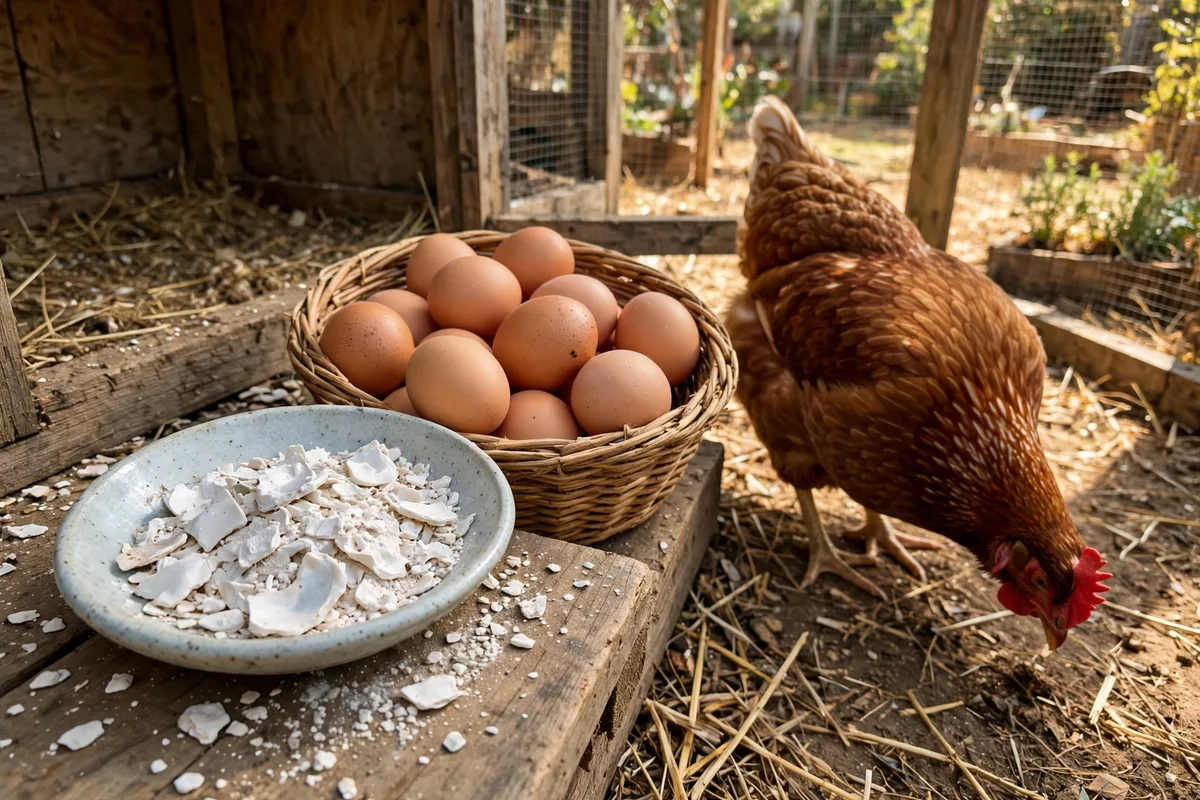
Oyster shell for chickens is crushed oyster shell, made almost entirely of calcium carbonate, and it is the standard calcium supplement for laying hens. It is sold as coarse flakes or chips in feed stores, and it is offered in a separate dish so each hen can eat as much or as little as she needs.
A laying hen needs roughly 4 grams of calcium a day to form one eggshell, because the shell itself is about 94 percent calcium carbonate and contains around 2 grams of calcium. Layer feed already contains about 3.5 to 4.5 percent calcium, which covers much of that demand, but oyster shell fills the gap, especially for heavy layers and older hens whose shells tend to thin.
Oyster shell works well because it dissolves slowly in the hen's digestive tract. The larger particles stay in the gizzard longer and release calcium steadily through the night, which is when most of the shell is actually formed. That slow release is one reason oyster shell outperforms fine limestone powder in many trials, even though both are calcium carbonate.
Do chickens need oyster shell?
Laying hens need oyster shell, or another reliable calcium source, once they reach point of lay. Hens that are not laying, roosters, chicks and pullets under about 18 weeks do not need extra calcium, and too much calcium can damage a young bird's kidneys, so the supplement is only for birds that are actively laying eggs.
If your hens lay eggs with strong, smooth shells and you feed a complete layer ration, they may take very little oyster shell from the dish, and that is normal. Hens regulate their own intake remarkably well when the shell is offered free choice, eating more when they need it and ignoring it when they do not.
The clearest sign that hens need more calcium is a run of thin, rough, soft-shelled or shell-less eggs. Before assuming calcium is the problem, check that the hens are actually eating enough layer feed rather than filling up on treats, because a hen that eats mostly scratch grains is short of calcium no matter how much shell sits in the dish.
Oyster shell vs grit: what is the difference?
Oyster shell and grit look similar in the bag and are often sold side by side, but they do completely different jobs, and one cannot replace the other. Grit is hard, insoluble stone, usually crushed granite, that sits in the gizzard and grinds food. Oyster shell is soluble calcium that dissolves in the gut and supplies the mineral for eggshells.
The difference matters because oyster shell is far too soft to grind food, and granite grit carries no usable calcium at all. A flock that gets oyster shell but no grit will struggle to digest whole grains, scratch and forage, while a flock that gets grit but no oyster shell will lay thinner shells as the hens draw calcium from their own bones.
Both belong in the coop in separate dishes, offered free choice. Hens will take what they need of each, and the two dishes side by side make it easy to see which one your flock is actually using. Our guide to grit for chickens explains sizes, ages and how to offer it.
When should you start offering oyster shell?
Start offering oyster shell when your pullets reach about 18 weeks of age, or roughly two weeks before you expect the first eggs. That timing matches the switch to layer feed, and it gives the hens a calcium source in place just as shell formation begins. Use the first egg calculator to estimate when your breed should start laying.
Do not offer oyster shell to chicks or growers. Young birds cannot process the high calcium load, and excess calcium in a growing bird can damage the kidneys and interfere with bone development. Keep the oyster shell dish out of the brooder and out of the grower pen entirely.
If you run a mixed flock with roosters or non-laying birds alongside your layers, the separate-dish method solves the problem by itself. Roosters and pullets will mostly ignore the oyster shell, while the laying hens help themselves, so nobody is force-fed calcium they do not need.
How much oyster shell do chickens need per day?
A laying hen typically eats about 2 to 4 grams of oyster shell a day when it is offered free choice, though the amount varies with her laying rate, her age, the calcium level in her feed, and the season. Heavy layers in their first year take more, and older hens often take more too, because their shells thin with age.
Published guides disagree on the exact figure: some say a laying hen eats about 1 to 2 grams of oyster shell a day on top of her feed, while others say 2 to 4 grams. The disagreement is not a mistake; it reflects real differences in feed, breed and laying rate. What is consistent is the total: a laying hen needs about 4 grams of calcium a day, about 2 grams of which goes into the shell of a single egg, and most of that comes from her layer feed. The oyster shell she eats is the remainder, and the amount varies from bird to bird and from day to day.
Calcium is needed most at night, when the shell is forming. Oyster shell is useful because it is hard and dissolves slowly in the gizzard, which means calcium is released gradually through the night. That slow release is the reason oyster shell is preferred over faster sources such as crushed eggshell, which dissolve more quickly.
You do not need to measure it out. Fill a small dish or a hanging feeder with crushed oyster shell, keep it topped up, and let the hens regulate themselves. A 4 lb bag lasts a small flock of six hens a surprisingly long time, because the hens eat it by the pinch rather than by the beakful.
If the dish never seems to go down, that is usually good news, not a problem: it means the layer feed is covering most of the calcium demand. If the dish empties fast and shells are still thin, look at the rest of the diet first, because treats diluting the layer ration are the most common cause of thin shells in backyard flocks.
How to offer oyster shell to your flock
Offer oyster shell free choice in a separate container, never mixed through the flock's feed. Mixed in, a hen cannot self-regulate, some birds take far more than they need, and roosters and young birds get calcium they should not have. A small dish, a hanging feeder or a wall-mounted dispenser all work.
Put the dish somewhere dry and sheltered, near the feed but not under the waterer, because wet oyster shell clumps and goes stale. A dish inside the coop near the nest boxes works well, since hens often visit it on their way to lay. Keep it clean and top it up whenever it runs low, because an empty dish is easy to miss.
Choose a coarse grade rather than a fine powder. Larger particles dissolve more slowly and stay in the gizzard longer, which matches the overnight shell-building window. Fine shell passes through too quickly and does less good, so if your feed store offers a choice, take the coarser grade.
Can chickens eat their own eggshells instead?
Yes, hens can eat their own eggshells as a calcium source, provided the shells are prepared properly. Rinse the shells, dry them thoroughly, bake them at a low temperature until they are dry and brittle, then crush them fine and offer them in a dish beside the oyster shell.
The preparation matters for two reasons. First, drying and baking kills bacteria on shells that may carry salmonella. Second, crushing the shells so they no longer look like eggs prevents hens from learning to break and eat their own eggs in the nest, which is a habit that is hard to stop once it starts.
Crushed eggshells are a useful supplement, but they are not a complete replacement for oyster shell. Eggshell is finer and dissolves faster, so it does not give the same slow overnight calcium release as coarse oyster shell. Most keepers who recycle eggshells offer both, and let the hens choose.
What causes thin or soft eggshells?
Thin or soft shells have many causes, and calcium is only one of them, so check the whole picture before adding more shell. The most common backyard cause is treats diluting the layer ration: a hen that fills up on scratch grains, kitchen scraps and mealworms eats less layer feed, and therefore less calcium, even with a full oyster shell dish beside her.
Age is another major factor. Hens lay their thinnest shells in their second and third laying years, and no amount of extra calcium fully reverses that, because the shell gland itself becomes less efficient. Heat stress also thins shells, because a hot hen eats less feed and pants away carbon dioxide that the shell gland needs. See our guide on signs of heat stress in chickens for what to watch for in summer.
Disease, sudden stress, and a shortage of vitamin D can also weaken shells, because vitamin D controls how much calcium the hen actually absorbs. If shells stay thin for weeks despite a full oyster shell dish, a balanced layer ration and cool weather, talk to a poultry vet or your local extension office rather than simply adding more calcium.
Oyster shell mistakes to avoid
The most common mistake is mixing oyster shell into the feed, which removes the hens' ability to self-regulate and forces calcium on birds that do not need it. Keep it in a separate dish, always, and let each bird decide how much to eat.
The second mistake is offering oyster shell to chicks. Layer feed and oyster shell both belong only to laying birds, and the extra calcium can damage developing kidneys. If chicks and layers share a run, put the oyster shell dish where only the adults can reach it, or wait until the young birds are housed separately.
The third mistake is assuming oyster shell fixes every shell problem. It fixes a calcium shortage, and nothing else. If the real problem is heat, age, disease or a diet full of treats, the shells will stay thin until that cause is dealt with, no matter how much shell you buy.
The fourth mistake is buying oyster shell that is too fine, or a blend bulked out with limestone dust. Fine shell passes through the gut quickly and does little for the overnight shell-building window, while coarse flakes stay in the gizzard longer and release calcium steadily. Check the bag before you buy: you want visible coarse chips and flakes, not powder, and a single ingredient on the label.
Buying and storing oyster shell
Buy plain crushed oyster shell with a single ingredient on the label and nothing else added. Flaked and coarse grades are both fine, and a bag from a feed store is usually cheaper per pound than a small bag from a pet shop. Check that the shell is clean, dry and free of dust and debris before you buy.
Store it somewhere dry, in a sealed container or a tied bag, because damp shell clumps and can grow mould. Kept dry, oyster shell lasts indefinitely: it is a mineral, not a feed, so it does not go stale in the way grain does. A bag bought this year is still good next year.
Do not buy shell grit blends that mix oyster shell with limestone or other fillers unless you know what is in them. Plain oyster shell is the simplest and most reliable choice, and the slow-dissolving coarse particles are the reason it has been the standard calcium supplement for laying hens for decades.
Sources: the calcium figures on this page — about 4 grams of calcium a day per laying hen, about 2 grams of calcium in each eggshell, and layer feed at about 3.5 to 4.5 percent calcium — are the planning values used across PeckCalc. For feeding guidance, see the poultry pages at the University of Minnesota Extension and poultry.extension.org.
The daily calcium picture
A laying hen needs about 4 grams of calcium a day in total. About 2 grams of that goes into the shell of a single egg, and the rest covers the hen's own needs and the calcium that is lost in droppings. That is a large amount for a small bird, and it is why layer feed is formulated with a high calcium content.
| Source | What it supplies | How to offer it |
|---|---|---|
| Layer feed | Most of the daily calcium need | Free choice, always available |
| Oyster shell | The remainder, released slowly overnight | Free choice in a separate dish |
| Crushed eggshells | A fast-release top-up | Free choice in a separate dish |
| Grit | No calcium (unless limestone grit) | Free choice in a separate dish |
How much oyster shell will a flock go through?
A small flock of six laying hens will go through a bag of oyster shell slowly, and the amount varies with the season and the laying rate. A flock that is laying well in spring will eat more shell than a flock that is moulting in autumn, because the birds that are not laying do not need it. That variation is normal, and it is another reason free choice is the right method.
Do not measure the shell out by the spoonful. A keeper who measures out a spoonful a day is guessing, and the guess will be wrong for some birds and right for others. A full dish, topped up when it runs low, is the only method that works for every bird in the flock.
If the dish never seems to go down, that is usually a good sign: the flock is getting enough calcium from its feed, and the birds do not need the top-up. If the dish empties quickly, the flock may need more calcium, and it is worth checking that the feed is a complete layer feed and that it is fresh. A sudden increase in shell eating can also mean the flock has started laying more, which is a good sign.
What size oyster shell should I offer?
Offer oyster shell in pieces about the size of coarse grit, roughly a few millimetres across. Pieces that are too small pass through the gizzard too quickly to be useful, and pieces that are too large are hard for the birds to eat. Most bagged oyster shell sold for poultry is already the right size, and there is no need to crush it further.
Do not offer oyster shell as a fine powder. Powder passes through the gizzard quickly, and it does not provide the slow release that makes oyster shell useful. Powder is also dusty, and it can irritate the birds' respiratory systems. If the bag you bought is mostly powder, it is not the right product, and a coarser shell is worth buying.
Keep the shell dry. Oyster shell that gets wet will clump, and a clumped dish will be ignored. Put the dish under cover, where rain cannot reach it, and replace the shell if it gets wet. A dry dish, topped up regularly, is all the maintenance the shell needs.
When hens need more or less oyster shell
Hens need more oyster shell when they are laying well, when they are laying large eggs, and when they are young and their shells are still forming. A pullet in her first weeks of laying may eat more shell than an older hen, because her system is still settling down. A hen that lays a double-yolk egg needs more calcium than a hen that lays a normal egg, because the shell is larger.
Hens need less oyster shell when they are not laying, when they are moulting, and when they are broody. A moulting hen is not forming shells, so she does not need the top-up, and she will usually ignore the dish. A broody hen is sitting, not laying, and she will not eat shell either. That is normal, and the dish should stay full for the birds that are laying.
If the flock's shells are thin, soft or rough, the first thing to check is the feed and the water, not the oyster shell dish. A flock that is short of feed or water will lay poor shells whatever is in the dish.
Related tools and guides
For more on the same topic, see Why Is My Chicken Laying Soft Shelled Eggs? and What to Feed Chickens.
Frequently asked questions
Do laying hens need oyster shell?
Yes, laying hens need a calcium source such as oyster shell once they reach point of lay at about 18 weeks. A hen puts about 2 grams of calcium into every eggshell, and oyster shell offered free choice in a separate dish fills the gap that layer feed alone may not cover.
What is the difference between oyster shell and grit?
Oyster shell is soluble calcium carbonate that dissolves in the gut and supplies calcium for eggshells. Grit is hard, insoluble granite that sits in the gizzard and grinds food. They do different jobs and one cannot replace the other; a flock needs both in separate dishes.
When should I start giving oyster shell to my chickens?
Start offering oyster shell at about 18 weeks of age, or roughly two weeks before you expect the first eggs. Do not offer it to chicks or growers, because excess calcium can damage developing kidneys.
How much oyster shell does a hen eat per day?
A laying hen typically eats about 2 to 4 grams of oyster shell a day when it is offered free choice. You do not need to measure it: keep a dish topped up and let the hens regulate their own intake.
Can chickens eat their own eggshells instead of oyster shell?
Yes, if the shells are rinsed, dried, baked until brittle and crushed so they no longer look like eggs. Crushed eggshells are a useful supplement, but coarse oyster shell is better because it dissolves slowly and releases calcium through the night while the shell is forming.
Should I mix oyster shell into the feed?
No. Offer it free choice in a separate dish. Mixing it into feed forces every bird to eat it, including roosters, young birds and non-laying hens, and too much calcium can damage the kidneys of birds that are not laying.
How much oyster shell will six hens eat in a week?
It varies with the laying rate and the season. A flock laying well in spring eats more than a flock moulting in autumn. Do not measure it out by the spoonful — keep the dish full and top it up when it runs low.
What size oyster shell should I offer?
Pieces about the size of coarse grit, roughly a few millimetres across. Do not offer fine powder, because it passes through the gizzard too quickly and does not provide the slow release that makes oyster shell useful.
Do hens need oyster shell when they are not laying?
No. Hens that are moulting, broody or not laying do not need the top-up, and they will usually ignore the dish. Keep the dish full for the birds that are laying.
About the author
John Walker is the founder of PeckCalc and has kept backyard chickens in Dallas, Texas since 2017. He started PeckCalc to give backyard keepers free calculators and guides with every figure traced to a university extension source.